Luo Yun-Gang, Wang Defeng, Liu Kai, Weng Jian, Guan Yuefeng, Chan Kate C C, Chu Winnie C W, Shi Lin
Department of Stomatology, The Second Hospital of Jilin University, Changchun, 130041, Jilin Province, China.
Research Center for Medical Image Computing, Department of Imaging and Interventional Radiology, The Chinese University of Hong Kong, Shatin, New Territories, Hong Kong, China; CUHK Shenzhen research institute, Shenzhen, China; Department of Biomedical Engineering and Shun Hing Institute of Advanced Engineering, The Chinese University of Hong Kong, Shatin, New Territories, Hong Kong, China.
PLoS One. 2015 Sep 28;10(9):e0139055. doi: 10.1371/journal.pone.0139055. eCollection 2015.
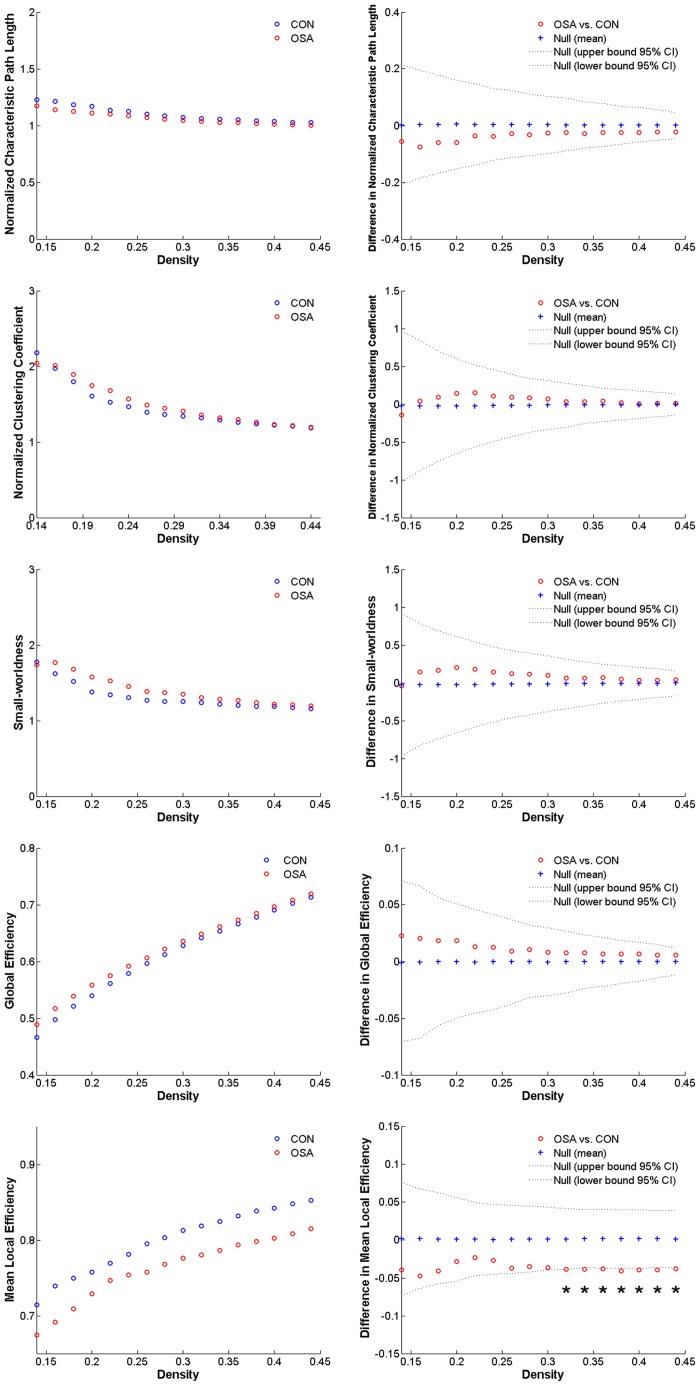
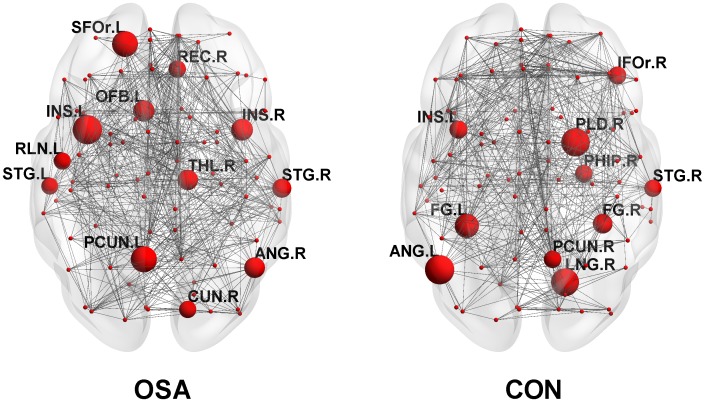
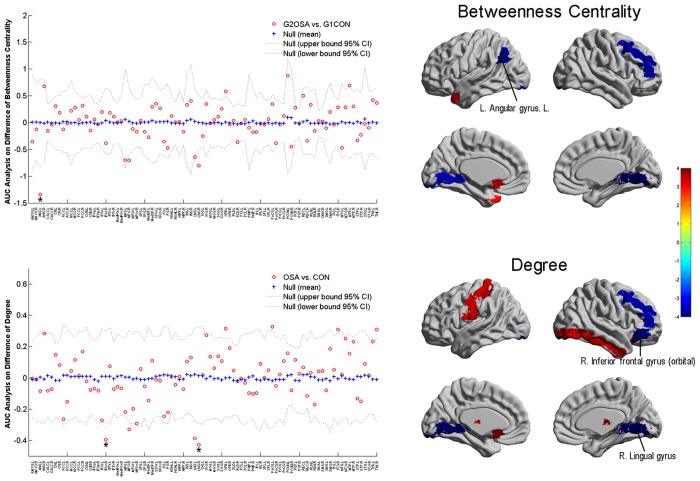
Childhood obstructive sleep apnea (OSA) is a sleeping disorder commonly affecting school-aged children and is characterized by repeated episodes of blockage of the upper airway during sleep. In this study, we performed a graph theoretical analysis on the brain morphometric correlation network in 25 OSA patients (OSA group; 5 female; mean age, 10.1 ± 1.8 years) and investigated the topological alterations in global and regional properties compared with 20 healthy control individuals (CON group; 6 females; mean age, 10.4 ± 1.8 years). A structural correlation network based on regional gray matter volume was constructed respectively for each group. Our results revealed a significantly decreased mean local efficiency in the OSA group over the density range of 0.32-0.44 (p < 0.05). Regionally, the OSAs showed a tendency of decreased betweenness centrality in the left angular gyrus, and a tendency of decreased degree in the right lingual and inferior frontal (orbital part) gyrus (p < 0.005, uncorrected). We also found that the network hubs in OSA and controls were distributed differently. To the best of our knowledge, this is the first study that characterizes the brain structure network in OSA patients and invests the alteration of topological properties of gray matter volume structural network. This study may help to provide new evidence for understanding the neuropathophysiology of OSA from a topological perspective.
儿童阻塞性睡眠呼吸暂停(OSA)是一种常见于学龄儿童的睡眠障碍,其特征是睡眠期间上呼吸道反复阻塞发作。在本研究中,我们对25名OSA患者(OSA组;5名女性;平均年龄10.1±1.8岁)的脑形态计量相关网络进行了图论分析,并与20名健康对照个体(CON组;6名女性;平均年龄10.4±1.8岁)比较,研究了全局和局部属性的拓扑变化。分别为每组构建基于区域灰质体积的结构相关网络。我们的结果显示,在密度范围为0.32 - 0.44时,OSA组的平均局部效率显著降低(p < 0.05)。在区域上,OSA患者左侧角回的中介中心性有降低趋势,右侧舌回和额下回(眶部)的度有降低趋势(p < 0.005,未校正)。我们还发现OSA患者和对照组的网络枢纽分布不同。据我们所知,这是第一项对OSA患者脑结构网络进行特征描述并研究灰质体积结构网络拓扑属性变化的研究。本研究可能有助于从拓扑学角度为理解OSA的神经病理生理学提供新证据。