Negoro Hiromitsu, Sugino Yoshio, Nishizawa Koji, Soda Takeshi, Shimizu Yosuke, Yoshimura Kenichi, Ogawa Osamu, Yoshimura Koji
Department of Urology, Kyoto University Graduate School of Medicine, Kyoto, Japan.
Department of Urology, Kobe City Medical Center General Hospital, Kobe, Japan.
BMC Res Notes. 2015 Sep 29;8:490. doi: 10.1186/s13104-015-1456-6.
Although nocturia has been reported to increase mortality in elderly individuals, the particular risk factors that are associated with this event are unclear. Therefore, we evaluated risk factors for death in outpatients with nocturia.
Between October 2002 and December 2009, 250 consecutive patients with nocturia were enrolled in two general hospitals in Japan. Among them, 193 patients were able to be followed for at least 1 year and up to 9 years (median 4.8 years) if the patients did not die. Mortality rates and risk factors were evaluated in the nocturic outpatients.
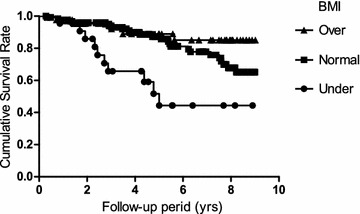
Two- and 5-year survival of the nocturic outpatients was 94.6% [95% confidence interval (CI) = 92.2-97.1] and 82.6% (95% CI = 75.4-87.8), respectively. Higher Charlson Comorbidity Score, lower body mass index (BMI) and lower Physical Component Summary of Short Form-36 item scores were significantly correlated with mortality (p < 0.0001, p < 0.005 and p < 0.05, respectively) in multivariate analysis. The International Prostate Symptom Score, Pittsburgh Sleep Quality Index, Mental or Role/Social Component Summary of Short Form-36 item scores and Nocturnal Polyuria index were not significantly correlated with mortality. The mortality rate was significantly higher in subjects with an underweight BMI (<18.50) compared with a normal range (18.50-24.99) or overweight (≥25.00) BMI [p < 0.00005, hazard ratio (HR) = 5.84, 95% CI = 2.03-16.8; p < 0.0005, HR = 5.92, 95% CI = 1.94-18.0].
Additional attention is required for nocturic outpatients with not only a high Charlson Comorbidity Score but also an underweight BMI because of their high mortality. Large prospective studies are warranted to validate this finding and extend more.
尽管据报道夜尿症会增加老年人的死亡率,但与此事件相关的具体风险因素尚不清楚。因此,我们评估了夜尿症门诊患者的死亡风险因素。
2002年10月至2009年12月期间,日本两家综合医院连续纳入了250例夜尿症患者。其中,如果患者未死亡,193例患者能够被随访至少1年,最长9年(中位时间4.8年)。对夜尿症门诊患者的死亡率和风险因素进行了评估。
夜尿症门诊患者的2年和5年生存率分别为94.6%[95%置信区间(CI)=92.2 - 97.1]和82.6%(95%CI = 75.4 - 87.8)。在多变量分析中,较高的查尔森合并症评分、较低的体重指数(BMI)和较低的简短健康调查问卷36项身体成分总结评分与死亡率显著相关(分别为p < 0.0001、p < 0.005和p < 0.05)。国际前列腺症状评分、匹兹堡睡眠质量指数、简短健康调查问卷36项心理或角色/社会成分总结评分和夜间多尿指数与死亡率无显著相关性。体重指数过低(<18.50)的受试者的死亡率显著高于正常范围(18.50 - 24.99)或超重(≥25.00)的受试者[p < 0.00005,风险比(HR)= 5.84,95%CI = 2.03 - 16.8;p < 0.0005,HR = 5.92,95%CI = 1.94 - 18.0]。
由于死亡率高,对于不仅查尔森合并症评分高而且体重指数过低的夜尿症门诊患者需要给予额外关注。有必要进行大型前瞻性研究来验证这一发现并进一步拓展。