Aris Izzuddin M, Soh Shu E, Tint Mya Thway, Saw Seang Mei, Rajadurai Victor S, Godfrey Keith M, Gluckman Peter D, Yap Fabian, Chong Yap Seng, Lee Yung Seng
Singapore Institute for Clinical Sciences, Agency for Science, Technology and Research, Singapore, Singapore.
Department of Paediatrics, Yong Loo Lin School of Medicine, National University of Singapore, 1E Kent Ridge Road, NUHS Tower Block - Level 12, Singapore, 119228, Singapore.
Eur J Nutr. 2017 Feb;56(1):55-64. doi: 10.1007/s00394-015-1057-0. Epub 2015 Sep 28.
Infants on prolonged breastfeeding are known to grow slower during the first year of life. It is still unclear if such effects are similar in offspring exposed to gestational diabetes (GDM) in utero. We examined the associations of infant milk feeding on postnatal growth from birth till 36 months of age in offspring exposed and unexposed to GDM.
Pregnant mothers undertook 75 g 2-h oral glucose tolerance tests at 26-28 weeks of gestation for GDM diagnosis. Up to 9 measurements of offspring weight and length were collected from birth till 36 months, and interviewer-administered questionnaires were used to ascertain the duration of breastfeeding.
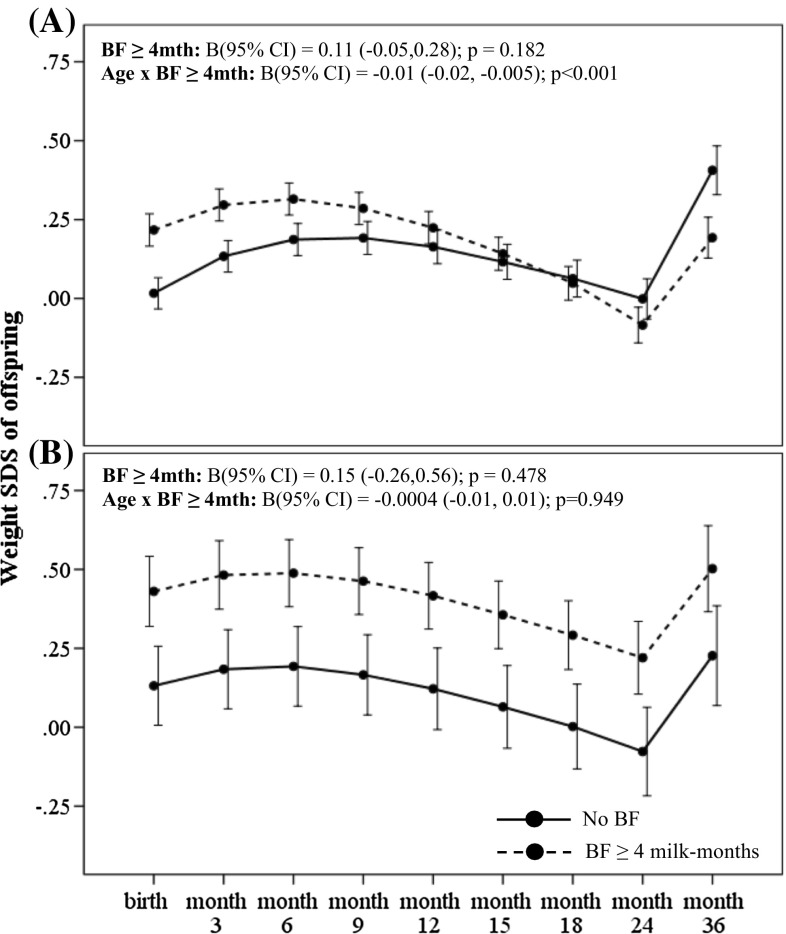
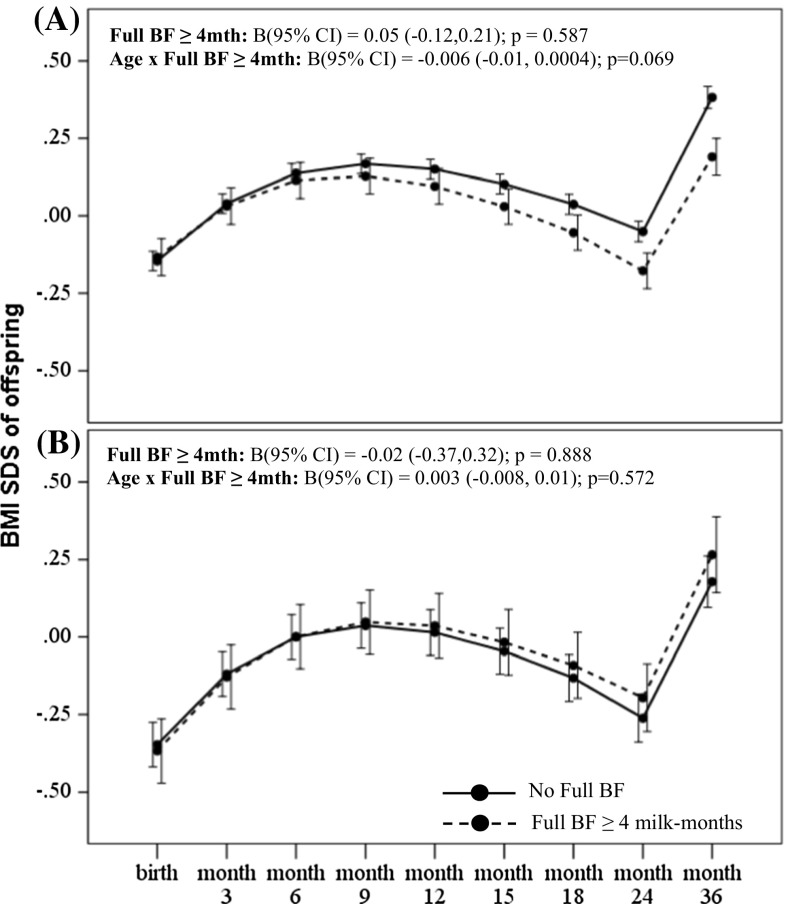
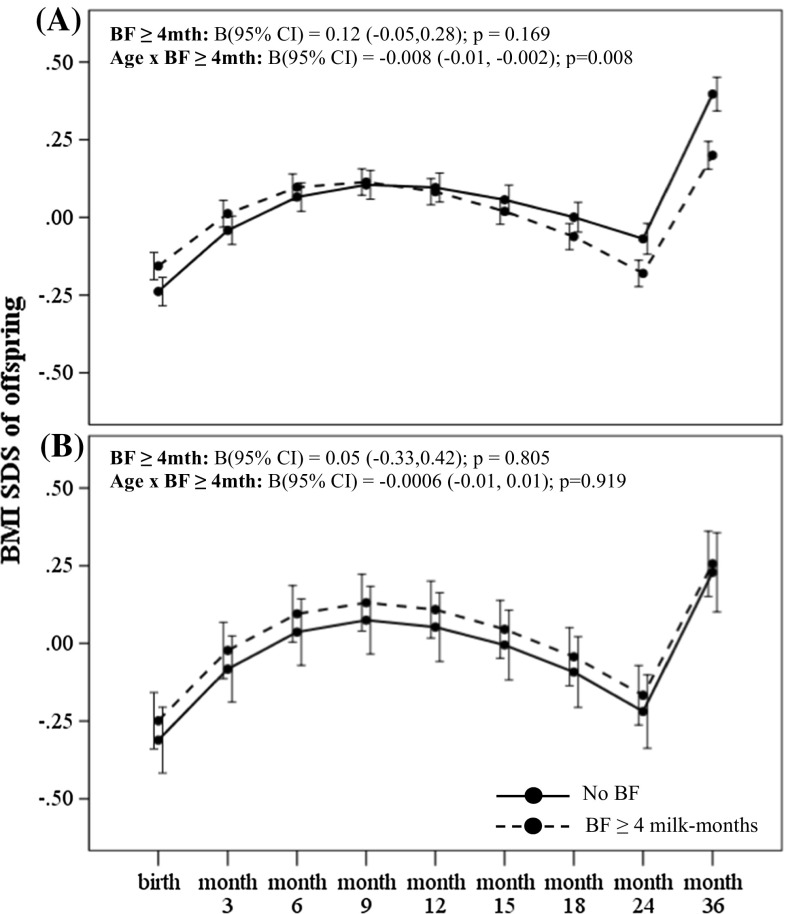
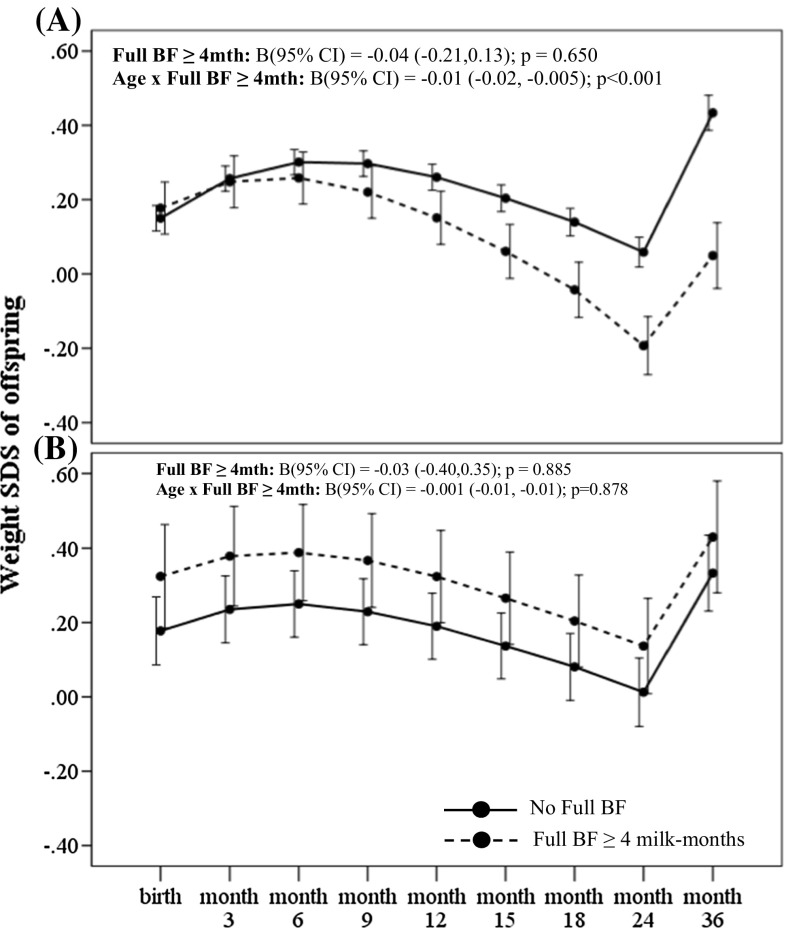
There was a statistically significant interaction between GDM status and breastmilk intake by any (p = 0.038) or exclusive/predominant breastfeeding (p = 0.035) for the outcome of conditional weight gain. In offspring of non-GDM mothers (n = 835), greater breastmilk intake (BF ≥ 4 milk months) was associated with lower conditional gains in weight [B (95 % CI) -0.48 (-0.58, -0.28); p < 0.001] within the first year of life, as well as decreasing weight SDS velocity [-0.01 (-0.02, -0.005); p < 0.001] and BMI SDS velocity [-0.008 (0.01, -0.002); p = 0.008] across age in the first 36 months. In offspring of GDM mothers (n = 181), however, greater breastmilk intake was associated with increased conditional gains in weight [0.72 (0.23, 1.20); p = 0.029] and BMI SDS [0.49 (0.04, 0.95); p = 0.04] in the first 6 months and did not demonstrate the decreasing weight and BMI SDS velocity observed in offspring of non-GDM mothers.
The reduced weight gain in the first year of life conferred by greater breastmilk intake in non-GDM children was not observed in GDM children.
This study is registered under the Clinical Trials identifier NCT01174875; http://www.clinicaltrials.gov/ct2/show/NCT01174875?term=GUSTO&rank=2 .
已知长期母乳喂养的婴儿在出生后第一年生长较慢。目前尚不清楚这种影响在子宫内暴露于妊娠期糖尿病(GDM)的后代中是否相似。我们研究了在暴露于GDM和未暴露于GDM的后代中,婴儿喂养方式与出生至36个月龄产后生长之间的关联。
怀孕母亲在妊娠26 - 28周时进行75克2小时口服葡萄糖耐量试验以诊断GDM。从出生至36个月收集后代体重和身长的多达9次测量数据,并使用访谈者管理的问卷来确定母乳喂养的持续时间。
对于条件性体重增加的结果,GDM状态与任何母乳喂养(p = 0.038)或纯母乳喂养/主要母乳喂养(p = 0.035)之间存在统计学上显著的相互作用。在非GDM母亲的后代(n = 835)中,母乳喂养量增加(母乳喂养≥4个月)与出生后第一年体重条件性增加较低相关[B(95% CI)-0.48(-0.58,-0.28);p < 0.001],并且在36个月内体重标准差评分速度降低[-0.01(-0.02,-0.005);p < 0.001]以及BMI标准差评分速度降低[-0.008(-0.01,-0.002);p = 0.008]。然而,在GDM母亲的后代(n = 181)中,母乳喂养量增加与前6个月体重条件性增加增加[0.72(0.23,1.20);p = 0.029]和BMI标准差评分增加[0.49(0.04,0.95);p = 0.04]相关,并且未表现出非GDM母亲后代中观察到的体重和BMI标准差评分速度降低。
在GDM儿童中未观察到非GDM儿童中因母乳喂养量增加而导致的出生后第一年体重增加减少的情况。
本研究在临床试验标识符NCT01174875下注册;http://www.clinicaltrials.gov/ct2/show/NCT01174875?term=GUSTO&rank=2 。