Lainhart William, Bickersmith Sara A, Nadler Kyle J, Moreno Marta, Saavedra Marlon P, Chu Virginia M, Ribolla Paulo E, Vinetz Joseph M, Conn Jan E
Department of Biomedical Sciences, School of Public Health, State University of New York at Albany, Albany, NY, USA.
Wadsworth Center, New York State Department of Health, Griffin Laboratory, 5669 State Farm Road, Building 1, Room 101, Slingerlands, NY, 12159, USA.
Malar J. 2015 Sep 29;14:375. doi: 10.1186/s12936-015-0863-4.
The major Neotropical malaria vector, Anopheles darlingi, was reintroduced into the Iquitos, Loreto, Peru area during the early 1990s, where it displaced other anophelines and caused a major malaria epidemic. Since then, case numbers in Loreto have fluctuated, but annual increases have been reported since 2012.
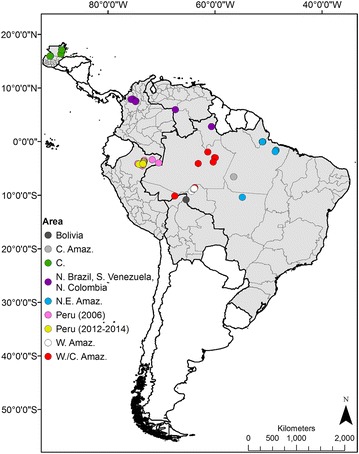
The population genetic structure of An. darlingi sampled before and after the introduction of long-lasting insecticidal nets (LLINs) was investigated to test the hypothesis of temporal population change (2006 vs. 2012). Current samples of An. darlingi were used to test the hypothesis of ecological adaptation to human modified (highway) compared with wild (riverine) habitat, linked to forest cover. In total, 693 An. darlingi from nine localities in Loreto, Peru area were genotyped using 13 microsatellite loci. To test the hypothesis of habitat differentiation in An. darlingi biting time patterns, HBR and EIR, four collections of An. darlingi from five localities (two riverine and three highway) were analysed.
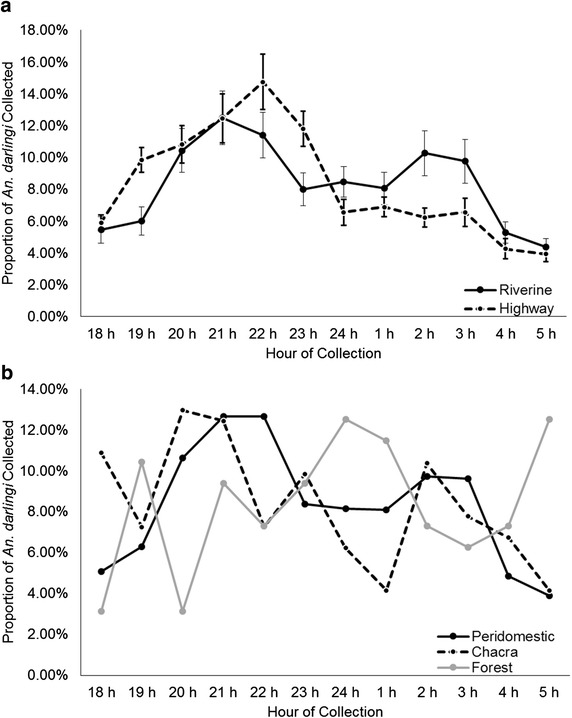
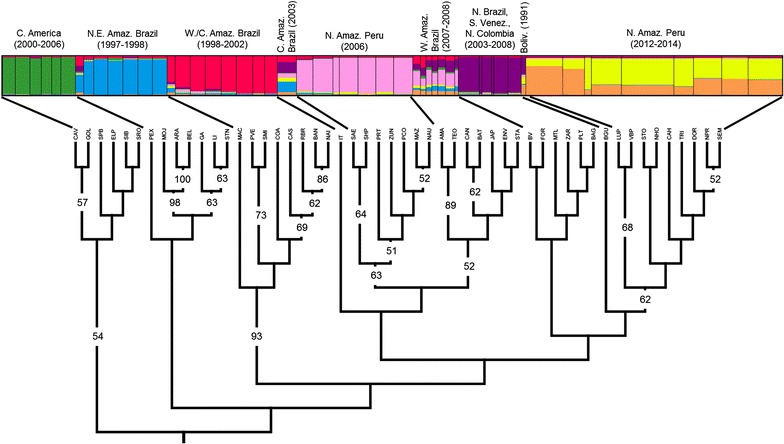
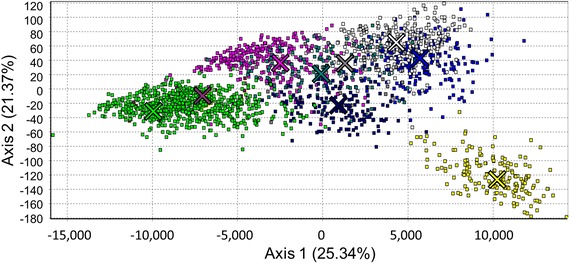
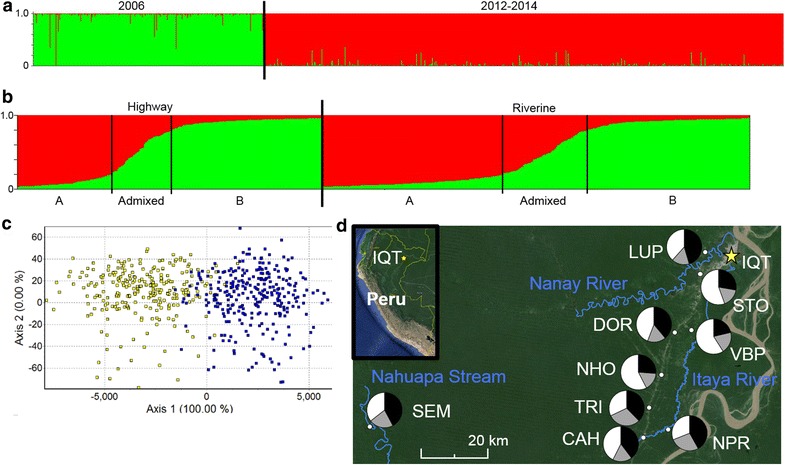
Analyses of microsatellite loci from seven (2006) and nine settlements (2012-2014) in the Iquitos area detected two distinctive populations with little overlap, although it is unclear whether this population replacement event is associated with LLIN distribution or climate. Within the 2012-2014 population two admixed subpopulations, A and B, were differentiated by habitat, with B significantly overrepresented in highway, and both in near-equal proportions in riverine. Both subpopulations had a signature of expansion and there was moderate genetic differentiation between them. Habitat and forest cover level had significant effects on HBR, such that Plasmodium transmission risk, as measured by EIR, in peridomestic riverine settlements was threefold higher than in peridomestic highway settlements. HBR was directly associated with available host biomass rather than forest cover.
A population replacement event occurred between 2006 and 2012-2014, concurrently with LLIN distribution and a moderate El Niño event, and prior to an increase in malaria incidence. The likely drivers of this replacement cannot be determined with current data. The present-day An. darlingi population is composed of two highly admixed subpopulations, which appear to be in an early stage of differentiation, triggered by anthropogenic alterations to local habitat.
主要的新热带区疟疾媒介——达林按蚊,于20世纪90年代初被重新引入秘鲁洛雷托的伊基托斯地区,在那里它取代了其他按蚊并引发了一场大规模疟疾疫情。从那时起,洛雷托的病例数有所波动,但自2012年以来报告称病例数逐年增加。
调查了在长效驱虫蚊帐(LLINs)引入之前和之后采集的达林按蚊的种群遗传结构,以检验时间上种群变化的假设(2006年与2012年)。使用当前的达林按蚊样本检验与森林覆盖相关的、与野生(河流)栖息地相比对人类改造(公路)栖息地生态适应的假设。总共对来自秘鲁洛雷托地区9个地点的693只达林按蚊使用13个微卫星位点进行了基因分型。为了检验达林按蚊叮咬时间模式、人类叮咬率(HBR)和昆虫叮咬率(EIR)中的栖息地分化假设,对来自5个地点(2个河流栖息地和3个公路栖息地)的4批达林按蚊进行了分析。
对伊基托斯地区7个(2006年)和9个定居点(2012 - 2014年)的微卫星位点分析检测到两个几乎没有重叠的独特种群,尽管尚不清楚这种种群替代事件是否与LLIN分布或气候有关。在2012 - 2014年的种群中,两个混合亚种群A和B按栖息地区分,B在公路栖息地中显著占比过高,在河流栖息地中两者比例近乎相等。两个亚种群都有扩张的特征,并且它们之间存在中等程度的遗传分化。栖息地和森林覆盖水平对HBR有显著影响,以至于按昆虫叮咬率衡量的疟原虫传播风险,在居家河流栖息地定居点比居家公路栖息地定居点高三倍。HBR与可利用的宿主生物量直接相关,而不是与森林覆盖相关。
在2006年至2012 - 2014年期间发生了种群替代事件,同时伴随着LLIN分布和一次中等强度的厄尔尼诺事件,且早于疟疾发病率上升。根据当前数据无法确定这种替代的可能驱动因素。当今的达林按蚊种群由两个高度混合的亚种群组成,它们似乎正处于由当地栖息地的人为改变引发的分化早期阶段。