Department of Biomedical Sciences, School of Public Health, University at Albany - State University of New York, Albany, NY, USA.
Division of Infectious Diseases, Department of Medicine, University of California San Diego, La Jolla, CA, USA.
Malar J. 2018 Feb 20;17(1):86. doi: 10.1186/s12936-018-2234-4.
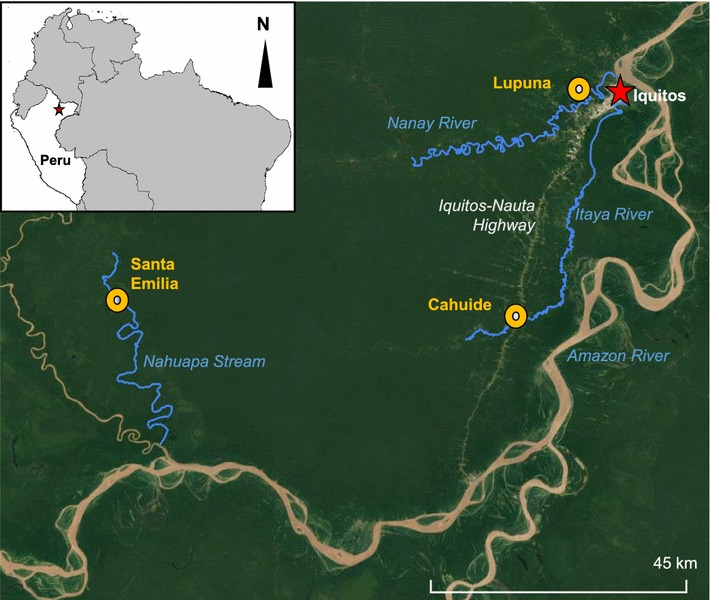
In Loreto Department, Peru, a successful 2005-2010 malaria control programme (known as PAMAFRO) included massive distribution of long-lasting insecticidal nets (LLINs). Additional local distribution of LLINs occurred in individual villages, but not between 2012 and 2015. A 2011-2012 study of the primary regional malaria vector Anopheles darlingi detected a trend of increased exophagy compared with pre-PAMAFRO behaviour. For the present study, An. darlingi were collected in three villages in Loreto in 2013-2015 to test two hypotheses: (1) that between LLIN distributions, An. darlingi reverted to pre-intervention biting behaviour; and, (2) that there are separate sub-populations of An. darlingi in Loreto with distinct biting behaviour.
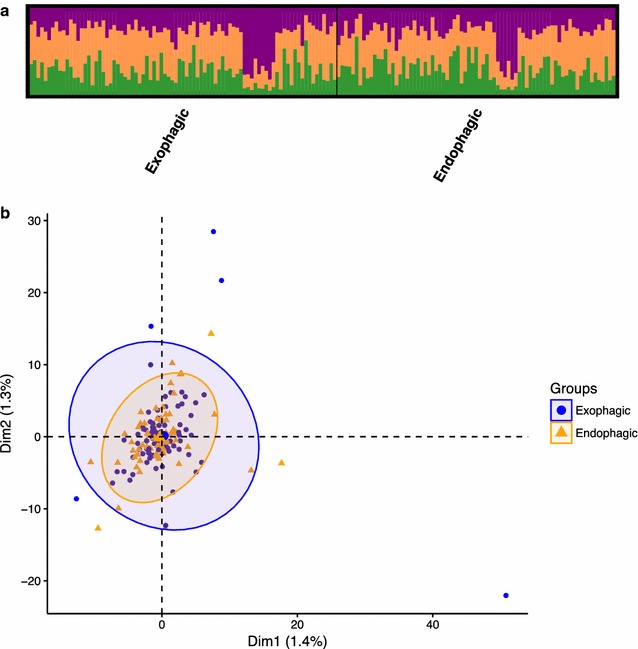
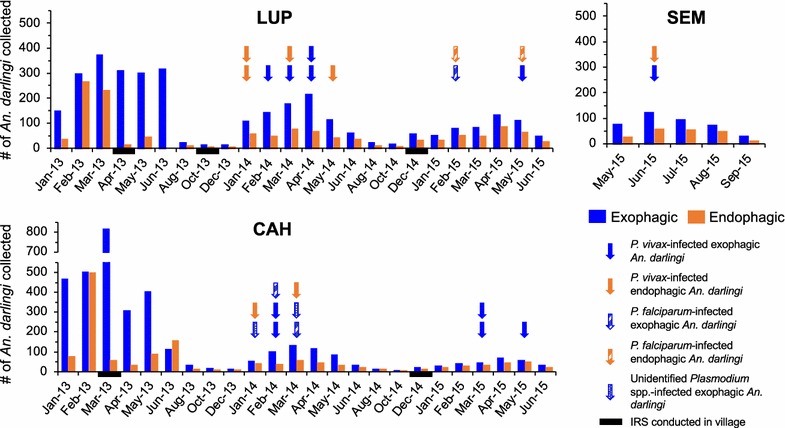
In 2013-2015 An. darlingi were collected by human landing catch during the rainy and dry seasons in the villages of Lupuna and Cahuide. The abundance of An. darlingi varied substantially across years, villages and time periods, and there was a twofold decrease in the ratio of exophagic:endophagic An. darlingi over the study period. Unexpectedly, there was evidence of a rainy season population decline in An. darlingi. Plasmodium-infected An. darlingi were detected indoors and outdoors throughout the night, and the monthly An. darlingi human biting rate was correlated with the number of malaria cases. Using nextRAD genotyping-by-sequencing, 162 exophagic and endophagic An. darlingi collected at different times during the night were genotyped at 1021 loci. Based on model-based and non-model-based analyses, all genotyped An. darlingi belonged to a homogeneous population, with no evidence for genetic differentiation by biting location or time.
This study identified a decreasing proportion of exophagic An. darlingi in two villages in the years between LLIN distributions. As there was no evidence for genetic differentiation between endophagic and exophagic An. darlingi, this shift in biting behaviour may be the result of behavioural plasticity in An. darlingi, which shifted towards increased exophagy due to repellence by insecticides used to impregnate LLINs and subsequently reverted to increased endophagy as the nets aged. This study highlights the need to target vector control interventions to the biting behaviour of local vectors, which, like malaria risk, shows high temporal and spatial heterogeneity.
在秘鲁洛雷托省,一个成功的 2005-2010 年疟疾控制项目(称为 PAMAFRO)包括大规模分发长效驱虫蚊帐(LLINs)。在 2012 年至 2015 年期间,个别村庄还额外分发了 LLINs,但村庄之间没有分发。2011-2012 年对主要区域疟疾传播媒介按蚊 darlingi 的研究发现,与 PAMAFRO 前行为相比,外食行为呈增加趋势。本研究于 2013-2015 年在洛雷托的三个村庄采集按蚊 darlingi,以检验两个假设:(1)在 LLIN 分发之间,按蚊 darlingi 恢复到干预前的叮咬行为;(2)在洛雷托存在具有不同叮咬行为的按蚊 darlingi 亚种群。
2013-2015 年,在 Lupuna 和 Cahuide 两个村庄,采用人诱停落法在雨季和旱季采集按蚊 darlingi。按蚊 darlingi 的数量在不同年份、村庄和时间段差异很大,在研究期间,外食性:内食性按蚊 darlingi 的比例下降了两倍。出乎意料的是,按蚊 darlingi 存在雨季种群减少的证据。在整个夜晚,室内和室外都检测到感染疟原虫的按蚊 darlingi,每月按蚊 darlingi 人叮咬率与疟疾病例数相关。使用 nextRAD 基因分型测序,在夜间不同时间采集的 162 只外食性和内食性按蚊 darlingi 在 1021 个基因座上进行了基因分型。基于基于模型和非模型的分析,所有基因分型的按蚊 darlingi 都属于同质种群,没有证据表明叮咬位置或时间的遗传分化。
本研究在 LLIN 分发之间的两年内,在两个村庄发现了外食性按蚊 darlingi 的比例降低。由于内食性和外食性按蚊 darlingi 之间没有遗传分化的证据,这种叮咬行为的转变可能是按蚊 darlingi 行为可塑性的结果,由于杀虫剂驱避作用,按蚊 darlingi 更倾向于外食,随后随着蚊帐老化,按蚊 darlingi 又恢复了更多的内食。本研究强调了需要针对当地媒介的叮咬行为进行蚊虫控制干预,就像疟疾风险一样,当地媒介的叮咬行为具有高度的时空异质性。