Guo Fei, Xu Zhizhen, Zhang Yan, Jiang Peng, Huang Gang, Chen Shan, Lyu Xilin, Zheng Ping, Zhao Xin, Zeng Yijun, Wang Shuguang, He Fengtian
Department of Hepatobiliary Surgery Institute, Southwest Hospital, Third Military Medical University, Chongqing 400038, China.
Department of Biochemistry and Molecular Biology, College of Basic Medical Sciences, Third Military Medical University, Chongqing 400038, China.
Oncotarget. 2015 Oct 27;6(33):34606-16. doi: 10.18632/oncotarget.5314.
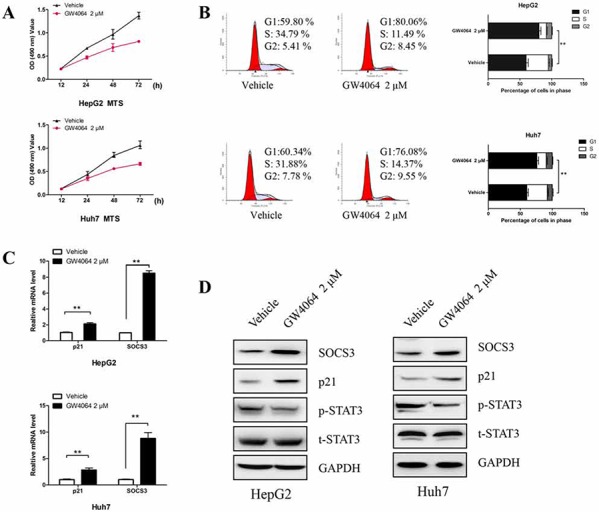
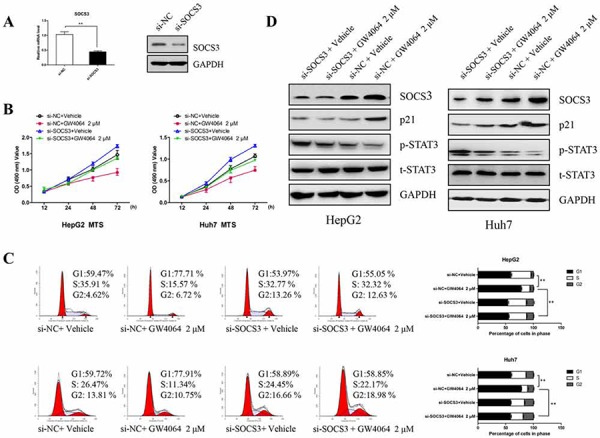
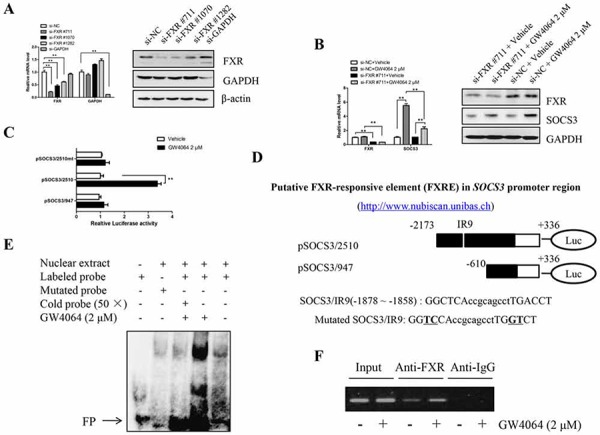
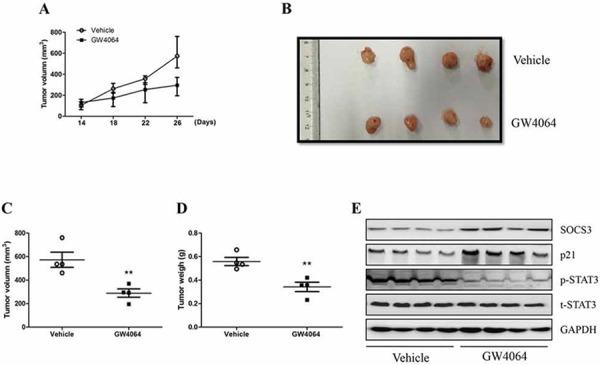
Suppressor of cytokine signaling 3 (SOCS3) is regarded as a vital repressor in the liver carcinogenesis mainly by inhibiting signal transducer and activator of transcription 3 (STAT3) activity. Farnesoid X Receptor (FXR), highly expressed in liver, has an important role in protecting against hepatocellular carcinoma (HCC). However, it is unclear whether the tumor suppressive activity of FXR involves the regulation of SOCS3. In the present study, we found that activation of FXR by its specific agonist GW4064 in HCC cells inhibited cell growth, induced cell cycle arrest at G1 phase, elevated p21 expression and repressed STAT3 activity. The above anti-tumor effects of FXR were dramatically alleviated by knockdown of SOCS3 with siRNA. Reporter assay revealed that FXR activation enhanced the transcriptional activity of SOCS3 promoter. Electrophoretic mobility shift assay (EMSA) and chromatin immunoprecipitation (ChIP) assay displayed that FXR directly bound to IR9 DNA motif within SOCS3 promoter region. The in vivo study in nude mice showed that treatment with FXR ligand GW4064 could decelerate the growth of HCC xenografts, up-regulate SOCS3 and p21 expression and inhibit STAT3 phosphorylation in the xenografts. These results suggest that induction of SOCS3 may be a novel mechanism by which FXR exerts its anti-HCC effects, and the FXR-SOCS3 signaling may serve as a new potential target for the prevention/treatment of HCC.
细胞因子信号转导抑制因子3(SOCS3)被认为是肝癌发生过程中的一种重要抑制因子,主要通过抑制信号转导及转录激活因子3(STAT3)的活性发挥作用。法尼醇X受体(FXR)在肝脏中高度表达,在预防肝细胞癌(HCC)方面具有重要作用。然而,FXR的肿瘤抑制活性是否涉及SOCS3的调节尚不清楚。在本研究中,我们发现用其特异性激动剂GW4064激活HCC细胞中的FXR可抑制细胞生长,诱导细胞周期阻滞于G1期,提高p21表达并抑制STAT3活性。用小干扰RNA(siRNA)敲低SOCS3可显著减轻FXR的上述抗肿瘤作用。报告基因检测显示,FXR激活增强了SOCS3启动子的转录活性。电泳迁移率变动分析(EMSA)和染色质免疫沉淀(ChIP)分析表明,FXR直接与SOCS3启动子区域内的IR9 DNA基序结合。裸鼠体内研究表明,用FXR配体GW4064治疗可减缓HCC异种移植瘤的生长,上调异种移植瘤中SOCS3和p21的表达并抑制STAT3磷酸化。这些结果表明,诱导SOCS3可能是FXR发挥抗HCC作用的一种新机制,FXR-SOCS3信号通路可能成为预防/治疗HCC的新潜在靶点。