Wu Jia-Ru, Hu Chi-Tan, You Ren-In, Pan Siou-Mei, Cheng Chuan-Chu, Lee Ming-Che, Wu Chao-Chuan, Chang Yao-Jen, Lin Shu-Chuan, Chen Chang-Shan, Lin Teng-Yi, Wu Wen-Sheng
Institute of Medical Sciences, College of Medicine, Tzu Chi University, Hualien, Taiwan.
Research Centre for Hepatology, Department of Internal Medicine, Buddhist Tzu Chi General Hospital and Tzu Chi University, Hualien, Taiwan.
Oncotarget. 2015 Oct 20;6(32):32526-44. doi: 10.18632/oncotarget.5322.
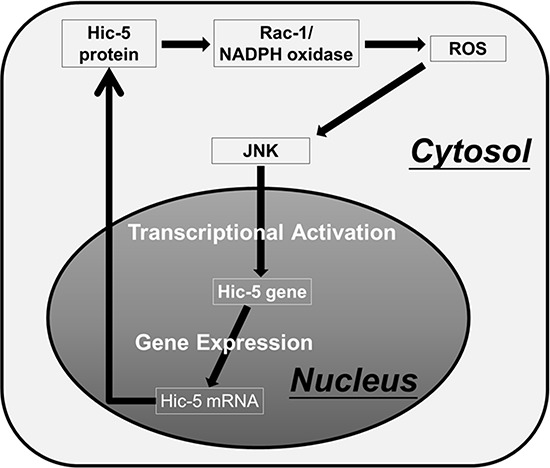
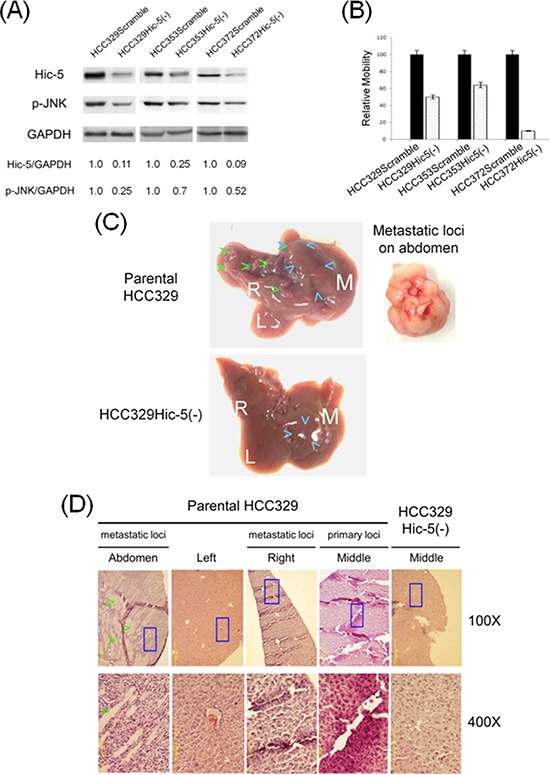
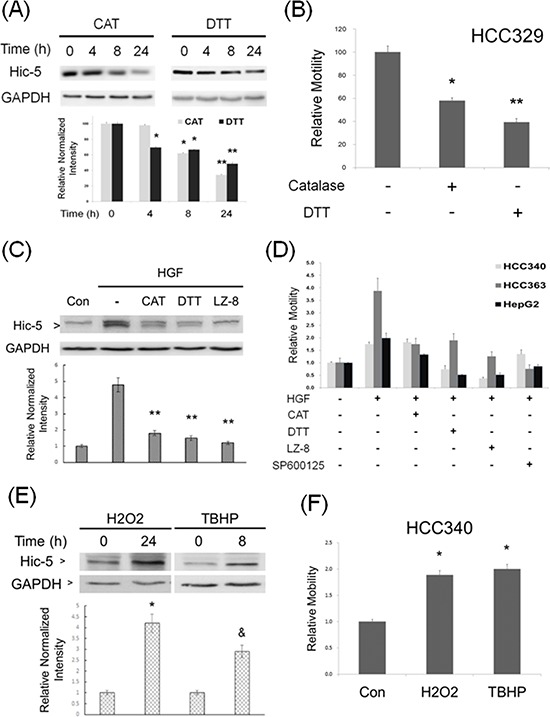
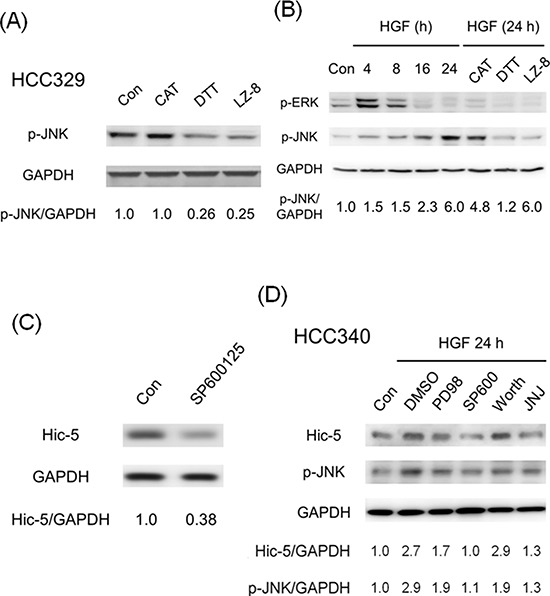
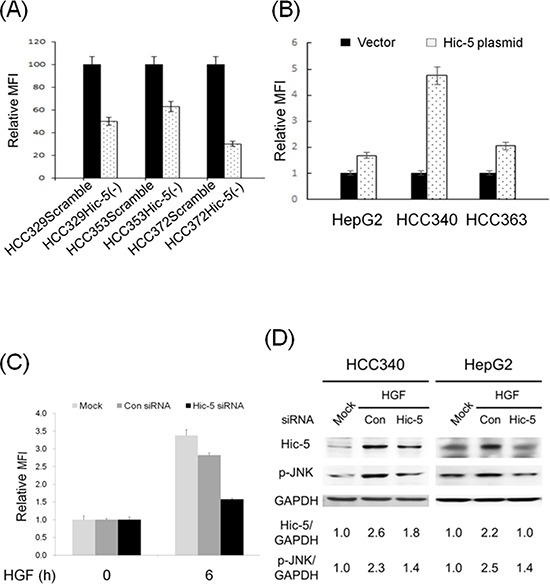
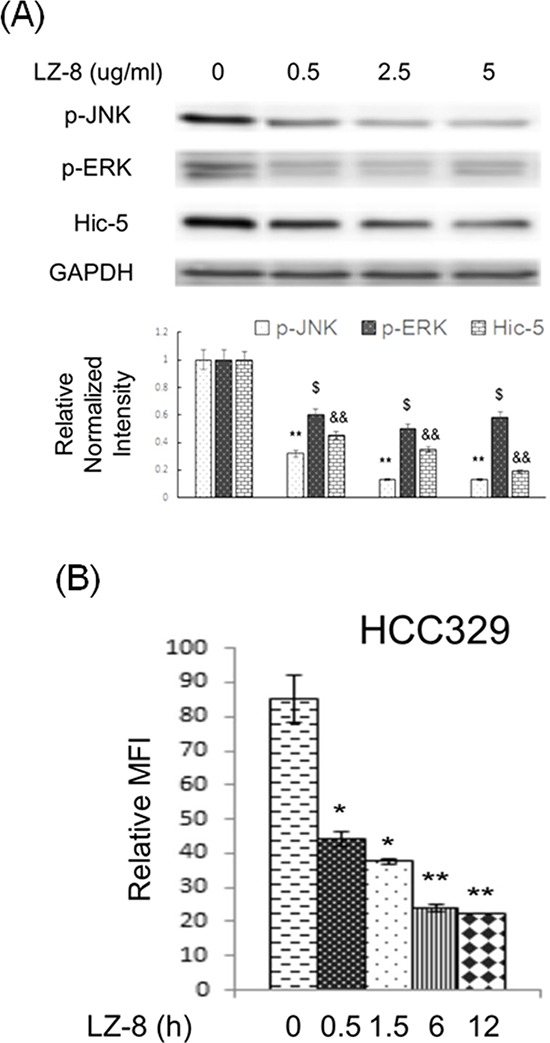
One of the signaling components involved in hepatocellular carcinoma (HCC) progression is the focal adhesion adaptor paxillin. Hydrogen peroxide inducible clone-5 (Hic-5), one of the paralogs of paxillin, exhibits many biological functions distinct from paxillin, but may cooperate with paxillin to trigger tumor progression. Screening of Hic-5 in 145 surgical HCCs demonstrated overexpression of Hic-5 correlated well with intra- and extra-hepatic metastasis. Hic-5 highly expressed in the patient derived HCCs with high motility such as HCC329 and HCC353 but not in the HCCs with low motility such as HCC340. Blockade of Hic-5 expression prevented constitutive migration of HCC329 and HCC353 and HGF-induced cell migration of HCC340. HCC329Hic-5(-), HCC353Hic-5(-), HCC372Hic-5(-), the HCCs stably depleted of Hic-5, exhibited reduced motility compared with each HCC expressing Scramble shRNA. Moreover, intra/extrahepatic metastasis of HCC329Hic-5(-) in SCID mice greatly decreased compared with HCC329Scramble. On the other hand, ectopic Hic-5 expression in HCC340 promoted its progression. Constitutive and HGF-induced Hic-5 expression in HCCs were suppressed by the reactive oxygen species (ROS) scavengers catalase and dithiotheritol and c-Jun N-terminal kinase (JNK) inhibitor SP600125. On the contrary, depletion of Hic-5 blocked constitutive and HGF-induced ROS generation and JNK phosphorylation in HCCs. Also, ectopic expression of Hic-5 enhanced ROS generation and JNK phosphorylation. These highlighted that Hic-5 plays a central role in the positive feedback ROS-JNK signal cascade. Finally, the Chinese herbal derived anti-HCC peptide LZ-8 suppressed constitutive Hic-5 expression and JNK phosphorylation. In conclusion, Hic-5 mediates ROS-JNK signaling and may serve as a therapeutic target for prevention of HCC progression.
参与肝细胞癌(HCC)进展的信号转导成分之一是粘着斑衔接蛋白桩蛋白。桩蛋白的旁系同源物之一过氧化氢诱导克隆-5(Hic-5)表现出许多与桩蛋白不同的生物学功能,但可能与桩蛋白协同作用以触发肿瘤进展。对145例手术切除的肝癌组织进行Hic-5筛查发现,Hic-5的过表达与肝内和肝外转移密切相关。Hic-5在具有高迁移率的患者来源的肝癌组织如HCC329和HCC353中高表达,但在具有低迁移率的肝癌组织如HCC340中不表达。阻断Hic-5的表达可阻止HCC329和HCC353的组成性迁移以及HGF诱导的HCC340细胞迁移。稳定缺失Hic-5的肝癌组织HCC329Hic-5(-)、HCC353Hic-5(-)、HCC372Hic-5(-)与每个表达乱序shRNA的肝癌组织相比,迁移能力降低。此外,与HCC329Scramble相比,SCID小鼠中HCC329Hic-5(-)的肝内/肝外转移大大减少。另一方面,在HCC340中异位表达Hic-5促进了其进展。肝癌组织中组成性和HGF诱导的Hic-5表达被活性氧(ROS)清除剂过氧化氢酶和二硫苏糖醇以及c-Jun氨基末端激酶(JNK)抑制剂SP600125抑制。相反,缺失Hic-5可阻断肝癌组织中组成性和HGF诱导的ROS生成以及JNK磷酸化。此外,Hic-5的异位表达增强了ROS生成和JNK磷酸化。这些结果突出表明,Hic-5在ROS-JNK信号级联的正反馈中起核心作用。最后,中药来源的抗肝癌肽LZ-8抑制了组成性Hic-5表达和JNK磷酸化。总之,Hic-5介导ROS-JNK信号传导,可能作为预防肝癌进展的治疗靶点。