Narendra P L, Naphade Ramesh W, Nallamilli Samson, Mohd Shanawaz
Department of Anesthesiology, Shri B. M. Patil Medical College Hospital and Research Centre, BLDE University, Bijapur, Karnataka, India.
Department of Anesthesiology, Smt. Kashibai Navale Medical College and General Hospital, Pune, Maharashtra, India.
Anesth Essays Res. 2015 May-Aug;9(2):213-8. doi: 10.4103/0259-1162.154051.
The aim of our study is to compare the efficacy and side-effects of Ketamine and Midazolam administered nasally for the pediatric premedication.
We studied 100 American Society of Anesthesiology I and II children aged from 1 to 10 years undergoing various surgical procedures. Totally, 50 children were evaluated for nasal ketamine (using 50 mg/ml vials) at the dose of 5 mg/kg and the other 50 received nasal midazolam 0.2 mg/kg, before induction in operation theater each patient was observed for onset of sedation, degree of sedation, emotional status being recorded with a five point sedation scale, response to venipuncture and acceptance of mask, whether readily, with persuasion or refuse.
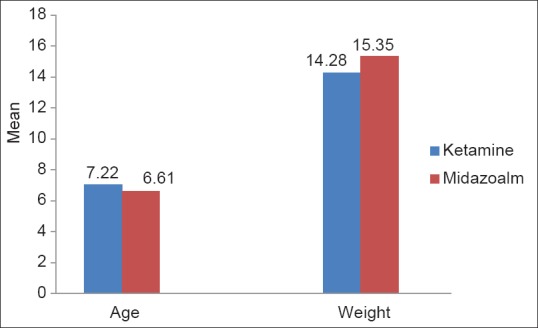
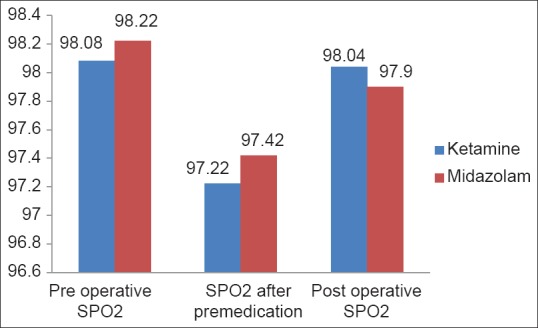
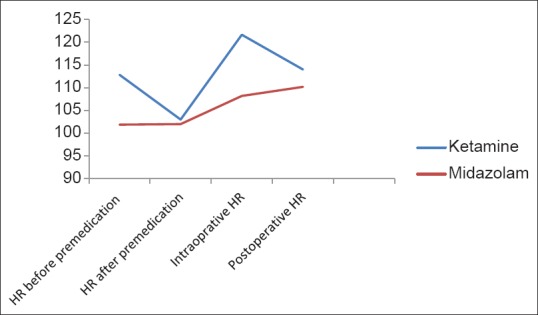
The two groups were homogenous. Midazolam showed a statistically significant early onset of sedation (10.76 ± 2.0352 vs. 16.42 ± 2.0696 min). There were no significant differences in venipuncture score, sedation scale at 20 min, acceptance of mask and oxygen saturation throughout the study. Significant tachycardia and 'secretions were observed in the ketamine group intra operatively. Postoperatively emergence (8% vs. 0%) and secretions (28% vs. 4%) were significant in the ketamine group. Nausea and vomiting occurred in l6% versus 10% for midazolam and ketamine group.
Both midazolam and ketamine nasally are an effective pediatric premedication. Midazolam has an early onset of sedation and is associated with fewer side-effects.
我们研究的目的是比较鼻内给予氯胺酮和咪达唑仑用于小儿术前用药的疗效和副作用。
我们研究了100名年龄在1至10岁、美国麻醉医师协会分级为I级和II级、接受各种外科手术的儿童。总共50名儿童接受了剂量为5mg/kg的鼻内氯胺酮(使用50mg/ml的药瓶)评估,另外50名接受了0.2mg/kg的鼻内咪达唑仑。在手术室诱导前,观察每位患者的镇静起效时间、镇静程度、用五点镇静量表记录情绪状态、对静脉穿刺的反应以及对面罩的接受情况,即是否容易接受、经劝说后接受或拒绝。
两组具有同质性。咪达唑仑在统计学上显示出显著更早的镇静起效时间(10.76±2.0352分钟对16.42±2.0696分钟)。在整个研究过程中,静脉穿刺评分、20分钟时的镇静量表、对面罩的接受情况和血氧饱和度方面没有显著差异。氯胺酮组术中观察到显著的心动过速和分泌物。氯胺酮组术后苏醒(8%对0%)和分泌物(28%对4%)差异显著。咪达唑仑组和氯胺酮组恶心和呕吐的发生率分别为16%和10%。
鼻内给予咪达唑仑和氯胺酮都是有效的小儿术前用药。咪达唑仑起效早且副作用较少。