Cosacak Mehmet Ilyas, Papadimitriou Christos, Kizil Caghan
German Centre for Neurodegenerative Diseases (DZNE), The Helmholtz Association, Arnoldstraße 18, 01307 Dresden, Germany ; DFG-Center for Regenerative Therapies Dresden (CRTD), Cluster of Excellence at the TU Dresden, Fetscherstraße 105, 01307 Dresden, Germany.
Biomed Res Int. 2015;2015:769763. doi: 10.1155/2015/769763. Epub 2015 Aug 31.
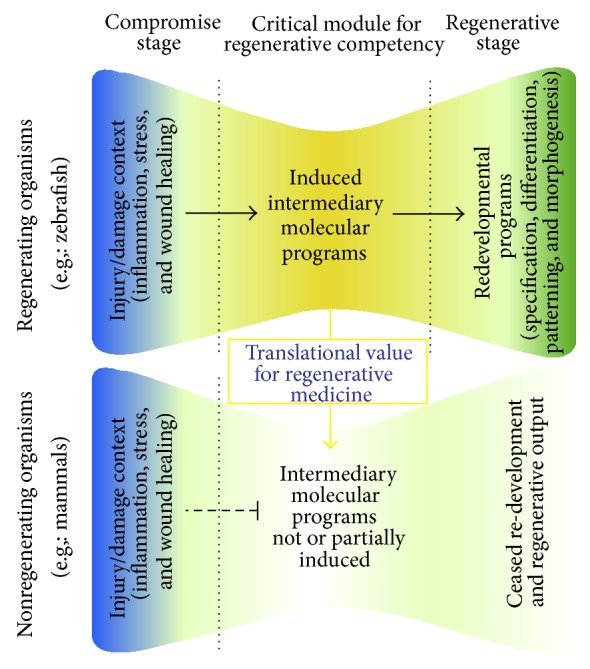
Regenerative capacity of the brain is a variable trait within animals. Aquatic vertebrates such as zebrafish have widespread ability to renew their brains upon damage, while mammals have--if not none--very limited overall regenerative competence. Underlying cause of such a disparity is not fully evident; however, one of the reasons could be activation of peculiar molecular programs, which might have specific roles after injury or damage, by the organisms that regenerate. If this hypothesis is correct, then there must be genes and pathways that (a) are expressed only after injury or damage in tissues, (b) are biologically and functionally relevant to restoration of neural tissue, and (c) are not detected in regenerating organisms. Presence of such programs might circumvent the initial detrimental effects of the damage and subsequently set up the stage for tissue redevelopment to take place by modulating the plasticity of the neural stem/progenitor cells. Additionally, if transferable, those "molecular mechanisms of regeneration" could open up new avenues for regenerative therapies of humans in clinical settings. This review focuses on the recent studies addressing injury/damage-induced molecular programs in zebrafish brain, underscoring the possibility of the presence of genes that could be used as biomarkers of neural plasticity and regeneration.
大脑的再生能力在动物界是一种可变的特性。像斑马鱼这样的水生脊椎动物在大脑受损后具有广泛的自我更新能力,而哺乳动物即使不是完全没有,其整体再生能力也非常有限。这种差异的根本原因尚不完全清楚;然而,其中一个原因可能是能够再生的生物体激活了特殊的分子程序,这些程序在受伤或受损后可能具有特定作用。如果这个假设是正确的,那么必然存在这样一些基因和信号通路:(a)仅在组织受伤或受损后表达;(b)在神经组织修复方面具有生物学和功能相关性;(c)在再生生物体中未被检测到。这些程序的存在可能会规避损伤最初的有害影响,并随后通过调节神经干细胞/祖细胞的可塑性为组织重新发育奠定基础。此外,如果这些“再生分子机制”具有可转移性,那么它们可能为临床环境中人类的再生治疗开辟新途径。这篇综述聚焦于近期关于斑马鱼大脑中损伤诱导分子程序的研究,强调了存在可作为神经可塑性和再生生物标志物的基因的可能性。