Laohasinnarong Dusit, Goto Yasuyuki, Asada Masahito, Nakao Ryo, Hayashida Kyoko, Kajino Kiichi, Kawazu Shin-ichiro, Sugimoto Chihiro, Inoue Noboru, Namangala Boniface
O.I.E. Reference Laboratory on Surra, National Research Center for Protozoan Diseases, Obihiro University of Agriculture and Veterinary Medicine, Inada-cho, Obihiro, Hokkaido, 080-8555, Japan.
Clinical Sciences and Public Health Department, Faculty of Veterinary Science, Mahidol University, 999 Phuttamonthon 4 Road, Salaya, Phuttamonthon, Nakhon Pathom, 73170, Thailand.
Parasit Vectors. 2015 Sep 30;8:497. doi: 10.1186/s13071-015-1112-y.
The present study, conducted in Zambia's Luangwa valley where both animal African trypanosomiasis (AAT) and human African trypanosomiasis (HAT) are endemic, combined the use of microscopy and molecular techniques to determine the presence of trypanosome species in cattle, goats and tsetse flies.
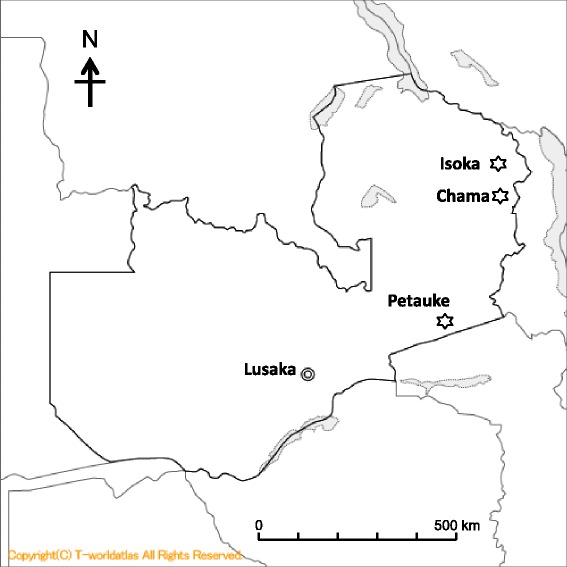
This study was conducted between 2008 and 2010 in Petauke, Chama and Isoka districts, north-eastern Zambia. A total of 243 cattle, 36 goats and 546 tsetse flies, were examined for presence of trypanosome species using microscopy, PCR and loop-mediated isothermal amplification (LAMP).
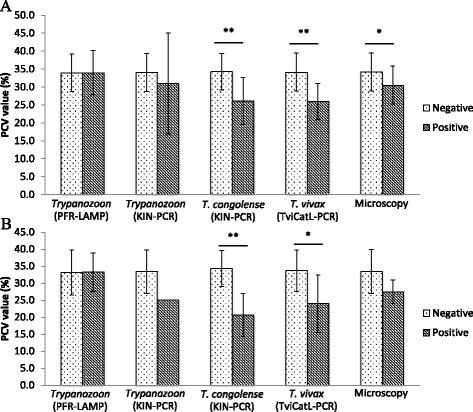
There was poor agreement among the test methods used for detection of trypanosomes species in animal blood and tsetse flies. Trypanosomes were observed in 6.1 % (95 % CI: 3.3-8.9 %) of the animals sampled by microscopy, 7.5 % (95 % CI: 4.4-10.6 %) by PCR and 18.6 % (95 % CI: 13.6-23.6 %) by PFR-LAMP. PFR-LAMP was more sensitive for detecting Trypanozoon than KIN-PCR. The highest occurrence of AAT was recorded in cattle from Petauke (58.7 %, 95 % CI: 44.7-72.7 %) while the lowest was from Isoka (5.4 %, 95 % CI: 0.8-10.0 %). Infection of both cattle and goats with Trypanosoma congolense and T. vivax was associated with clinical AAT.
When selecting molecular techniques for AAT surveillance in endemic regions, the KIN-PCR and species-specific PCR may be recommended for screening animal or tsetse fly samples for T. congolense and T. vivax, respectively. On the other hand, species-specific PCR and/or LAMP might be of greater value in the screening of animal and human body fluids as well as tsetse fly samples for Trypanozoon.
本研究在赞比亚卢安瓜山谷开展,该地区动物非洲锥虫病(AAT)和人类非洲锥虫病(HAT)均为地方病,研究结合使用显微镜检查和分子技术来确定牛、山羊和采采蝇体内锥虫种类的存在情况。
本研究于2008年至2010年在赞比亚东北部的佩陶凯、查马和伊索卡地区进行。使用显微镜检查、聚合酶链反应(PCR)和环介导等温扩增技术(LAMP)对总共243头牛、36只山羊和546只采采蝇进行检查,以确定是否存在锥虫种类。
用于检测动物血液和采采蝇体内锥虫种类的检测方法之间一致性较差。通过显微镜检查,在6.1%(95%置信区间:3.3 - 8.9%)的抽样动物中观察到锥虫;通过PCR检测为7.5%(95%置信区间:4.4 - 10.6%);通过PFR - LAMP检测为18.6%(95%置信区间:13.6 - 23.6%)。PFR - LAMP在检测布氏锥虫(Trypanozoon)方面比KIN - PCR更敏感。在佩陶凯的牛中记录到的AAT发生率最高(58.7%,95%置信区间:44.7 - 72.7%),而在伊索卡的牛中最低(5.4%,95%置信区间:0.8 - 10.0%)。牛和山羊感染刚果锥虫(Trypanosoma congolense)和活泼锥虫(T. vivax)均与临床AAT相关。
在地方病流行地区选择用于AAT监测的分子技术时,KIN - PCR和种特异性PCR可能分别推荐用于筛查动物或采采蝇样本中的刚果锥虫和活泼锥虫。另一方面,种特异性PCR和/或LAMP在筛查动物和人体体液以及采采蝇样本中的布氏锥虫方面可能具有更大价值。