Division of Pathway Medicine and Centre for Infectious Diseases, School of Biomedical Sciences, College of Medicine and Veterinary Medicine, The University of Edinburgh, Edinburgh, United Kingdom; Health Protection Scotland, Glasgow, Scotland, United Kingdom.
Division of Pathway Medicine and Centre for Infectious Diseases, School of Biomedical Sciences, College of Medicine and Veterinary Medicine, The University of Edinburgh, Edinburgh, United Kingdom.
PLoS Negl Trop Dis. 2014 Jun 5;8(6):e2931. doi: 10.1371/journal.pntd.0002931. eCollection 2014 Jun.
Uganda has active foci of both chronic and acute HAT with the acute zoonotic form of disease classically considered to be restricted to southeast Uganda, while the focus of the chronic form of HAT was confined to the northwest of the country. Acute HAT has however been migrating from its traditional disease focus, spreading rapidly to new districts, a spread linked to movement of infected cattle following restocking. Cattle act as long-term reservoirs of human infective T. b. rhodesiense showing few signs of morbidity, yet posing a significant risk to human health. It is important to understand the relationship between infected cattle and infected individuals so that an appropriate response can be made to the risk posed to the community from animals infected with human pathogens in a village setting.
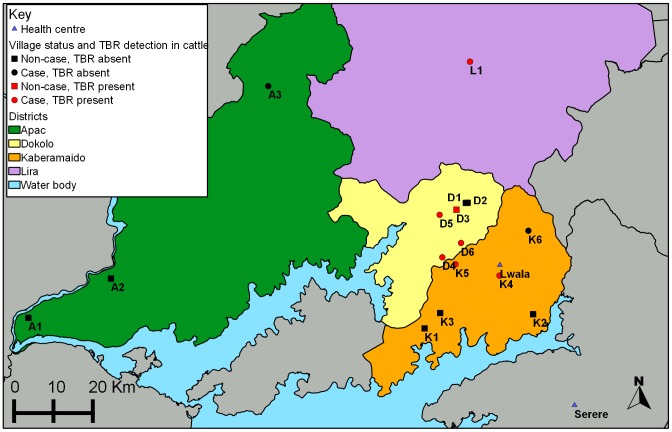
METHODOLOGY/PRINCIPAL FINDINGS: This paper examines the relationship between human T. b. rhodesiense infection and human infective and non-human T. brucei s.l. circulating in cattle at village level in Kaberamaido and Dokolo Districts, Uganda. The study was undertaken in villages that had reported a case of sleeping sickness in the six months prior to sample collection and those villages that had never reported a case of sleeping sickness.
The sleeping sickness status of the villages had a significant effect with higher odds of infection in cattle from case than from non-case villages for T. brucei s.l. (OR: 2.94, 95%CI: 1.38-6.24). Cattle age had a significant effect (p<0.001) on the likelihood of T. brucei s.l. infection within cattle: cattle between 18-36 months (OR: 3.51, 95%CI: 1.63-7.51) and cattle over 36 months (OR: 4.20, 95%CI: 2.08-8.67) had significantly higher odds of T. brucei s. l. infection than cattle under 18 months of age. Furthermore, village human sleeping sickness status had a significant effect (p<0.05) on the detection of T. b. rhodesiense in the village cattle herd, with significantly higher likelihood of T. b. rhodesiense in the village cattle of case villages (OR: 25, 95%CI: 1.2-520.71). Overall a higher than average T. brucei s.l. prevalence (>16.3%) in a village herd over was associated with significantly higher likelihood of T. b. rhodesiense being detected in a herd (OR: 25, 95%CI: 1.2-520.71).
乌干达存在慢性和急性恰加斯病的活跃疫区,急性人畜共患形式的疾病传统上被认为仅限于乌干达东南部,而慢性恰加斯病的焦点则局限于该国西北部。然而,急性恰加斯病已经从其传统的疾病焦点迁移,迅速传播到新的地区,这种传播与受感染牛在重新放养后的移动有关。牛作为人类感染的锥虫布氏冈比亚亚种的长期储存宿主,几乎没有表现出病态,但对人类健康构成重大威胁。了解受感染牛与受感染个体之间的关系非常重要,以便对村庄环境中受人类病原体感染的动物给社区带来的风险做出适当的反应。
方法/主要发现:本文研究了在乌干达卡贝拉马伊多和多科罗地区的村庄中,人类感染的 T. b. rhodesiense 与人类感染和非人类的 T. brucei s.l. 在牛群中的关系。这项研究是在报告了六个月内有昏睡病病例的村庄和从未报告过昏睡病病例的村庄中进行的。
村庄的昏睡病状况有显著影响,来自病例村的牛感染锥虫布氏冈比亚亚种的几率高于非病例村(OR:2.94,95%CI:1.38-6.24)。牛的年龄对牛感染锥虫布氏冈比亚亚种有显著影响(p<0.001):18-36 个月的牛(OR:3.51,95%CI:1.63-7.51)和 36 个月以上的牛(OR:4.20,95%CI:2.08-8.67)感染锥虫布氏冈比亚亚种的几率显著高于 18 个月以下的牛。此外,村庄人类昏睡病状况对检测村庄牛群中的 T. b. rhodesiense 有显著影响,病例村的村庄牛群中 T. b. rhodesiense 的检测概率显著较高(OR:25,95%CI:1.2-520.71)。总体而言,一个村庄牛群中锥虫布氏冈比亚亚种的流行率(>16.3%)高于平均水平,与在牛群中检测到 T. b. rhodesiense 的可能性显著相关(OR:25,95%CI:1.2-520.71)。