Win Mar-Kyaw, Soliman Tarek Abdellatif Aly, Lee Linda Kay, Wong Chia Siong, Chow Angela, Ang Brenda, Roman Carrasco L, Leo Yee-Sin
Institute of Infectious Diseases and Epidemiology, Tan Tock Seng Hospital, Singapore, Singapore.
Saw Swee Hock School of Public Health, National University of Singapore, Singapore, Singapore.
BMC Infect Dis. 2015 Sep 29;15:391. doi: 10.1186/s12879-015-1131-5.
Methicillin-resistant Staphylococcus aureus (MRSA) poses an increasingly large disease and economic burden worldwide. The effectiveness of screening programs in the tropics is poorly understood. The aims of this study are: (i) to analyze the factors affecting MRSA colonization at admission and acquisition during hospitalization and (ii) to evaluate the cost-effectiveness of a screening program which aims to control MRSA incidence during hospitalization.
We conducted a retrospective case-control study of patients admitted to the Communicable Disease Centre (CDC) in Singapore between Jan 2009 and Dec 2010 when there was an ongoing selective screening and isolation program. Risk factors contributing to MRSA colonization on admission and acquisition during hospital stay were evaluated using a logistic regression model. In addition, a cost-effectiveness analysis was conducted to determine the cost per disability-adjusted life year (DALY) averted due to implementing the screening and isolation program.
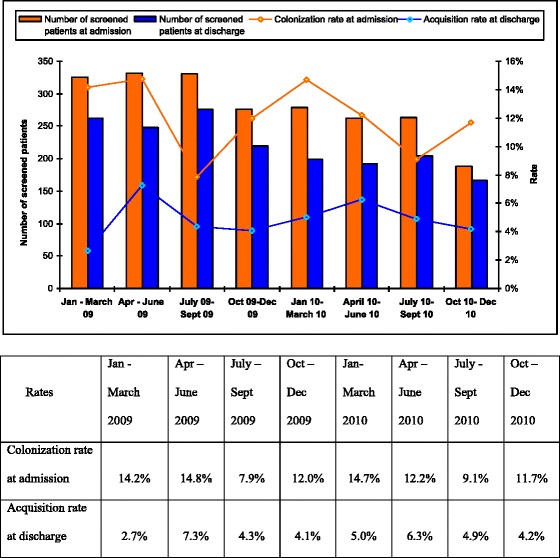
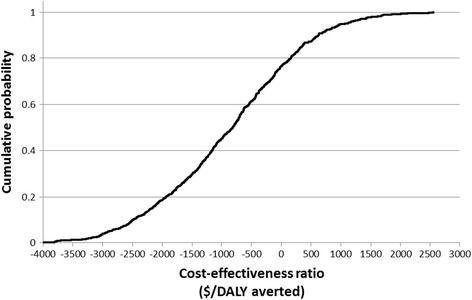
The average prevalence rate of screened patients at admission and the average acquisition rate at discharge during the study period were 12.1 and 4.8 % respectively. Logistic regression models showed that older age (adjusted odds ratio (OR) 1.03, 95 % CI 1.02-1.04, p < 0.001) and dermatological conditions (adjusted OR 1.49, 95 % CI 1.11-1.20, p = 0.008) were independently associated with an increased risk of MRSA colonization at admission. Age (adjusted OR 1.02, 95 % CI 1.01-1.03, p = 0.002) and length of stay in hospital (adjusted OR 1.04, 95 % CI 1.03-1.06, p < 0.001) were independent factors associated with MRSA acquisition during hospitalization. The screening and isolation program reduced the acquisition rate by 1.6 % and was found to be cost saving. For the whole study period, the program cost US$129,916, while it offset hospitalization costs of US$103,869 and loss of productivity costs of US$50,453 with -400 $/DALY averted.
This study is the first to our knowledge that evaluates the cost-effectiveness of screening and isolation of MRSA patients in a tropical country. Another unique feature of the analysis is the evaluation of acquisition rates among specific types of patients (dermatological, HIV and infectious disease patients)and the comparison of the cost-effectiveness of screening and isolation between them.
Overall our results indicate high MRSA prevalence that can be cost effectively reduced by selective screening and isolation programs in Singapore.
耐甲氧西林金黄色葡萄球菌(MRSA)在全球范围内造成的疾病负担和经济负担日益加重。热带地区筛查项目的有效性尚不清楚。本研究的目的是:(i)分析影响入院时MRSA定植及住院期间获得MRSA感染的因素;(ii)评估旨在控制住院期间MRSA发病率的筛查项目的成本效益。
我们对2009年1月至2010年12月期间入住新加坡传染病中心(CDC)的患者进行了一项回顾性病例对照研究,当时该中心正在实施一项选择性筛查和隔离项目。使用逻辑回归模型评估导致入院时MRSA定植及住院期间获得MRSA感染的危险因素。此外,进行了成本效益分析,以确定实施筛查和隔离项目每避免一个伤残调整生命年(DALY)的成本。
研究期间,筛查患者入院时的平均患病率和出院时的平均获得率分别为12.1%和4.8%。逻辑回归模型显示,年龄较大(调整优势比(OR)1.03,95%可信区间1.02 - 1.04,p < 0.001)和皮肤病(调整OR 1.49,95%可信区间1.11 - 1.20,p = 0.008)与入院时MRSA定植风险增加独立相关。年龄(调整OR 1.02,95%可信区间1.01 - 1.03,p = 0.002)和住院时间(调整OR 1.04,95%可信区间1.03 - 1.06,p < 0.001)是与住院期间获得MRSA感染相关的独立因素。筛查和隔离项目使获得率降低了1.6%,且发现该项目具有成本节约效益。在整个研究期间,该项目花费129,916美元,而避免了103,869美元的住院费用和50,453美元的生产力损失费用,每避免一个DALY的成本为 - 400美元。
据我们所知,本研究是首次评估热带国家对MRSA患者进行筛查和隔离的成本效益。该分析的另一个独特之处是评估特定类型患者(皮肤病、HIV和传染病患者)中的获得率,并比较他们之间筛查和隔离的成本效益。
总体而言,我们的结果表明新加坡MRSA患病率较高,通过选择性筛查和隔离项目可以有效降低成本。