Dean Lorraine T, DeMichele Angela, LeBlanc Mously, Stephens-Shields Alisa, Li Susan Q, Colameco Chris, Coursey Morgan, Mao Jun J
School of Medicine, Center for Clinical Epidemiology and Biostatistics, University of Pennsylvania, 909 Blockley Hall, 423 Guardian Drive, Philadelphia, PA, 19104, USA.
Abramson Cancer Center, University of Pennsylvania, Philadelphia, USA.
Breast Cancer Res Treat. 2015 Nov;154(1):117-25. doi: 10.1007/s10549-015-3580-3. Epub 2015 Sep 29.
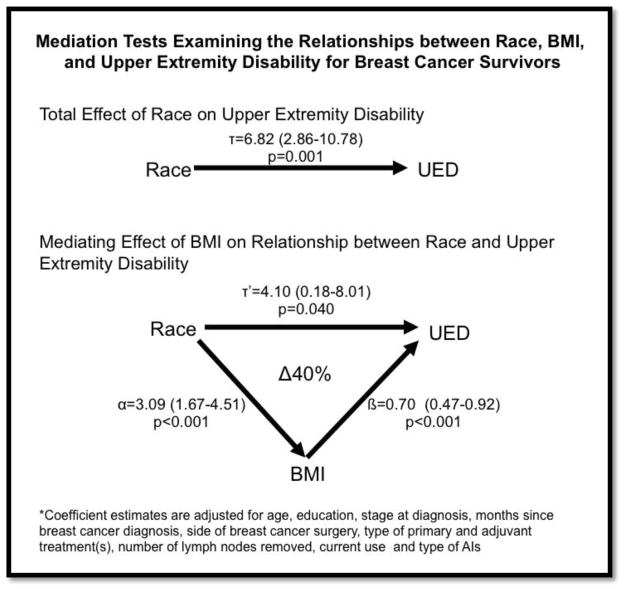
Over one-third of breast cancer survivors experience upper extremity disability. Black women present with factors associated with greater upper extremity disability, including: increased body mass index (BMI), more advanced disease stage at diagnosis, and varying treatment type compared with Whites. No prior research has evaluated the relationship between race and upper extremity disability using validated tools and controlling for these factors. Data were drawn from a survey study among 610 women with stage I-III hormone receptor positive breast cancer. The disabilities of the arm, shoulder and hand (QuickDASH) is an 11-item self-administered questionnaire that has been validated for breast cancer survivors to assess global upper extremity function over the past 7 days. Linear regression and mediation analysis estimated the relationships between race, BMI and QuickDASH score, adjusting for demographics and treatment types. Black women (n = 98) had 7.3 points higher average QuickDASH scores than White (n = 512) women (p < 0.001). After adjusting for BMI, age, education, cancer treatment, months since diagnosis, and aromatase inhibitor status, Black women had an average 4-point (95 % confidence interval 0.18-8.01) higher QuickDASH score (p = 0.04) than White women. Mediation analysis suggested that BMI attenuated the association between race and disability by 40 %. Even several years post-treatment, Black breast cancer survivors had greater upper extremity disability, which was partially mediated by higher BMIs. Close monitoring of high BMI Black women may be an important step in reducing disparities in cancer survivorship. More research is needed on the relationship between race, BMI, and upper extremity disability.
超过三分之一的乳腺癌幸存者存在上肢功能障碍。黑人女性存在与更严重上肢功能障碍相关的因素,包括:体重指数(BMI)增加、诊断时疾病分期更晚,以及与白人相比治疗类型不同。此前尚无研究使用经过验证的工具并控制这些因素来评估种族与上肢功能障碍之间的关系。数据来自一项对610名I - III期激素受体阳性乳腺癌女性的调查研究。手臂、肩部和手部功能障碍(QuickDASH)是一份11项的自填式问卷已在乳腺癌幸存者中得到验证,用于评估过去7天的整体上肢功能。线性回归和中介分析估计了种族、BMI与QuickDASH评分之间的关系,并对人口统计学和治疗类型进行了调整。黑人女性(n = 98)的QuickDASH平均得分比白人女性(n = 512)高7.3分(p < 0.001)。在调整了BMI、年龄、教育程度、癌症治疗、诊断后的月数和芳香化酶抑制剂使用情况后,黑人女性的QuickDASH得分比白人女性平均高4分(95%置信区间0.18 - 8.01)(p = 0.04)。中介分析表明,BMI使种族与功能障碍之间的关联减弱了40%。即使在治疗后数年,黑人乳腺癌幸存者的上肢功能障碍仍更严重,这部分是由较高的BMI介导的。密切监测高BMI的黑人女性可能是减少癌症幸存者差异的重要一步。关于种族、BMI和上肢功能障碍之间的关系还需要更多研究。