Department of Physical Medicine & Rehabilitation, University of Michigan Health Systems, Ann Arbor, MI, USA.
Section of Plastic Surgery, University of Michigan Health Systems, Ann Arbor, MI, USA.
Breast. 2018 Feb;37:119-125. doi: 10.1016/j.breast.2017.11.001. Epub 2017 Nov 13.
Chronic postsurgical pain (CPSP) is a reported risk for women undergoing breast reconstruction, but it remains unclear that such persistent pain is induced by reconstructive surgery. To address this concern, this prospective cohort study examined the prevalence of and risk factors associated with CPSP among women undergoing breast reconstruction.
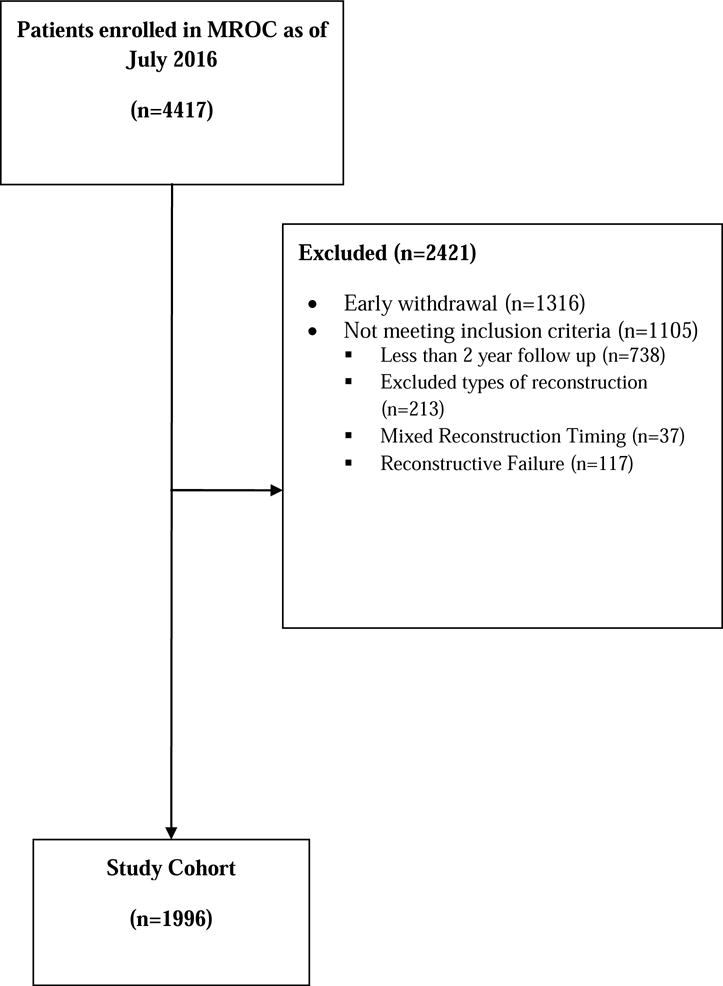
Women (n = 1996) recruited for the Mastectomy Reconstruction Outcomes Consortium (MROC) Study were assessed preoperatively and at two-years postoperatively for relevant medical/.surgical variables, pain experience, body physical well-being, anxiety, depression, and reconstruction procedure type and characteristics.
Nearly half of the entire sample reported some level of preoperative pain. At two years there were statistically significant but not clinically meaningful increases in both pain intensity and chest/upper body discomfort but a decrease in affective pain rating. Average clinical pain severity was strikingly similar for preoperative and postoperative assessments. Preoperative levels of pain, acute postoperative pain, and (marginally) level of depression held consistent relationship at two-year follow-up with all outcome measures. Autologous flap reconstruction was associated with more severe CPSP compared to TE/I reconstruction. Older age, higher BMI, bilateral reconstruction, and adjuvant radiation and chemotherapy were associated with CPSP and chest/upper body discomfort for at least one outcome measure at two years.
The substantial rate of preoperative pain and comparable prevalence of preoperative and postoperative pain ratings suggest that persistent pain after breast reconstruction may not necessarily reflect surgery-induced pain. Future research will need to determine those factors that contribute to long-term pain following breast reconstruction.
慢性术后疼痛(CPSP)是接受乳房重建的女性报告的风险,但尚不清楚这种持续疼痛是否是由重建手术引起的。为了解决这一担忧,本前瞻性队列研究调查了接受乳房重建的女性中 CPSP 的患病率和相关风险因素。
招募参加乳房切除术重建结果联盟(MROC)研究的女性(n=1996)在术前和术后两年评估相关的医学/手术变量、疼痛体验、身体生理健康、焦虑、抑郁以及重建手术类型和特征。
将近一半的整个样本报告了某种程度的术前疼痛。在两年时,疼痛强度和胸部/上半身不适均有统计学意义但无临床意义的增加,但疼痛的情感评价降低。平均临床疼痛严重程度在术前和术后评估中非常相似。术前疼痛水平、急性术后疼痛以及(边缘)抑郁水平在两年随访时与所有结果测量均保持一致的关系。与 TE/I 重建相比,自体皮瓣重建与更严重的 CPSP 相关。年龄较大、BMI 较高、双侧重建以及辅助放疗和化疗与至少一项两年时的 CPSP 和胸部/上半身不适结果相关。
术前疼痛的发生率很高,且术前和术后疼痛评分的患病率相当,这表明乳房重建后的持续性疼痛不一定反映手术引起的疼痛。未来的研究需要确定哪些因素导致乳房重建后长期疼痛。