
基于中国造血干细胞捐献者资料库项目169995名志愿者的人类白细胞抗原等位基因和单倍型频率的高分辨率分析
High-Resolution Analyses of Human Leukocyte Antigens Allele and Haplotype Frequencies Based on 169,995 Volunteers from the China Bone Marrow Donor Registry Program.
作者信息
Zhou Xiao-Yang, Zhu Fa-Ming, Li Jian-Ping, Mao Wei, Zhang De-Mei, Liu Meng-Li, Hei Ai-Lian, Dai Da-Peng, Jiang Ping, Shan Xiao-Yan, Zhang Bo-Wei, Zhu Chuan-Fu, Shen Jie, Deng Zhi-Hui, Wang Zheng-Lei, Yu Wei-Jian, Chen Qiang, Qiao Yan-Hui, Zhu Xiang-Ming, Lv Rong, Li Guo-Ying, Li Guo-Liang, Li Heng-Cong, Zhang Xu, Pei Bin, Jiao Li-Xin, Shen Gang, Liu Ying, Feng Zhi-Hui, Su Yu-Ping, Xu Zhao-Xia, Di Wen-Ying, Jiang Yao-Qin, Fu Hong-Lei, Liu Xiang-Jun, Liu Xiang, Zhou Mei-Zhen, Du Dan, Liu Qi, Han Ying, Zhang Zhi-Xin, Cai Jian-Ping
机构信息
The Key Laboratory of Geriatrics, Beijing hospital & Beijing Institute of Geriatrics, Ministry of Health, Beijing, China; Quality control laboratory, China Bone Marrow Program, Beijing, China.
HLA Laboratory, Zhejiang Blood Center, Hangzhou, Zhejiang, China.
出版信息
PLoS One. 2015 Sep 30;10(9):e0139485. doi: 10.1371/journal.pone.0139485. eCollection 2015.
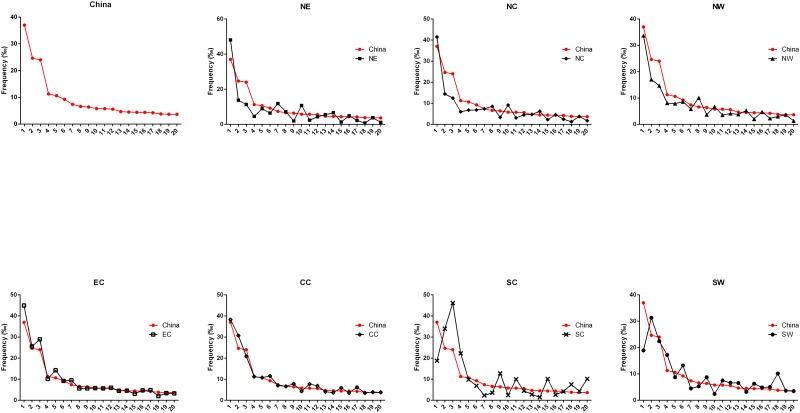
Allogeneic hematopoietic stem cell transplantation is a widely used and effective therapy for hematopoietic malignant diseases and numerous other disorders. High-resolution human leukocyte antigen (HLA) haplotype frequency distributions not only facilitate individual donor searches but also determine the probability with which a particular patient can find HLA-matched donors in a registry. The frequencies of the HLA-A, -B, -C, -DRB1, and -DQB1 alleles and haplotypes were estimated among 169,995 Chinese volunteers using the sequencing-based typing (SBT) method. Totals of 191 HLA-A, 244 HLA-B, 146 HLA-C, 143 HLA-DRB1 and 47 HLA-DQB1 alleles were observed, which accounted for 6.98%, 7.06%, 6.46%, 9.11% and 7.91%, respectively, of the alleles in each locus in the world (IMGT 3.16 Release, Apr. 2014). Among the 100 most common haplotypes from the 169,995 individuals, nine distinct haplotypes displayed significant regionally specific distributions. Among these, three were predominant in the South China region (i.e., the 20th, 31st, and 81sthaplotypes), another three were predominant in the Southwest China region (i.e., the 68th, 79th, and 95th haplotypes), one was predominant in the South and Southwest China regions (the 18th haplotype), one was relatively common in the Northeast and North China regions (the 94th haplotype), and one was common in the Northeast, North and Northwest China (the 40th haplotype). In conclusion, this is the first to analyze high-resolution HLA diversities across the entire country of China, based on a detailed and complete data set that covered 31 provinces, autonomous regions, and municipalities. Specifically, we also evaluated the HLA matching probabilities within and between geographic regions and analyzed the regional differences in the HLA diversities in China. We believe that the data presented in this study might be useful for unrelated HLA-matched donor searches, donor registry planning, population genetic studies, and anthropogenesis studies.
异基因造血干细胞移植是治疗造血系统恶性疾病及许多其他病症的一种广泛应用且有效的疗法。高分辨率人类白细胞抗原(HLA)单倍型频率分布不仅有助于寻找个体供者,还能确定特定患者在登记库中找到HLA匹配供者的概率。采用基于测序的分型(SBT)方法,对169,995名中国志愿者的HLA - A、- B、- C、- DRB1和- DQB1等位基因及单倍型频率进行了估计。共观察到191个HLA - A、244个HLA - B、146个HLA - C、143个HLA - DRB1和47个HLA - DQB1等位基因,分别占世界各基因座等位基因的6.98%、7.06%、6.46%、9.11%和7.91%(IMGT 3.16版本,2014年4月)。在这169,995人的100种最常见单倍型中,9种不同的单倍型呈现出显著的区域特异性分布。其中,3种在华南地区占主导地位(即第20、31和81号单倍型),另外3种在西南地区占主导地位(即第68、79和95号单倍型),1种在华南和西南地区占主导地位(第18号单倍型),1种在东北和华北地区相对常见(第94号单倍型),1种在东北、华北和西北地区常见(第40号单倍型)。总之,这是首次基于覆盖中国31个省、自治区和直辖市的详细完整数据集,对全国范围内的高分辨率HLA多样性进行分析。具体而言,我们还评估了地理区域内和区域间的HLA匹配概率,并分析了中国HLA多样性的区域差异。我们认为本研究提供的数据可能有助于无关HLA匹配供者的搜索、供者登记库规划、群体遗传学研究和人类起源研究。



 Zotero 插件