Kowalczuk Maria K, Dudbridge Frank, Nanda Shreeya, Harriman Stephanie L, Patel Jigisha, Moylan Elizabeth C
BioMed Central, London, UK.
Department of Non-communicable Disease Epidemiology, London School of Hygiene and Tropical Medicine, London, UK.
BMJ Open. 2015 Sep 29;5(9):e008707. doi: 10.1136/bmjopen-2015-008707.
To assess whether reports from reviewers recommended by authors show a bias in quality and recommendation for editorial decision, compared with reviewers suggested by other parties, and whether reviewer reports for journals operating on open or single-blind peer review models differ with regard to report quality and reviewer recommendations.
Retrospective analysis of the quality of reviewer reports using an established Review Quality Instrument, and analysis of reviewer recommendations and author satisfaction surveys.
BioMed Central biology and medical journals. BMC Infectious Diseases and BMC Microbiology are similar in size, rejection rates, impact factors and editorial processes, but the former uses open peer review while the latter uses single-blind peer review. The Journal of Inflammation has operated under both peer review models.
Two hundred reviewer reports submitted to BMC Infectious Diseases, 200 reviewer reports submitted to BMC Microbiology and 400 reviewer reports submitted to the Journal of Inflammation.
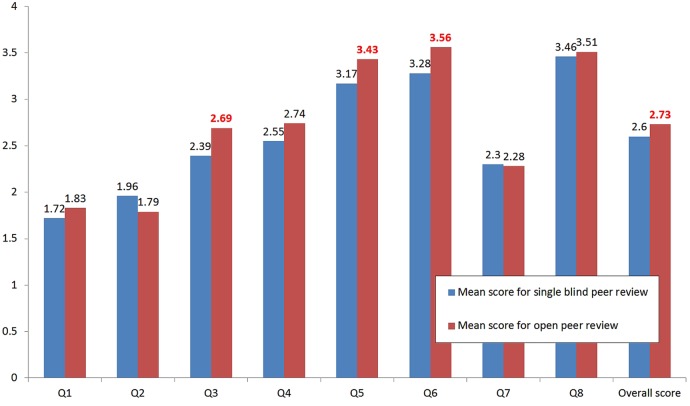
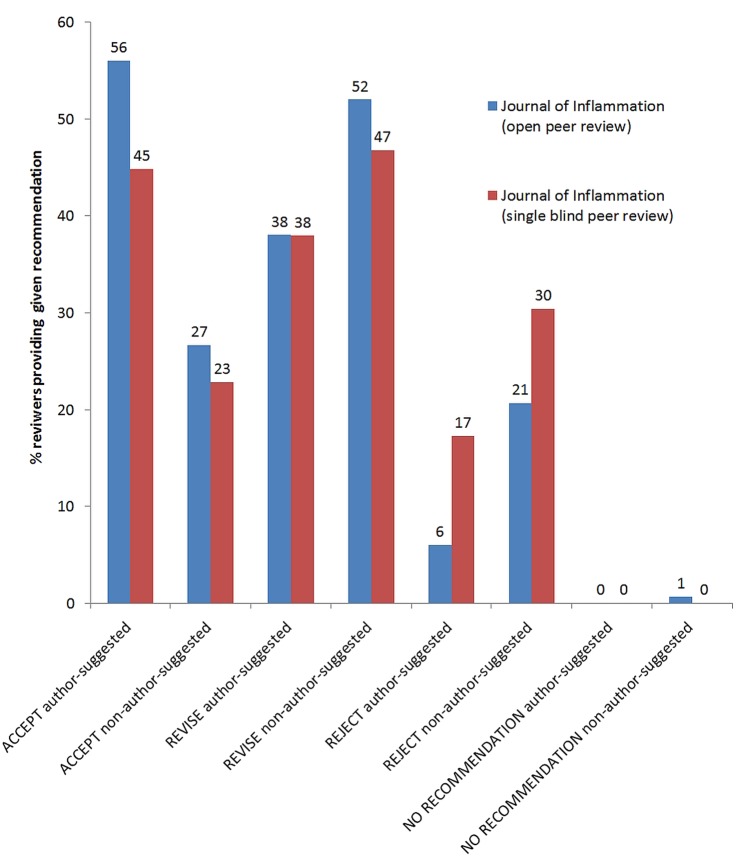
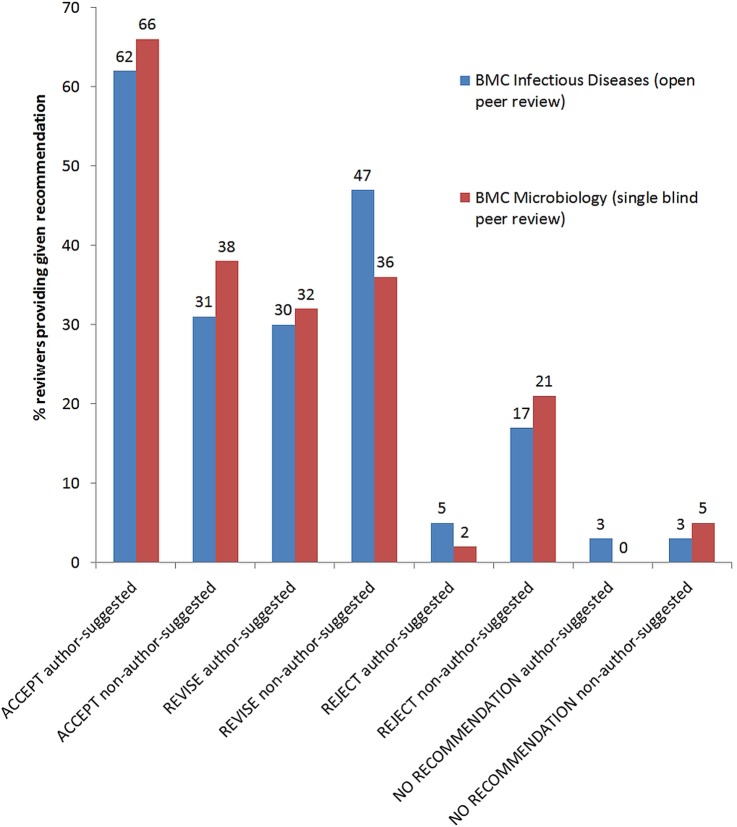
For each journal, author-suggested reviewers provided reports of comparable quality to non-author-suggested reviewers, but were significantly more likely to recommend acceptance, irrespective of the peer review model (p<0.0001 for BMC Infectious Diseases, BMC Microbiology and the Journal of Inflammation). For BMC Infectious Diseases, the overall quality of reviewer reports measured by the Review Quality Instrument was 5% higher than for BMC Microbiology (p=0.042). For the Journal of Inflammation, the quality of reports was the same irrespective of the peer review model used.
Reviewers suggested by authors provide reports of comparable quality to non-author-suggested reviewers, but are significantly more likely to recommend acceptance. Open peer review reports for BMC Infectious Diseases were of higher quality than single-blind reports for BMC Microbiology. There was no difference in quality of peer review in the Journal of Inflammation under open peer review compared with single blind.
评估与其他方推荐的审稿人相比,由作者推荐的审稿人所撰写的报告在质量和编辑决策建议方面是否存在偏差,以及采用开放或单盲同行评审模式的期刊的审稿人报告在报告质量和审稿人建议方面是否存在差异。
使用既定的评审质量工具对审稿人报告的质量进行回顾性分析,并对审稿人建议和作者满意度调查进行分析。
生物医学中心的生物学和医学期刊。《BMC传染病》和《BMC微生物学》在规模、拒稿率、影响因子和编辑流程方面相似,但前者采用开放同行评审,而后者采用单盲同行评审。《炎症杂志》曾在两种同行评审模式下运作。
提交给《BMC传染病》的200份审稿人报告、提交给《BMC微生物学》的200份审稿人报告以及提交给《炎症杂志》的400份审稿人报告。
对于每种期刊,作者推荐的审稿人提供的报告质量与非作者推荐的审稿人相当,但无论同行评审模式如何,他们更有可能建议接受(《BMC传染病》、《BMC微生物学》和《炎症杂志》的p均<0.0001)。对于《BMC传染病》,用评审质量工具衡量的审稿人报告的总体质量比《BMC微生物学》高5%(p=0.042)。对于《炎症杂志》,无论采用何种同行评审模式,报告质量都相同。
作者推荐的审稿人提供的报告质量与非作者推荐的审稿人相当,但更有可能建议接受。《BMC传染病》的开放同行评审报告质量高于《BMC微生物学》的单盲报告。与单盲相比,《炎症杂志》在开放同行评审下的同行评审质量没有差异。