Wang Wenjin, Ma Zhiyuan
From the Department of Emergency, The First Hospital of Lanzhou University, Lanzhou, China (WWJ); Department of Geriatric Medicine, The First Hospital of Lanzhou University, Lanzhou, China (MZY); and Center of Evidence-based Medicine, Lanzhou University First Hospital, Lanzhou, China (MZY).
Medicine (Baltimore). 2015 Sep;94(39):e1664. doi: 10.1097/MD.0000000000001664.
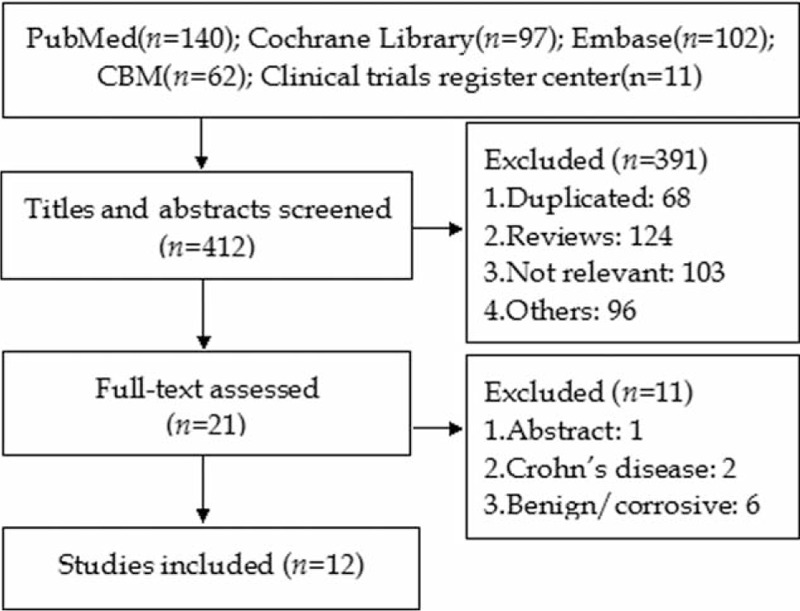
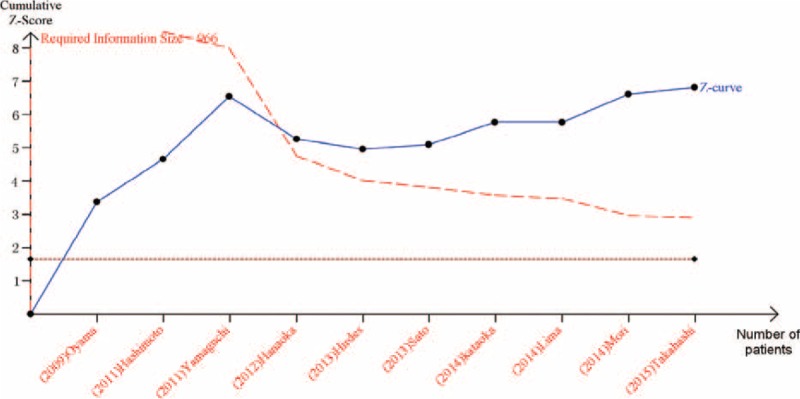
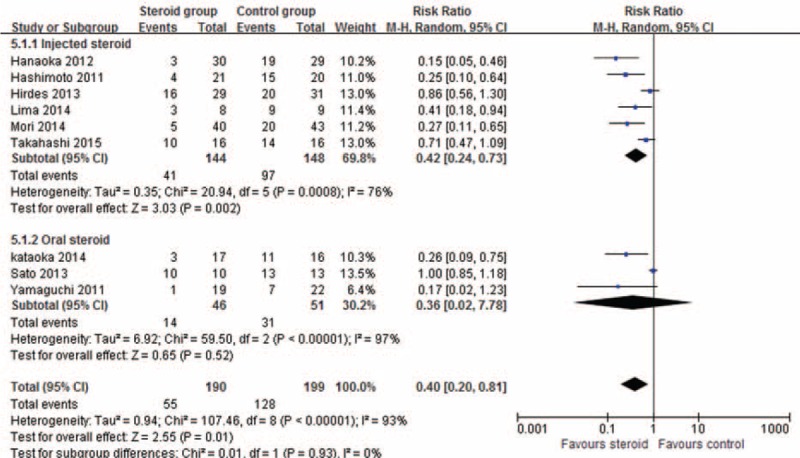
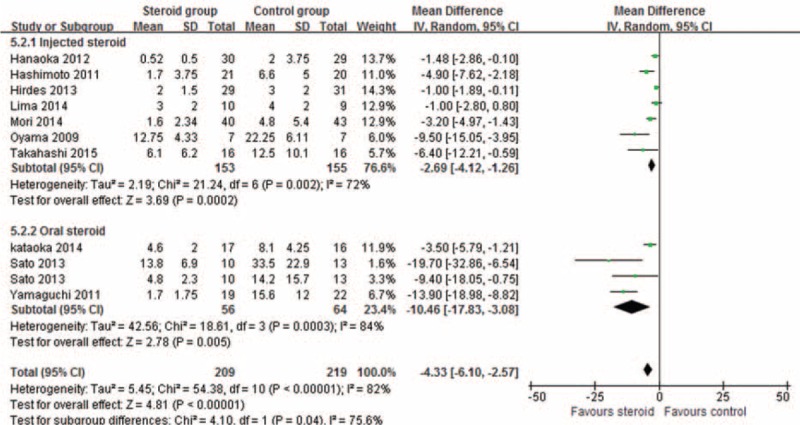
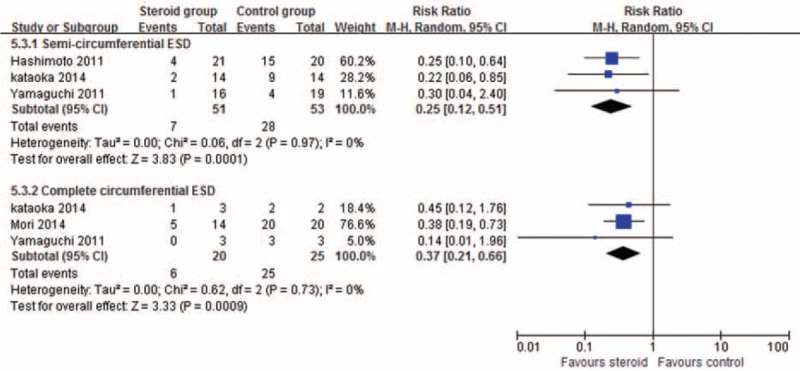
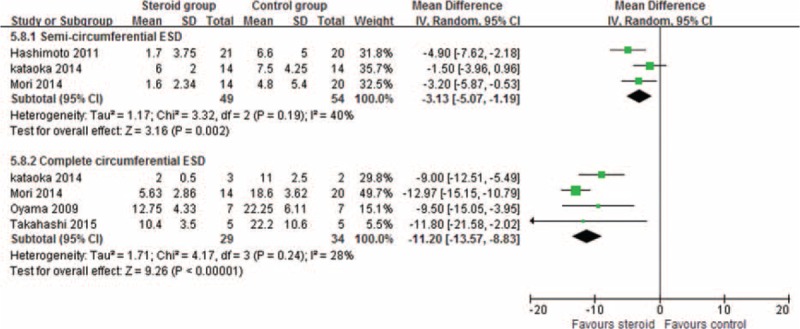
Esophageal stricture is a severe adverse event after circumferential endoscopic submucosal dissection (ESD). Steroid administration is a new method to prevent stricture formation. We performed a meta-analysis to investigate the efficacy and safety of steroid administration to prevent esophageal stricture after circumferential ESD. PubMed, the Cochrane Library, EMBASE, Chinese Biomedical Database, and Clinicaltrials.gov were searched. Studies on steroid administration + endoscopic balloon dilation (EBD) versus EBD alone for esophageal stricture were included and pooled analyzed in random-effects models. Besides, subgroup analysis and network analysis were performed to define the influence of ESD type and steroid administration method. Twelve studies involving 513 patients were included. Meta-analysis showed that steroid administration significantly achieved a lower stricture rate (risk ratio [RR], 0.40; 95% CI, 0.20-0.81) and less required EBD sessions (mean difference [MD], -4.33; 95% CI, -6.10 to -2.57) than control. Subgroup analysis indicated that steroid was effective after both semi- and complete circumferential ESD. Network meta-analysis showed that compared with oral steroid, local injected steroid had a similar effect to prevent stricture (RR, 1.16; 95% CI, 0.48-2.85), whereas a better effect to reduce required EBD sessions (MD, 7.77; 95%CI, 0.26-15.3). Additional steroid administration is effective to reduce the stricture rate and required EBD sessions. And local injected steroid was superior to oral steroid in EBD reduction, whereas due to the varied method and dose of steroid administration, the finding needs to be clarified in the future.
食管狭窄是环周内镜黏膜下剥离术(ESD)后一种严重的不良事件。给予类固醇是预防狭窄形成的一种新方法。我们进行了一项荟萃分析,以研究给予类固醇预防环周ESD术后食管狭窄的有效性和安全性。检索了PubMed、Cochrane图书馆、EMBASE、中国生物医学数据库和Clinicaltrials.gov。纳入了关于类固醇给药+内镜球囊扩张术(EBD)与单纯EBD治疗食管狭窄的研究,并采用随机效应模型进行汇总分析。此外,进行亚组分析和网状分析以确定ESD类型和类固醇给药方法的影响。纳入了12项涉及513例患者的研究。荟萃分析表明,与对照组相比,给予类固醇显著降低了狭窄率(风险比[RR],0.40;95%可信区间[CI],0.20 - 0.81),且所需的EBD次数更少(平均差[MD],-4.33;95%CI,-6.10至-2.57)。亚组分析表明,在半环周和全环周ESD后,类固醇均有效。网状荟萃分析表明,与口服类固醇相比,局部注射类固醇在预防狭窄方面效果相似(RR,1.16;95%CI,0.48 - 2.85),而在减少所需EBD次数方面效果更好(MD,7.77;95%CI,0.26 - 15.3)。额外给予类固醇可有效降低狭窄率和所需的EBD次数。并且局部注射类固醇在减少EBD次数方面优于口服类固醇,然而由于类固醇给药方法和剂量各不相同,这一发现未来还需进一步明确。