Barnes T R E, Bhatti S F, Adroer R, Paton C
The Centre for Mental Health, Imperial College London, Hammersmith Hospital Campus, London, UK Prescribing Observatory for Mental Health (POMH-UK), Royal College of Psychiatrists, London, UK.
Prescribing Observatory for Mental Health (POMH-UK), Royal College of Psychiatrists, London, UK.
BMJ Open. 2015 Oct 1;5(10):e007633. doi: 10.1136/bmjopen-2015-007633.
To increase the frequency and quality of screening for the metabolic syndrome in people prescribed continuing antipsychotic medication.
An audit-based, quality improvement programme (QIP) with customised feedback to participating mental health services after each audit, including benchmarked data on their relative and absolute performance against an evidence-based practice standard and the provision of bespoke change interventions.
Adult, assertive outreach, community psychiatric services in the UK.
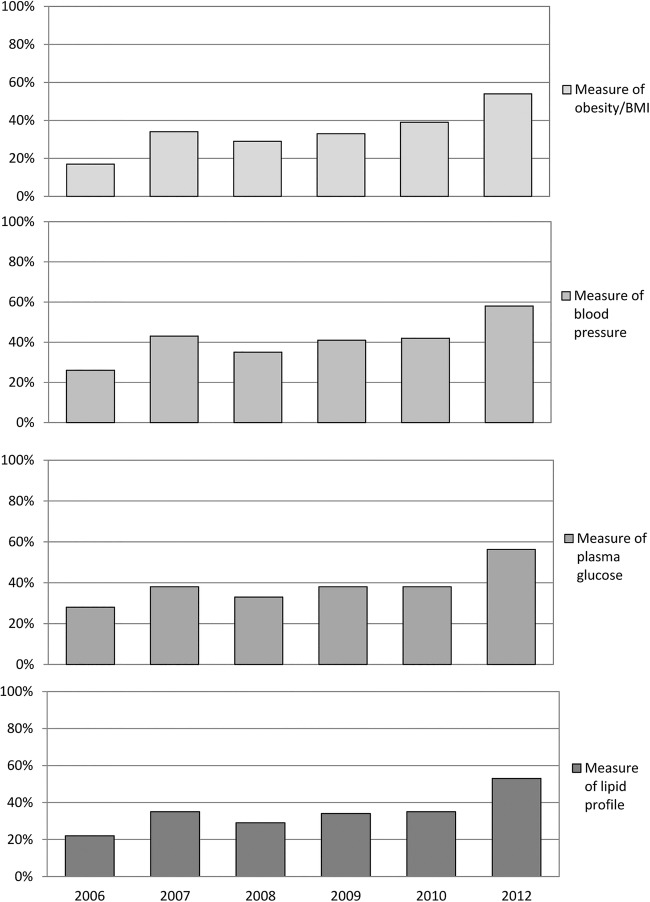
6 audits were conducted between 2006 and 2012. 21 mental health Trusts participated in the baseline audit in 2006, submitting data on screening for 1966 patients, while 32 Trusts participated in the 2012 audit, submitting data on 1591 patients.
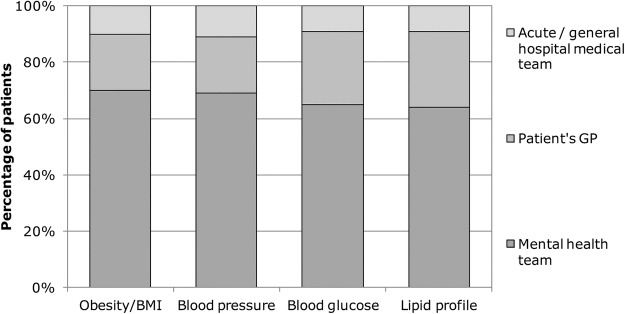
Over the 6 years of the programme, there was a statistically significant increase in the proportion of patients for whom measures for all 4 aspects of the metabolic syndrome had been documented in the clinical records in the previous year, from just over 1 in 10 patients in 2006 to just over 1 in 3 by 2012. The proportion of patients with no evidence of any screening fell from almost ½ to 1 in 7 patients over the same period.
The findings suggest that audit-based QIPs can help improve clinical practice in relation to physical healthcare screening. Nevertheless, they also reveal that only a minority of community psychiatric patients prescribed antipsychotic medication is screened for the metabolic syndrome in accordance with best practice recommendations, and therefore potentially remediable causes of poor physical health remain undetected and untreated.
提高正在服用持续性抗精神病药物的人群中代谢综合征筛查的频率和质量。
一项基于审核的质量改进计划(QIP),每次审核后向参与的精神卫生服务机构提供定制化反馈,包括其相对于循证实践标准的相对和绝对绩效的基准数据,以及提供定制的变革干预措施。
英国的成人、积极外展社区精神科服务。
2006年至2012年间进行了6次审核。2006年,21个精神卫生信托机构参与了基线审核,提交了1966名患者的筛查数据,而2012年有32个信托机构参与审核,提交了1591名患者的数据。
在该计划的6年中,前一年临床记录中记录了代谢综合征所有4个方面测量指标的患者比例有统计学显著增加,从2006年略高于十分之一的患者增加到2012年略高于三分之一的患者。同期,没有任何筛查证据的患者比例从近二分之一降至七分之一。
研究结果表明,基于审核的QIPs有助于改善与身体保健筛查相关的临床实践。然而,他们也发现,按照最佳实践建议,只有少数服用抗精神病药物的社区精神病患者接受了代谢综合征筛查,因此潜在的可补救的身体健康问题原因仍未被发现和治疗。