Takayama Saori, Kato Tetsuo, Imamura Kentaro, Kita Daichi, Ota Koki, Suzuki Eiichi, Sugito Hiroki, Saitoh Eiichi, Taniguchi Masayuki, Saito Atsushi
Department of Periodontology, Tokyo Dental College, Tokyo, Japan.
Laboratory of Chemistry, Tokyo Dental College, Tokyo, Japan.
BMC Res Notes. 2015 Oct 3;8:531. doi: 10.1186/s13104-015-1527-8.
We aimed to evaluate clinically the effect of mouthrinse containing a rice peptide on early dental plaque regrowth.
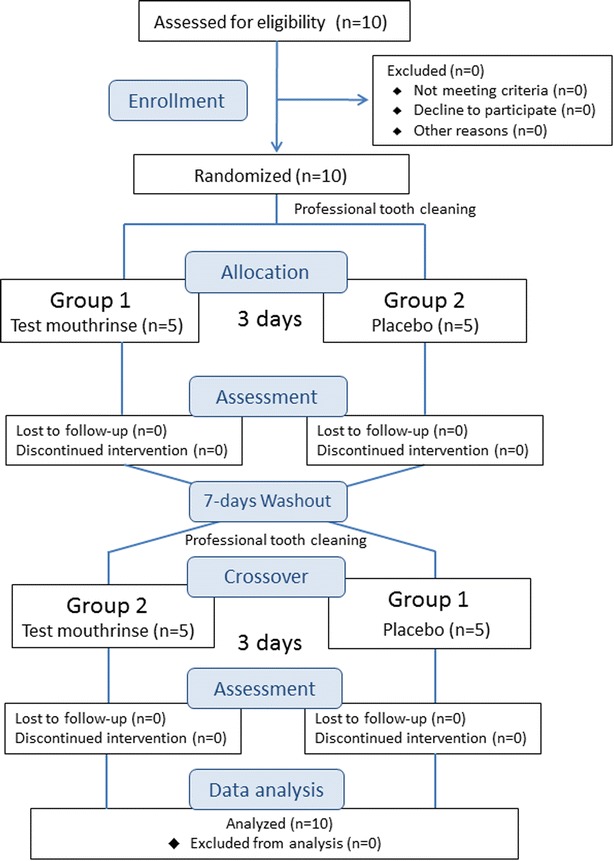
The study was designed as a double-masked, two-group crossover randomized pilot trial, involving 10 periodontally healthy volunteers. After receiving a professional tooth cleaning at baseline, over the next 3 days each participant refrained from all oral hygiene measures and had two daily rinses with 20 ml of the test mouthrinse containing 0.4 % rice peptide CL(14-25) or placebo rinse. At the end of each experimental period, plaque score was assessed using the modified Volpe's method, and the participants filled out a questionnaire. Each participant underwent a 7-day washout period followed by a second allocation. The plaque score was the primary outcome of the study and participant perception was the secondary outcome.
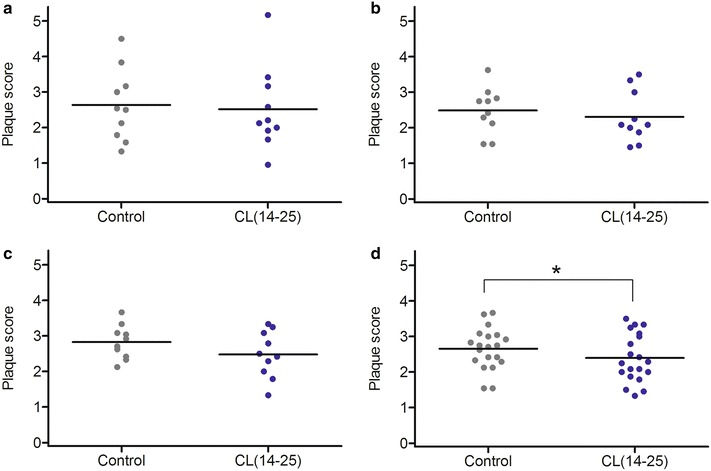
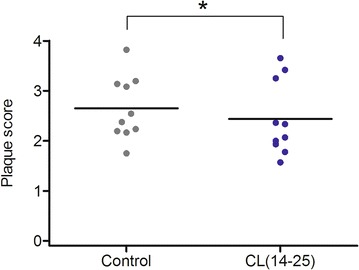
No adverse effects were observed in the participants during the study. Clinically, the mean plaque score of the examined teeth was significantly lower in the test group (2.44 ± 0.74, CI: 1.91-2.96) than the placebo group (2.65 ± 0.63, CI: 2.20-3.10) (P < 0.05). When analyzed according to the type of teeth, a significantly lower score of the premolars/molars was observed in the test group (2.39 ± 0.68, CI: 2.08-2.71) than that in the placebo group (2.66 ± 0.58, CI: 2.39-2.93) (P < 0.05).
The mouthrinse containing 0.4 % rice peptide CL(14-25) was effective in reducing the early regrowth of dental plaque. However, clinical relevance of this efficacy needs to be validated in a future large-scale study.
UMIN Clinical Trials Registry (UMIN-CTR) R000014000. Date of formal registration: November 1, 2013.
我们旨在临床评估含大米肽的漱口水对早期牙菌斑再生长的影响。
本研究设计为双盲、两组交叉随机试点试验,纳入10名牙周健康志愿者。在基线时接受专业牙齿清洁后,接下来3天每位参与者均不采取任何口腔卫生措施,每天用20毫升含0.4%大米肽CL(14 - 25)的测试漱口水或安慰剂漱口水漱口两次。在每个实验周期结束时,使用改良的沃尔普方法评估菌斑评分,参与者填写问卷。每位参与者经过7天的洗脱期后进行第二次分配。菌斑评分是研究的主要结局,参与者的感受是次要结局。
研究期间参与者未观察到不良反应。临床上,测试组检查牙齿的平均菌斑评分(2.44 ± 0.74,CI:1.91 - 2.96)显著低于安慰剂组(2.65 ± 0.63,CI:2.20 - 3.10)(P < 0.05)。按牙齿类型分析时,测试组前磨牙/磨牙的评分(2.39 ± 0.68,CI:2.08 - 2.71)显著低于安慰剂组(2.66 ± 0.58,CI:2.39 - 2.93)(P < 0.05)。
含0.4%大米肽CL(14 - 25)的漱口水在减少牙菌斑早期再生长方面有效。然而,这种疗效的临床相关性需要在未来的大规模研究中得到验证。
UMIN临床试验注册中心(UMIN - CTR)R000014000。正式注册日期:2013年11月1日。