Wang Bo, Tu Jian, Yin Junqiang, Zou Changye, Wang Jin, Huang Gang, Xie Xianbiao, Shen Jingnan
Musculoskeletal Oncology Center, The First Affiliated Hospital of Sun Yat-Sen University, Guangzhou, Guangdong, China.
Oncotarget. 2015 Nov 10;6(35):38348-59. doi: 10.18632/oncotarget.5276.
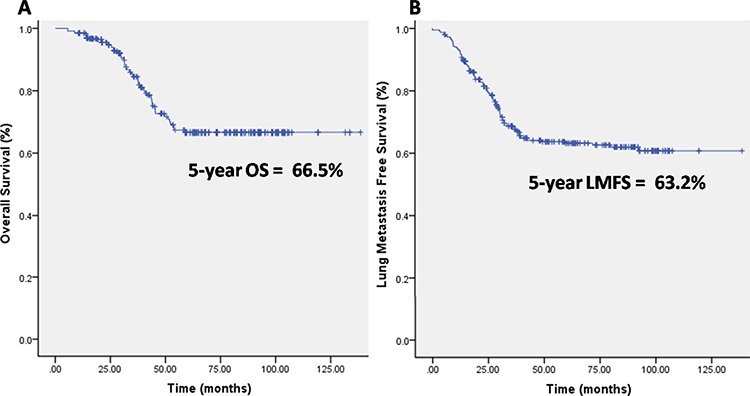
To develop a prognostic index to predict the 5-year overall survival (OS) and 5-year lung metastasis-free survival (LMFS) of patients with extremity osteosarcoma at the time of diagnosis.
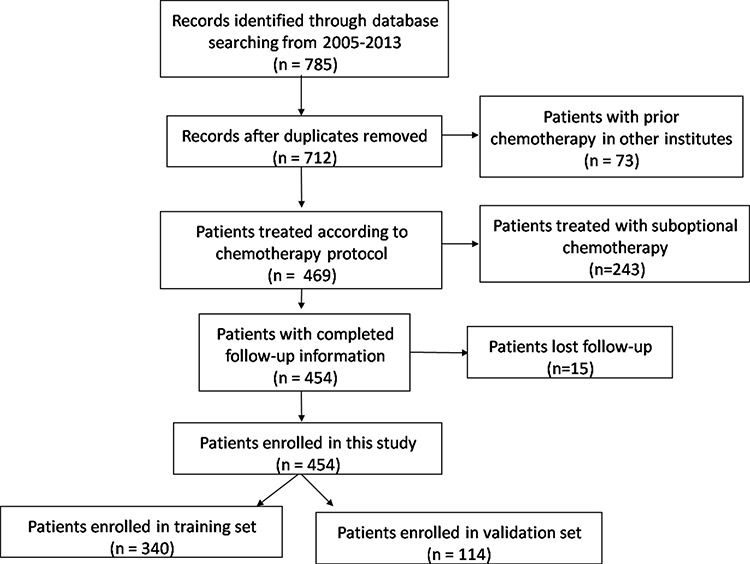
We retrospectively evaluated 454 patients with extremity osteosarcoma at our center from 2005 to 2013. The cohort was randomly divided into training and validation sets. The association of potential risk factors with OS and LMFS was assessed by Cox proportional hazards analysis in the training set, and a prognostic index was created according to scores that were proportional to a regression coefficient for each factor. This prognostic index was assessed in the validation set.
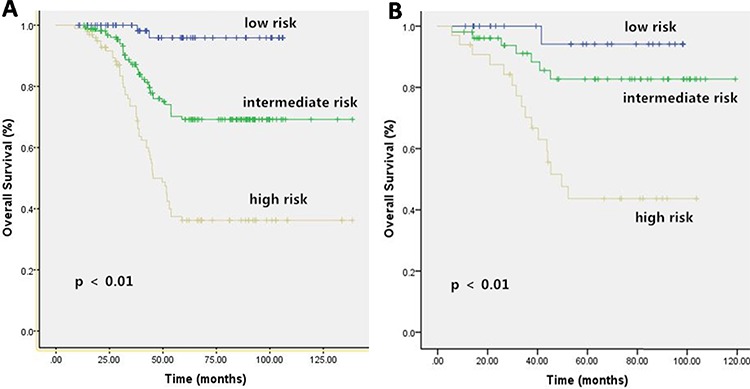
For the 5-year OS, 5 independent prognostic factors were identified: tumor size, Enneking stage, pretreatment platelet, alkaline phosphatase(ALP), and neutrophils. The multivariate Cox model identified tumor size, pretreatment platelets, ALP, and neutrophils as associated with the 5-year LMFS. A prognostic index for death and lung metastases was calculated. Three risk groups were defined for each survival point: low, intermediate, and high risk for the 5-year OS; low, intermediate, and high risk for the 5-year LMFS. The C statistic for the 5-year OS was 0.723 in the training set and 0.710 in the validation set. The C statistic for the 5-year LMFS was 0.661 and 0.693 respectively.
This prognostic index is based on routine tests and characteristics of extremity osteosarcoma patients and is a useful predictor of OS and lung metastases. This index could be applied to clinical practice and trials for individualized risk-adapted therapies.
建立一种预后指数,以预测肢体骨肉瘤患者诊断时的5年总生存率(OS)和5年无肺转移生存率(LMFS)。
我们回顾性评估了2005年至2013年在本中心就诊的454例肢体骨肉瘤患者。该队列被随机分为训练集和验证集。在训练集中通过Cox比例风险分析评估潜在危险因素与OS和LMFS的关联,并根据与每个因素的回归系数成比例的分数创建预后指数。在验证集中评估该预后指数。
对于5年OS,确定了5个独立的预后因素:肿瘤大小、Enneking分期、预处理血小板、碱性磷酸酶(ALP)和中性粒细胞。多变量Cox模型确定肿瘤大小、预处理血小板、ALP和中性粒细胞与5年LMFS相关。计算了死亡和肺转移的预后指数。为每个生存点定义了三个风险组:5年OS的低、中、高风险;5年LMFS的低、中、高风险。训练集中5年OS的C统计量为0.723,验证集中为0.710。5年LMFS的C统计量分别为0.661和0.693。
该预后指数基于肢体骨肉瘤患者的常规检查和特征,是OS和肺转移的有用预测指标。该指数可应用于临床实践和试验,以进行个体化的风险适应性治疗。