Kaushal Pulkit, Atri Rajeev, Soni Abhishek, Kaushal Vivek
Department of Psychiatry, Seth GS Medical College and KEM Hospital, Mumbai 400012, Maharashtra, India.
Department of Radiotherapy, Pt. B. D. Sharma Post Graduate Institute of Medical Sciences, Rohtak 124001, Haryana, India.
Ecancermedicalscience. 2015 Aug 25;9:567. doi: 10.3332/ecancer.2015.567. eCollection 2015.
To compare the antiemetic combination of palonosetron, dexamethasone, and aprepitant (PDA) with antiemetic combination of ondansetron and dexamethasone (OD) in head and neck cancer patients receiving docetaxel, carboplatin, and 5-FU based chemotherapy.
Sixty previously untreated patients were randomly divided into two groups of thirty patients each. The PDA group received a combination of palonosetron 0.25 mg intravenously (IV), dexamethasone 12 mg IV, and capsule aprepitant per oral. OD group received ondansetron 16 mg IV, and dexamethasone 12 mg IV for emesis control. The primary objective was to compare the efficacy of two antiemetic schedules for preventing acute and delayed CINV (chemotherapy-induced nausea and vomiting). The primary efficacy end point was complete response (CR).
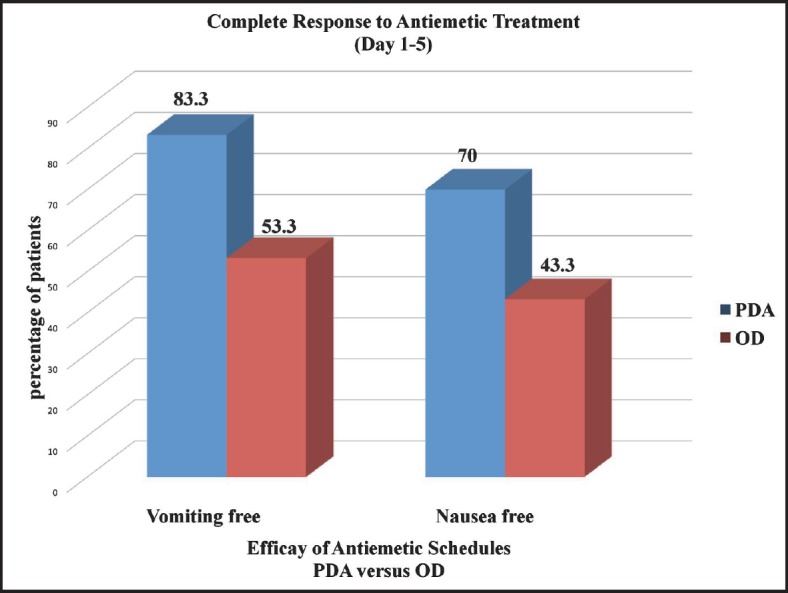
All the patients tolerated both schedules well. The antiemetic response for acute emesis (first 24 hours) in PDA versus OD group was: CR was 86.7 versus 60%. For delayed emesis (from day 2-5) in PDA versus OD group CR was 83.3 versus 53.3%. The intensity of acute nausea (first 24 hours) in PDA versus OD group was: no nausea-70 versus 46.6%. The intensity of delayed nausea (from day 2-5) in PDA versus OD was: no nausea-76.6 versus 43.3%. The CR to both acute and delayed emesis (no vomiting from day 1-5) in PDA versus OD group was 83.3 versus 53.3% (p < 0.05, significant). The CR to nausea (no nausea from day 1-5) in PDA versus OD group was 70 versus 43.3% (p < 0.05, significant).
Although both the schedules were tolerated well, the PDA schedule (palonosetron, aprepitant, and dexamethasone) was significantly better than the OD schedule (ondansetron and dexamethasone) in controlling cancer CINV in the acute as well as delayed phases.
在接受多西他赛、卡铂和5-氟尿嘧啶化疗的头颈癌患者中,比较帕洛诺司琼、地塞米松和阿瑞匹坦(PDA)的止吐联合方案与昂丹司琼和地塞米松(OD)的止吐联合方案。
60例既往未接受过治疗的患者随机分为两组,每组30例。PDA组静脉注射0.25mg帕洛诺司琼、静脉注射12mg地塞米松并口服阿瑞匹坦胶囊。OD组静脉注射16mg昂丹司琼和静脉注射12mg地塞米松以控制呕吐。主要目的是比较两种止吐方案预防急性和迟发性化疗引起的恶心和呕吐(CINV)的疗效。主要疗效终点是完全缓解(CR)。
所有患者对两种方案耐受性均良好。PDA组与OD组急性呕吐(最初24小时)的止吐反应:完全缓解率分别为86.7%和60%。PDA组与OD组迟发性呕吐(第2 - 5天)的完全缓解率分别为83.3%和53.3%。PDA组与OD组急性恶心(最初24小时)的强度:无恶心的比例分别为70%和46.6%。PDA组与OD组迟发性恶心(第2 - 5天)的强度:无恶心的比例分别为76.6%和43.3%。PDA组与OD组急性和迟发性呕吐(第1 - 5天无呕吐)的完全缓解率分别为83.3%和53.3%(p < 0.05,有显著差异)。PDA组与OD组恶心(第1 - 5天无恶心)的完全缓解率分别为70%和43.3%(p < 0.05,有显著差异)。
虽然两种方案耐受性均良好,但在控制癌症急性和迟发性CINV方面,PDA方案(帕洛诺司琼、阿瑞匹坦和地塞米松)明显优于OD方案(昂丹司琼和地塞米松)。