Amgen Inc. , Thousand Oaks, California , USA.
Strategic Healthcare Solutions, LLC , Aiken, South Carolina , USA.
BMJ Open Diabetes Res Care. 2015 Sep 23;3(1):e000132. doi: 10.1136/bmjdrc-2015-000132. eCollection 2015.
To examine real-world treatment patterns of lipid-lowering treatment and their possible associated intolerance and/or ineffectiveness among patients with type 2 diabetes mellitus initiating statins and/or ezetimibe.
Adult (aged ≥18 years) patients diagnosed with type 2 diabetes who initiated statins and/or ezetimibe from January 1, 2007 to June 30, 2011 were retrospectively identified from the IMS LifeLink Pharmetrics Plus commercial claims database. Patients were further classified into 3 high-risk cohorts: (1) history of cardiovascular event (CVE); (2) two risk factors (age and hypertension); (3) aged ≥40 years. Patients had continuous health plan enrolment ≥1 year preindex and postindex date (statin and/or ezetimibe initiation date). Primary outcomes were index statin intensity, treatment modification(s), possible associated statin/non-statin intolerance and/or ineffectiveness issues (based on treatment modification type), and time-to-treatment modification(s). Analyses for each cohort were stratified by age groups (<65 and ≥65 years).
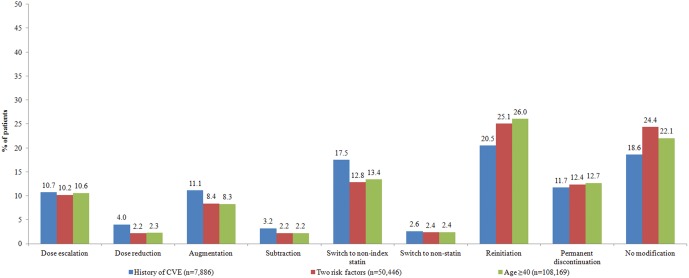
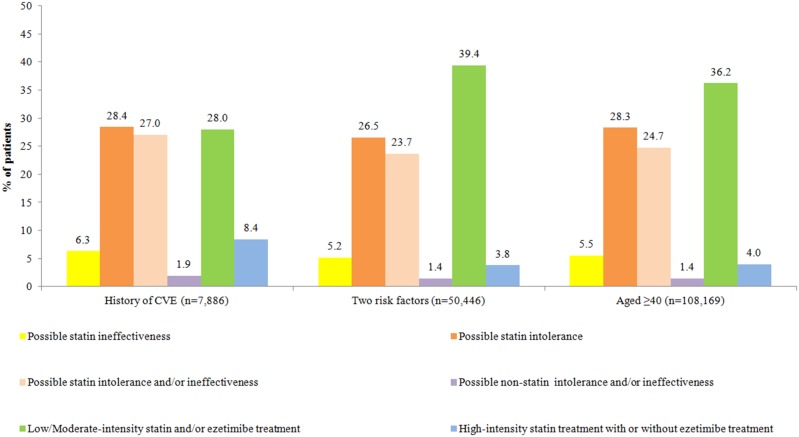
A total of 9823 (history of CVE), 62 049 (2 risk factors), and 128 691 (aged ≥40 years) patients were included. Among patients aged <65 years, 81.4% and 51.8% of those with history of CVE, 75.6% and 44.4% of those with 2 risk factors, and 77.9% and 47.1% of those aged ≥40 years had ≥1 and 2 treatment modification(s), respectively. Among all patients, 23.2-28.4% had possible statin intolerance and/or ineffectiveness issues after accounting for second treatment modification (if any).
Among patients with type 2 diabetes with high cardiovascular disease risk, index statin treatment modifications that potentially imply possible statin intolerance and/or ineffectiveness were frequent.
研究 2 型糖尿病患者起始他汀类药物和/或依折麦布治疗时的降脂治疗实际模式及其可能的不耐受和/或无效情况。
从 IMS LifeLink Pharmetrics Plus 商业索赔数据库中回顾性地确定了 2007 年 1 月 1 日至 2011 年 6 月 30 日期间起始他汀类药物和/或依折麦布的年龄≥18 岁的 2 型糖尿病成年患者。患者进一步分为 3 个高危队列:(1)有心血管事件(CVE)史;(2)有 2 个风险因素(年龄和高血压);(3)年龄≥40 岁。患者在索引他汀类药物和/或依折麦布起始日期前和后有≥1 年的持续健康计划参保。主要结局为起始他汀类药物强度、治疗调整(如果有)、可能的他汀类药物/非他汀类药物不耐受和/或无效问题(基于治疗调整类型)以及治疗调整(如果有)的时间。各队列的分析按年龄组(<65 岁和≥65 岁)分层。
共纳入 9823 例(CVE 史)、62049 例(2 个风险因素)和 128691 例(年龄≥40 岁)患者。在年龄<65 岁的患者中,有 CVE 史者中≥1 种和 2 种治疗调整的比例分别为 81.4%和 51.8%,有 2 个风险因素者中≥1 种和 2 种治疗调整的比例分别为 75.6%和 44.4%,年龄≥40 岁者中≥1 种和 2 种治疗调整的比例分别为 77.9%和 47.1%。在所有患者中,在考虑了第 2 次治疗调整(如果有)后,有 23.2%-28.4%的患者可能有他汀不耐受和/或无效问题。
在具有高心血管疾病风险的 2 型糖尿病患者中,起始他汀类药物治疗的调整很常见,这可能提示有他汀不耐受和/或无效情况。