Schär Michael, Ding Haiyan, Herzka Daniel A
Russell H. Morgan Department of Radiology and Radiological Science, Division of Magnetic Resonance Research, Johns Hopkins University, Baltimore, Maryland, United States of America; Clinical Science MRI, Philips Healthcare, Cleveland, Ohio, United States of America.
Biomedical Engineering, Johns Hopkins School of Medicine, Baltimore, Maryland, United States of America; Biomedical Engineering, Tsinghua University, Beijing, China.
PLoS One. 2015 Oct 5;10(10):e0139859. doi: 10.1371/journal.pone.0139859. eCollection 2015.
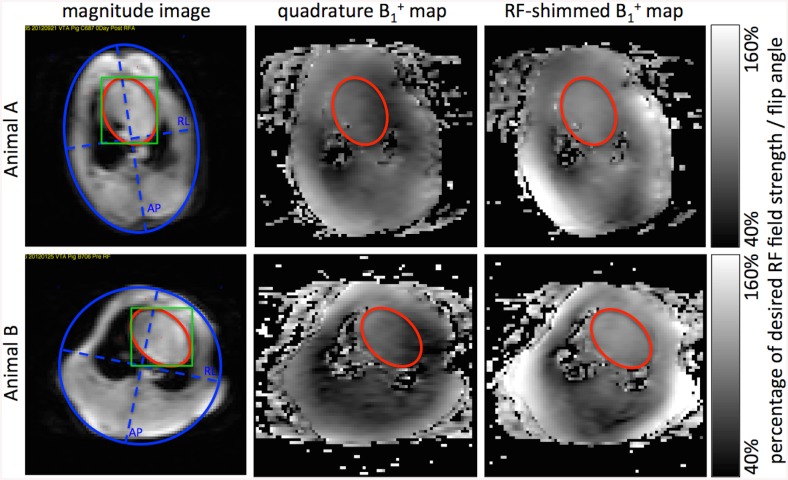
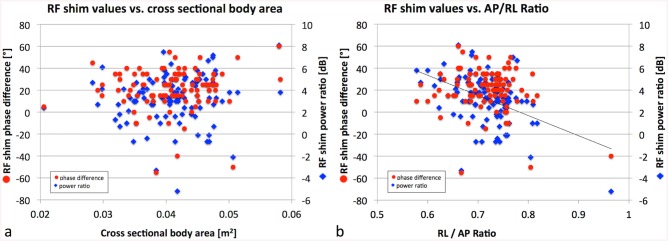
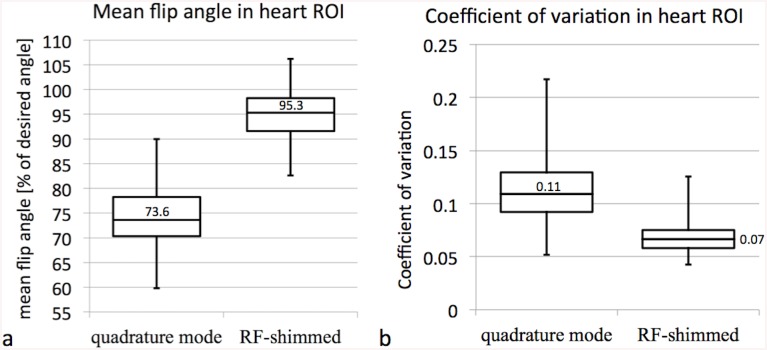
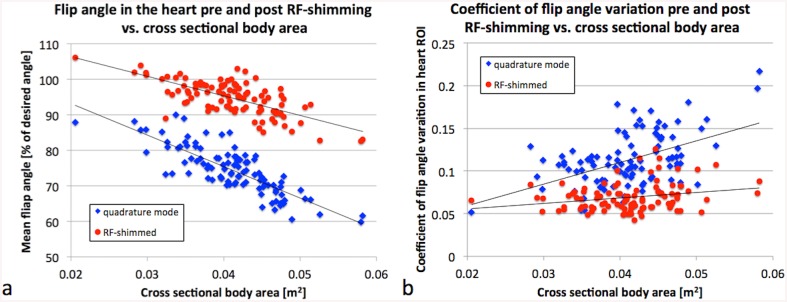
Cardiac MRI may benefit from increased polarization at high magnetic field strength of 3 Tesla but is challenged by increased field inhomogeneity. Initial human studies have shown that the radiofrequency (RF) excitation field (B1+) used for signal excitation in the heart is both inhomogeneous and significantly lower than desired, potentially leading to image artifacts and biased quantitative measures. Recently, multi-channel transmit systems have been introduced allowing localized patient specific RF shimming based on acquired calibration B1+ maps. Some prior human studies have shown lower than desired mean flip angles in the hearts of large patients even after RF shimming. Here, 100 cardiac B1+ map pairs before and after RF shimming were acquired in 55 swine. The mean flip angle and the coefficient of variation (CV) of the flip angle in the heart were determined before and after RF shimming. Mean flip angle, CV, and RF shim values (power ratio and phase difference between the two transmit channels) were tested for correlation with cross sectional body area and the Right-Left/Anterior-Posterior ratio. RF shimming significantly increased the mean flip angle in swine heart from 74.4±6.7% (mean ± standard deviation) to 94.7±4.8% of the desired flip angle and significantly reduced CV from 0.11±0.03 to 0.07±0.02 (p<<1e-10 for both). These results compare well with several previous human studies, except that the mean flip angle in the human heart only improved to 89% with RF shimming, possibly because the RF shimming routine does not consider safety constraints in very large patients. Additionally, mean flip angle decreased and CV increased with larger cross sectional body area, however, the RF shimming parameters did not correlate with cross sectional body area. RF shim power ratio correlated weakly with Right-Left/Anterior-Posterior ratio but phase difference did not, further substantiating the need for subject specific cardiac RF shimming.
心脏磁共振成像(Cardiac MRI)可能会受益于3特斯拉高磁场强度下增加的极化,但会受到场不均匀性增加的挑战。最初的人体研究表明,用于心脏信号激发的射频(RF)激发场(B1+)既不均匀,又明显低于预期,这可能会导致图像伪影和有偏差的定量测量。最近,多通道发射系统已被引入,允许基于获取的校准B1+图进行局部患者特异性RF匀场。一些先前的人体研究表明,即使在RF匀场后,大型患者心脏中的平均翻转角仍低于预期。在此,在55头猪身上获取了100对RF匀场前后的心脏B1+图。测定了RF匀场前后心脏中的平均翻转角和翻转角的变异系数(CV)。测试了平均翻转角、CV和RF匀场值(两个发射通道之间的功率比和相位差)与横截面积以及左右/前后比值的相关性。RF匀场显著提高了猪心脏中的平均翻转角,从所需翻转角的74.4±6.7%(平均值±标准差)提高到94.7±4.8%,并显著降低了CV,从0.11±0.03降至0.07±0.02(两者p均<<1e-10)。这些结果与之前的几项人体研究结果相当吻合,只是人体心脏中的平均翻转角在RF匀场后仅提高到89%,可能是因为RF匀场程序没有考虑非常大型患者的安全限制。此外,平均翻转角随着横截面积的增大而减小,CV增大,然而,RF匀场参数与横截面积不相关。RF匀场功率比与左右/前后比值弱相关,但相位差不相关,进一步证实了需要针对个体的心脏RF匀场。