Zhao Shuai, Wu Dang, Wu Pin, Wang Zhen, Huang Jian
Cancer Institute (Key Laboratory of Cancer Prevention & Intervention, National Ministry of Education; Provincial Key Laboratory of Molecular Biology in Medical Sciences), Zhejiang University, Hangzhou, China; Department of Oncology, Second Affiliated Hospital, Zhejiang University School of Medicine, Zhejiang University, Hangzhou, China.
Cancer Institute (Key Laboratory of Cancer Prevention & Intervention, National Ministry of Education; Provincial Key Laboratory of Molecular Biology in Medical Sciences), Zhejiang University, Hangzhou, China; Department of Thoracic Surgery, Second Affiliated Hospital, Zhejiang University School of Medicine, Zhejiang University, Hangzhou, China.
PLoS One. 2015 Oct 6;10(10):e0139598. doi: 10.1371/journal.pone.0139598. eCollection 2015.
IL-10 is an important immunosuppressive cytokine which is frequently elevated in tumor microenvironment. Some studies have reported that overexpression of serous IL-10 is correlated with worse outcome in patients with malignant tumor. Here, we conducted a meta-analysis to assess the prognostic impact of serous IL-10 expression in cancer patients.
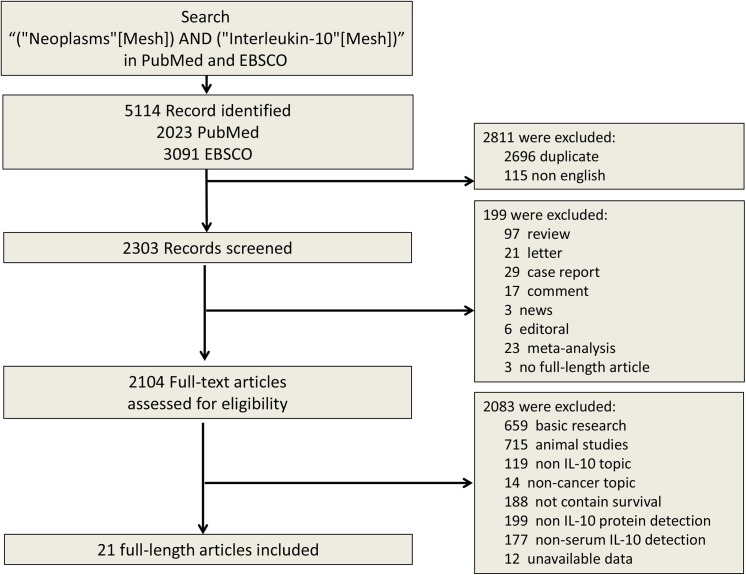
We searched PubMed and EBSCO for studies in evaluating the association of IL-10 expression-in serum and clinical outcome in cancer patients. Overall survival (OS) was the primary prognostic indicator and disease-free survival (DFS) was the secondary indicator. Extracted data were computed into odds ratios (ORs) and 95% confidence interval (CI) or a P value for survival at 1, 3 and 5 years. Pooled data were weighted using the Mantel-Haenszel Fixed-effect model. All statistical tests were two-sided.
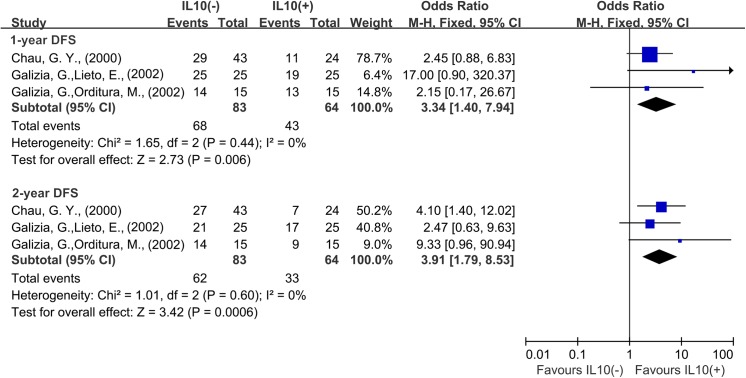
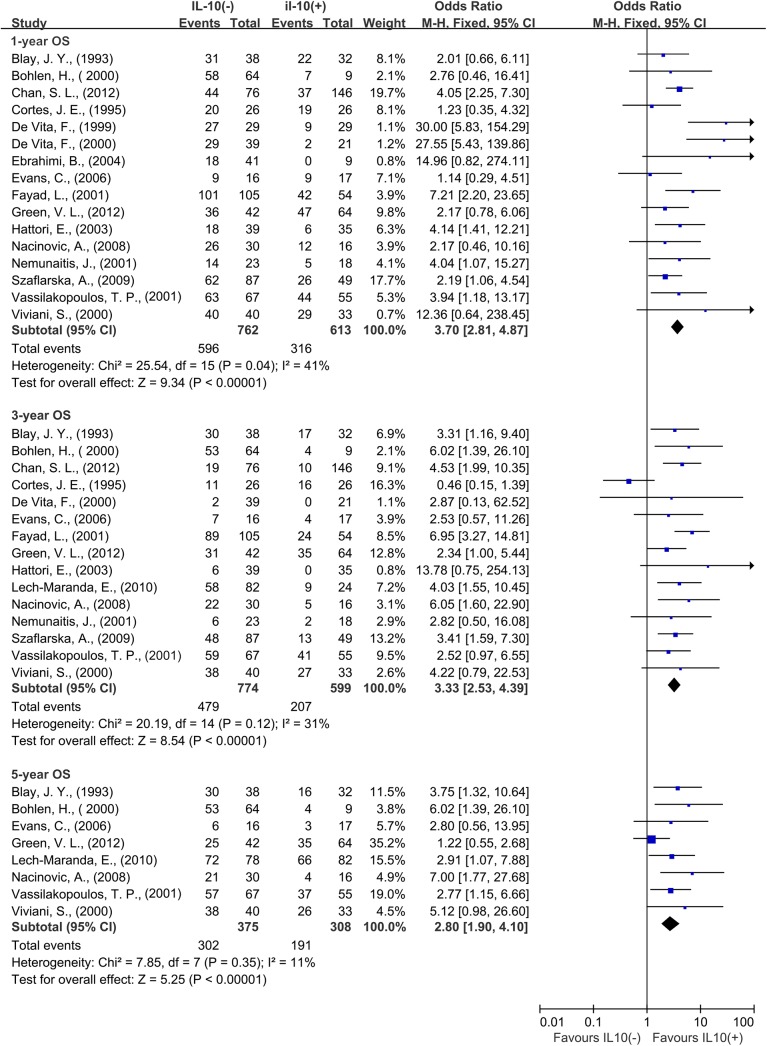
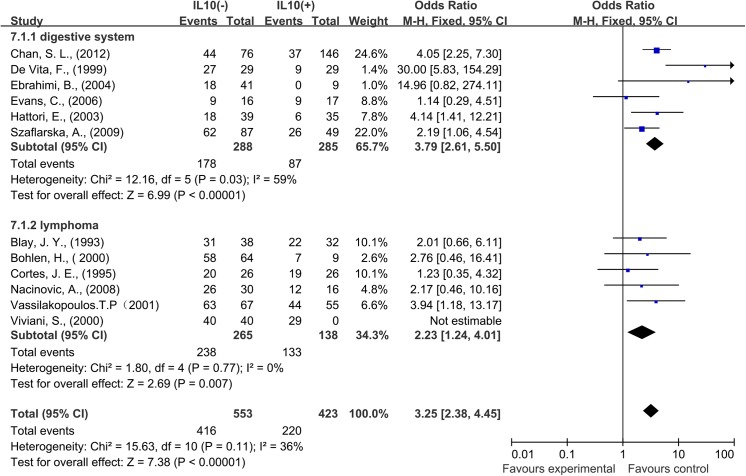
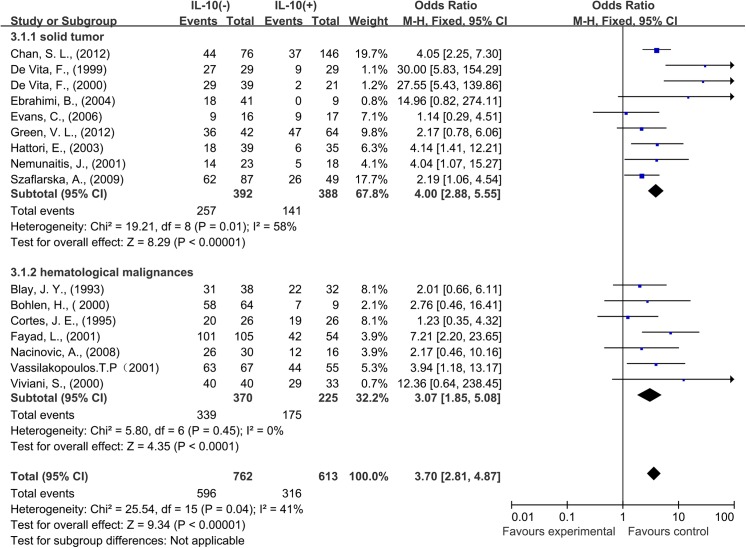
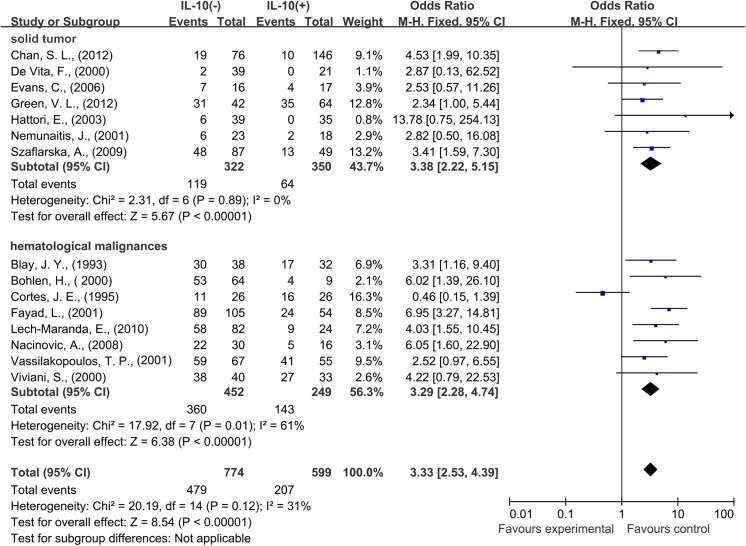
A total of 1788 patients with cancer from 21 published studies were incorporated into this meta-analysis. High level of serum IL-10 was significantly associated with worse OS at 1-year (OR = 3.70, 95% CI = 2.81 to 4.87, P < 0.00001), 3-year (OR = 3.33, 95% CI = 2.53 to 4.39, P < 0.0001) and 5-year (OR = 2.80, 95% CI = 1.90 to 4.10, P < 0.0001) of cancer. Subgroup analysis showed that the correlation between serous IL-10 expression and outcome of patients with solid tumors and hematological malignancies are consistent. The association of IL-10 with worse DFS at 1-year (OR = 3.34, 95% CI = 1.40 to 7.94, P = 0.006) and 2-year (OR = 3.91, 95% CI = 1.79 to 8.53, P = 0.0006) was also identified.
High expression of serous IL-10 leads to an adverse survival in most types of cancer. IL-10 is a valuable biomarker for prognostic prediction and targeting IL-10 treatment options for both solid tumors and hematological malignancies.
白细胞介素-10(IL-10)是一种重要的免疫抑制细胞因子,在肿瘤微环境中常升高。一些研究报道,浆液性IL-10的过表达与恶性肿瘤患者的不良预后相关。在此,我们进行了一项荟萃分析,以评估浆液性IL-10表达对癌症患者的预后影响。
我们在PubMed和EBSCO中检索了评估IL-10在血清中的表达与癌症患者临床结局之间关联的研究。总生存期(OS)是主要的预后指标,无病生存期(DFS)是次要指标。将提取的数据计算为比值比(OR)和95%置信区间(CI)或1、3和5年生存率的P值。使用Mantel-Haenszel固定效应模型对汇总数据进行加权分析。所有统计检验均为双侧检验。
本荟萃分析纳入了来自21项已发表研究的1788例癌症患者。血清IL-10水平升高与癌症患者1年(OR = 3.70,95% CI = 2.81至4.87,P < 0.00001)、3年(OR = 3.33,95% CI = 2.53至4.39,P < 0.0001)和5年(OR = 2.80,95% CI = 1.90至4.10,P < 0.0001)的较差总生存期显著相关。亚组分析表明,浆液性IL-10表达与实体瘤和血液系统恶性肿瘤患者结局之间的相关性是一致的。还发现IL-10与1年(OR = 3.34,95% CI = 1.40至7.94,P = 0.006)和2年(OR = 3.91,95% CI = 1.79至8.53,P = 0.0006)的较差无病生存期相关。
浆液性IL-10的高表达导致大多数类型癌症患者的生存预后不良。IL-10是一种有价值的预后预测生物标志物,也是实体瘤和血液系统恶性肿瘤的IL-10靶向治疗选择。