Trevisan Flavio, Oliveira Vanessa F, Carvalho Maria A M, Gaspar Marília
Núcleo de Pesquisa em Fisiologia e Bioquímica, Instituto de Botânica São Paulo, Brazil ; Instituto Federal de São Paulo, Campus São Roque São Roque, Brazil.
Núcleo de Pesquisa em Fisiologia e Bioquímica, Instituto de Botânica São Paulo, Brazil ; Núcleo de Ciências da Saúde, Universidade de Mogi das Cruzes São Paulo, Brazil.
Front Plant Sci. 2015 Sep 7;6:681. doi: 10.3389/fpls.2015.00681. eCollection 2015.
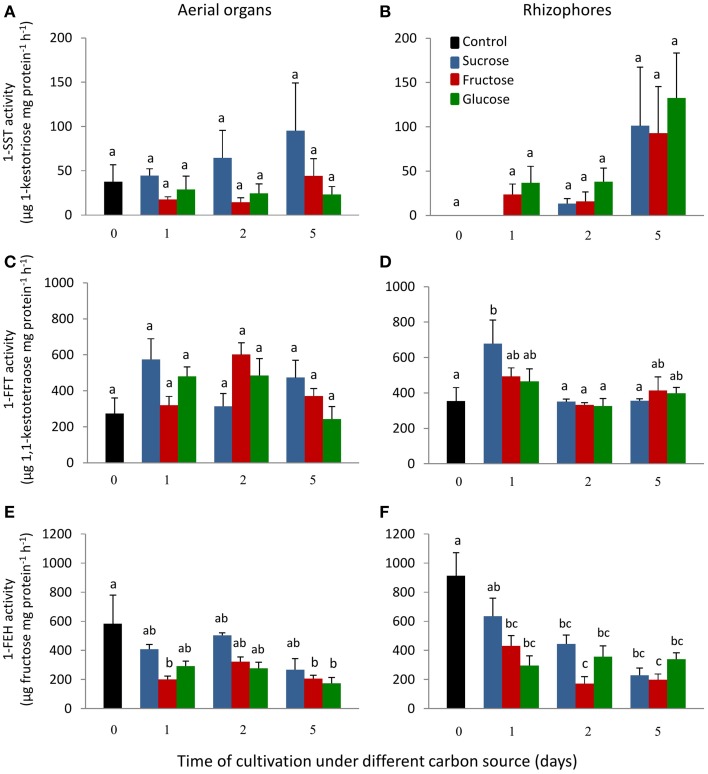
Chrysolaena obovata (Less.) Dematt., previously named Vernonia herbacea, is an Asteraceae native to the Cerrado which accumulates about 80% of the rhizophore dry mass as inulin-type fructans. Considering its high inulin production and the wide application of fructans, a protocol for C. obovata in vitro culture was recently established. Carbohydrates are essential for in vitro growth and development of plants and can also act as signaling molecules involved in cellular adjustments and metabolic regulation. This work aimed to evaluate the effect of different sources of carbohydrate on fructan metabolism in plants grown in vitro. For this purpose, C. obovata plants cultivated in vitro were submitted to carbon deprivation and transferred to MS medium supplemented with sucrose, glucose or fructose. Following, their fructan composition and activity and expression of genes encoding enzymes for fructan synthesis (1-SST and 1-FFT) and degradation (1-FEH) were evaluated. For qRT-PCR analysis partial cDNA sequences corresponding to two different C. obovata genes, 1-SST and 1-FFT, were isolated. As expected, C. obovata sequences showed highest sequence identity to other Asteraceae 1-SST and 1-FFT, than to Poaceae related proteins. A carbon deficit treatment stimulated the transcription of the gene 1-FEH and inhibited 1-SST and 1-FFT and carbohydrate supplementation promoted reversal of the expression profile of these genes. With the exception of 1-FFT, a positive correlation between enzyme activity and gene expression was observed. The overall results indicate that sucrose, fructose and glucose act similarly on fructan metabolism and that 1-FEH and 1-SST are transcriptionally regulated by sugar in this species. Cultivation of plants in increasing sucrose concentrations stimulated synthesis and inhibited fructan mobilization, and induced a distinct pattern of enzyme activity for 1-SST and 1-FFT, indicating the existence of a mechanism for differential regulation between them.
倒卵形金腰箭(Chrysolaena obovata (Less.) Dematt.,之前名为草本斑鸠菊(Vernonia herbacea))是菊科植物,原产于巴西塞拉多地区,其根状茎干重的约80%为菊糖型果聚糖。鉴于其菊糖产量高以及果聚糖的广泛应用,最近建立了倒卵形金腰箭的离体培养方案。碳水化合物对于植物的离体生长和发育至关重要,并且还可作为参与细胞调节和代谢调控的信号分子。本研究旨在评估不同碳水化合物来源对离体培养植物果聚糖代谢的影响。为此,将离体培养的倒卵形金腰箭植株进行碳饥饿处理,然后转移至添加蔗糖、葡萄糖或果糖的MS培养基中。随后,评估其果聚糖组成、活性以及编码果聚糖合成酶(1-SST和1-FFT)和降解酶(1-FEH)的基因表达。为进行qRT-PCR分析,分离了与倒卵形金腰箭两个不同基因1-SST和1-FFT对应的部分cDNA序列。正如预期的那样,倒卵形金腰箭序列与其他菊科植物的1-SST和1-FFT的序列同一性最高,高于与禾本科相关蛋白的序列同一性。碳缺乏处理刺激了1-FEH基因的转录,抑制了1-SST和1-FFT基因的转录,而碳水化合物补充促进了这些基因表达谱的逆转。除1-FFT外,观察到酶活性与基因表达之间呈正相关。总体结果表明,蔗糖、果糖和葡萄糖对果聚糖代谢的作用相似,并且在该物种中1-FEH和1-SST受糖的转录调控。在蔗糖浓度增加的条件下培养植物刺激了果聚糖的合成并抑制了果聚糖的动员,并诱导了1-SST和1-FFT不同的酶活性模式,表明它们之间存在差异调节机制。