• 文献检索
  • 文档翻译
  • 深度研究
  • 学术资讯
  • Suppr Zotero 插件Zotero 插件
  • 邀请有礼
  • 套餐&价格
  • 历史记录
应用&插件
Suppr Zotero 插件Zotero 插件浏览器插件Mac 客户端Windows 客户端微信小程序
定价
高级版会员购买积分包购买API积分包
服务
文献检索文档翻译深度研究API 文档MCP 服务
关于我们
关于 Suppr公司介绍联系我们用户协议隐私条款
关注我们

Suppr 超能文献

核心技术专利:CN118964589B侵权必究
粤ICP备2023148730 号-1Suppr @ 2026

文献检索

告别复杂PubMed语法,用中文像聊天一样搜索,搜遍4000万医学文献。AI智能推荐,让科研检索更轻松。

立即免费搜索

文件翻译

保留排版,准确专业,支持PDF/Word/PPT等文件格式,支持 12+语言互译。

免费翻译文档

深度研究

AI帮你快速写综述,25分钟生成高质量综述,智能提取关键信息,辅助科研写作。

立即免费体验

视觉线索训练改善中风后步行适应性的可行性和初步疗效:多中心、单盲随机对照试验

Feasibility and Preliminary Efficacy of Visual Cue Training to Improve Adaptability of Walking after Stroke: Multi-Centre, Single-Blind Randomised Control Pilot Trial.

作者信息

Hollands Kristen L, Pelton Trudy A, Wimperis Andrew, Whitham Diane, Tan Wei, Jowett Sue, Sackley Catherine M, Wing Alan M, Tyson Sarah F, Mathias Jonathan, Hensman Marianne, van Vliet Paulette M

机构信息

School of Health Sciences, University of Salford, Allerton Building, Salford, M6 6PU, United Kingdom.

Colleges of Life and Environmental Sciences, University of Birmingham, Edgbaston, Birmingham, B15 2TT, United Kingdom.

出版信息

PLoS One. 2015 Oct 7;10(10):e0139261. doi: 10.1371/journal.pone.0139261. eCollection 2015.

DOI:10.1371/journal.pone.0139261
PMID:26445137
原文链接:https://pmc.ncbi.nlm.nih.gov/articles/PMC4596478/
Abstract

OBJECTIVES

Given the importance of vision in the control of walking and evidence indicating varied practice of walking improves mobility outcomes, this study sought to examine the feasibility and preliminary efficacy of varied walking practice in response to visual cues, for the rehabilitation of walking following stroke.

DESIGN

This 3 arm parallel, multi-centre, assessor blind, randomised control trial was conducted within outpatient neurorehabilitation services.

PARTICIPANTS

Community dwelling stroke survivors with walking speed <0.8m/s, lower limb paresis and no severe visual impairments.

INTERVENTION

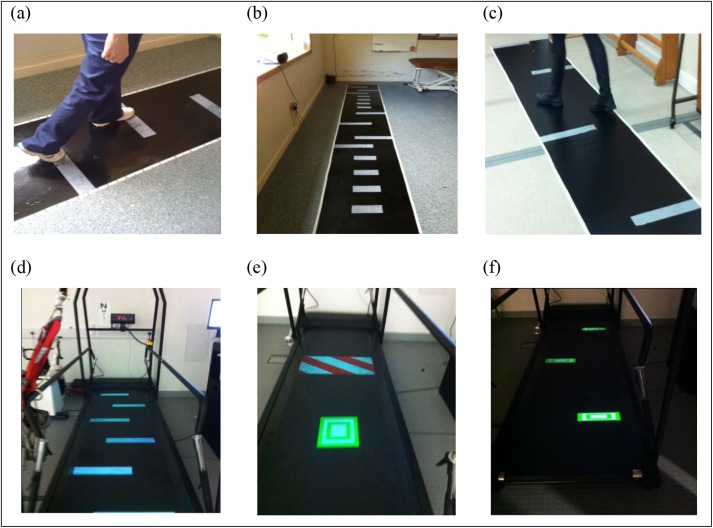
Over-ground visual cue training (O-VCT), Treadmill based visual cue training (T-VCT), and Usual care (UC) delivered by physiotherapists twice weekly for 8 weeks.

MAIN OUTCOME MEASURES

Participants were randomised using computer generated random permutated balanced blocks of randomly varying size. Recruitment, retention, adherence, adverse events and mobility and balance were measured before randomisation, post-intervention and at four weeks follow-up.

RESULTS

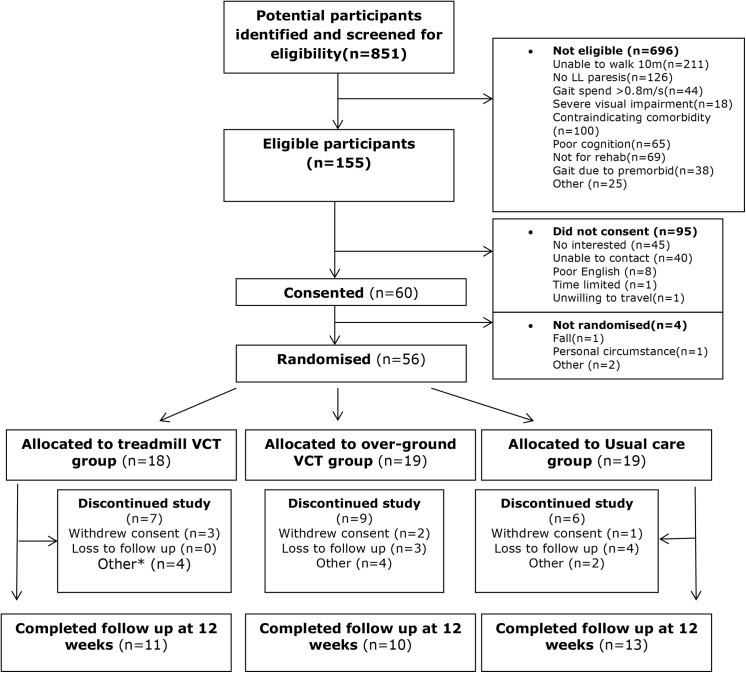
Fifty-six participants participated (18 T-VCT, 19 O-VCT, 19 UC). Thirty-four completed treatment and follow-up assessments. Of the participants that completed, adherence was good with 16 treatments provided over (median of) 8.4, 7.5 and 9 weeks for T-VCT, O-VCT and UC respectively. No adverse events were reported. Post-treatment improvements in walking speed, symmetry, balance and functional mobility were seen in all treatment arms.

CONCLUSIONS

Outpatient based treadmill and over-ground walking adaptability practice using visual cues are feasible and may improve mobility and balance. Future studies should continue a carefully phased approach using identified methods to improve retention.

TRIAL REGISTRATION

Clinicaltrials.gov NCT01600391.

摘要

目的

鉴于视觉在步行控制中的重要性,且有证据表明多样化的步行练习可改善运动能力结果,本研究旨在探讨响应视觉提示进行多样化步行练习对中风后步行康复的可行性和初步疗效。

设计

本三臂平行、多中心、评估者盲法随机对照试验在门诊神经康复服务机构内进行。

参与者

社区居住的中风幸存者,步行速度<0.8m/s,下肢轻瘫且无严重视力障碍。

干预

由物理治疗师每周两次进行为期8周的地面视觉提示训练(O-VCT)、基于跑步机的视觉提示训练(T-VCT)和常规护理(UC)。

主要结局指标

使用计算机生成的随机排列平衡块对参与者进行随机分组,随机块大小随机变化。在随机分组前、干预后和四周随访时测量招募、留存、依从性、不良事件以及运动能力和平衡情况。

结果

56名参与者参与研究(18名接受T-VCT,19名接受O-VCT,19名接受UC)。34名完成了治疗和随访评估。在完成研究的参与者中,依从性良好,T-VCT、O-VCT和UC分别在(中位数)8.4周、7.5周和9周内提供了16次治疗。未报告不良事件。所有治疗组在治疗后步行速度、对称性、平衡和功能性移动能力均有改善。

结论

基于门诊的使用视觉提示的跑步机和地面步行适应性练习是可行的,可能会改善运动能力和平衡。未来的研究应继续采用已确定的方法,谨慎地分阶段进行,以提高留存率。

试验注册

Clinicaltrials.gov NCT01600391

https://cdn.ncbi.nlm.nih.gov/pmc/blobs/1faa/4596478/e9f2377597f9/pone.0139261.g002.jpg
https://cdn.ncbi.nlm.nih.gov/pmc/blobs/1faa/4596478/278e27c6df52/pone.0139261.g001.jpg
https://cdn.ncbi.nlm.nih.gov/pmc/blobs/1faa/4596478/e9f2377597f9/pone.0139261.g002.jpg
https://cdn.ncbi.nlm.nih.gov/pmc/blobs/1faa/4596478/278e27c6df52/pone.0139261.g001.jpg
https://cdn.ncbi.nlm.nih.gov/pmc/blobs/1faa/4596478/e9f2377597f9/pone.0139261.g002.jpg

相似文献

1
Feasibility and Preliminary Efficacy of Visual Cue Training to Improve Adaptability of Walking after Stroke: Multi-Centre, Single-Blind Randomised Control Pilot Trial.视觉线索训练改善中风后步行适应性的可行性和初步疗效:多中心、单盲随机对照试验
PLoS One. 2015 Oct 7;10(10):e0139261. doi: 10.1371/journal.pone.0139261. eCollection 2015.
2
Visual cue training to improve walking and turning after stroke: a study protocol for a multi-centre, single blind randomised pilot trial.视觉线索训练改善中风后行走与转身能力:一项多中心、单盲随机试点试验的研究方案
Trials. 2013 Sep 3;14:276. doi: 10.1186/1745-6215-14-276.
3
Visually-guided gait training in paretic patients during the first rehabilitation phase: study protocol for a randomized controlled trial.首次康复阶段对偏瘫患者进行视觉引导步态训练:一项随机对照试验的研究方案
Trials. 2016 Oct 27;17(1):523. doi: 10.1186/s13063-016-1630-8.
4
Effects of circuit training as alternative to usual physiotherapy after stroke: randomised controlled trial.脑卒中后替代常规物理治疗的循环训练效果:随机对照试验。
BMJ. 2012 May 10;344:e2672. doi: 10.1136/bmj.e2672.
5
Physical Fitness Training in Patients with Subacute Stroke (PHYS-STROKE): multicentre, randomised controlled, endpoint blinded trial.亚急性脑卒中患者的体能训练研究(PHYS-STROKE):一项多中心、随机对照、终点盲法试验。
BMJ. 2019 Sep 18;366:l5101. doi: 10.1136/bmj.l5101.
6
Turning-based treadmill training improves turning performance and gait symmetry after stroke.基于回合的跑步机训练可改善脑卒中后的转弯表现和步态对称性。
Neurorehabil Neural Repair. 2014 Jan;28(1):45-55. doi: 10.1177/1545968313497102. Epub 2013 Jul 29.
7
Walking adaptability therapy after stroke: study protocol for a randomized controlled trial.中风后步行适应性治疗:一项随机对照试验的研究方案
Trials. 2016 Aug 26;17(1):425. doi: 10.1186/s13063-016-1527-6.
8
Ballistic strength training compared with usual care for improving mobility following traumatic brain injury: protocol for a randomised, controlled trial.弹道强度训练与常规护理对改善颅脑损伤后活动能力的比较:一项随机对照试验的方案。
J Physiother. 2016 Jul;62(3):164. doi: 10.1016/j.jphys.2016.04.003. Epub 2016 Jun 16.
9
Wristband Accelerometers to motiVate arm Exercise after Stroke (WAVES): study protocol for a pilot randomized controlled trial.腕带式加速度计促进卒中后手臂运动(WAVES):一项试点随机对照试验的研究方案
Trials. 2016 Oct 21;17(1):508. doi: 10.1186/s13063-016-1628-2.
10
How to improve walking, balance and social participation following stroke: a comparison of the long term effects of two walking aids--canes and an orthosis TheraTogs--on the recovery of gait following acute stroke. A study protocol for a multi-centre, single blind, randomised control trial.如何改善中风后的行走、平衡和社交参与能力:两种助行器——手杖和矫形器 TheraTogs——对急性中风后步态恢复的长期效果比较。一项多中心、单盲、随机对照试验的研究方案。
BMC Neurol. 2012 Mar 30;12:18. doi: 10.1186/1471-2377-12-18.

引用本文的文献

1
A scoping review of the applications of augmented reality in nursing.增强现实技术在护理领域应用的范围综述
BMC Nurs. 2025 Aug 23;24(1):1105. doi: 10.1186/s12912-025-03750-1.
2
Mode of locomotion and other determinants of navigation ability post-stroke.中风后运动方式及其他导航能力的决定因素
Neuropsychol Rehabil. 2025 Apr 17:1-28. doi: 10.1080/09602011.2025.2490802.
3
The Reliability and Validity of the OneStep Smartphone Application for Gait Analysis among Patients Undergoing Rehabilitation for Unilateral Lower Limb Disability.

本文引用的文献

1
Walking adaptability after a stroke and its assessment in clinical settings.中风后的行走适应性及其在临床环境中的评估。
Stroke Res Treat. 2014;2014:591013. doi: 10.1155/2014/591013. Epub 2014 Aug 28.
2
Feasibility and potential efficacy of high-intensity stepping training in variable contexts in subacute and chronic stroke.高强度阶梯训练在亚急性和慢性卒中不同情境下的可行性及潜在疗效
Neurorehabil Neural Repair. 2014 Sep;28(7):643-51. doi: 10.1177/1545968314521001. Epub 2014 Feb 10.
3
Treadmill training and body weight support for walking after stroke.
《用于单侧下肢残疾康复患者步态分析的 OneStep 智能手机应用的信度和效度》。
Sensors (Basel). 2024 Jun 2;24(11):3594. doi: 10.3390/s24113594.
4
Age-related effects of repeated task switching in a novel voluntary gait adaptability task.重复任务切换对新颖的自愿步态适应能力任务的年龄相关影响。
Exp Brain Res. 2023 Jun;241(6):1533-1542. doi: 10.1007/s00221-023-06623-8. Epub 2023 Apr 26.
5
Comparative efficacy of gait training for balance outcomes in patients with stroke: A systematic review and network meta-analysis.中风患者步态训练对平衡结果的比较疗效:一项系统评价和网状Meta分析。
Front Neurol. 2023 Apr 3;14:1093779. doi: 10.3389/fneur.2023.1093779. eCollection 2023.
6
Gait rehabilitation for foot and ankle impairments in early rheumatoid arthritis: a feasibility study of a new gait rehabilitation programme (GREAT Strides).早期类风湿性关节炎足踝功能障碍的步态康复:一项新的步态康复计划(大步向前)的可行性研究
Pilot Feasibility Stud. 2022 May 30;8(1):115. doi: 10.1186/s40814-022-01061-9.
7
Irregular Metronomes as Assistive Devices to Promote Healthy Gait Patterns.不规则节拍器作为促进健康步态模式的辅助设备。
IEEE Consum Commun Netw Conf. 2021 Jan;2021. doi: 10.1109/ccnc49032.2021.9369490. Epub 2021 Mar 11.
8
Gait complexity is acutely restored in older adults when walking to a fractal-like visual stimulus.当老年人走向分形样的视觉刺激时,其步态复杂性会得到明显恢复。
Hum Mov Sci. 2020 Dec;74:102677. doi: 10.1016/j.humov.2020.102677. Epub 2020 Oct 15.
9
Environmental and behavioural interventions for reducing physical activity limitation and preventing falls in older people with visual impairment.减少视力障碍老年人身体活动受限及预防跌倒的环境与行为干预措施
Cochrane Database Syst Rev. 2020 Sep 3;9(9):CD009233. doi: 10.1002/14651858.CD009233.pub3.
10
Auditory and Visual External Cues Have Different Effects on Spatial but Similar Effects on Temporal Measures of Gait Variability.听觉和视觉外部线索对步态变异性的空间指标有不同影响,但对时间指标有相似影响。
Front Physiol. 2020 Feb 11;11:67. doi: 10.3389/fphys.2020.00067. eCollection 2020.
中风后步行的跑步机训练和体重支持
Cochrane Database Syst Rev. 2014 Jan 23;2014(1):CD002840. doi: 10.1002/14651858.CD002840.pub3.
4
Visual cue training to improve walking and turning after stroke: a study protocol for a multi-centre, single blind randomised pilot trial.视觉线索训练改善中风后行走与转身能力:一项多中心、单盲随机试点试验的研究方案
Trials. 2013 Sep 3;14:276. doi: 10.1186/1745-6215-14-276.
5
Step by step: a proof of concept study of C-Mill gait adaptability training in the chronic phase after stroke.一步一步:一项在脑卒中慢性期使用 C-Mill 步态适应训练的概念验证研究。
J Rehabil Med. 2013 Jul;45(7):616-22. doi: 10.2340/16501977-1180.
6
Randomized trial of treadmill training to improve walking in community-dwelling people after stroke: the AMBULATE trial.社区居住的脑卒中患者经跑步机训练改善步行能力的随机试验:AMBULATE 试验。
Int J Stroke. 2013 Aug;8(6):436-44. doi: 10.1111/j.1747-4949.2012.00934.x. Epub 2013 Mar 7.
7
Newly acquired fear of falling leads to altered eye movement patterns and reduced stepping safety: a case study.新获得的恐摔倾向导致眼球运动模式改变和步态安全降低:案例研究。
PLoS One. 2012;7(11):e49765. doi: 10.1371/journal.pone.0049765. Epub 2012 Nov 21.
8
Deficits in motor response to avoid sudden obstacles during gait in functional walkers poststroke.脑卒中后功能性步行者在行走过程中对突发障碍物的回避运动反应缺陷。
Neurorehabil Neural Repair. 2013 Mar-Apr;27(3):230-9. doi: 10.1177/1545968312462070. Epub 2012 Oct 16.
9
Restoring voluntary control of locomotion after paralyzing spinal cord injury.恢复瘫痪性脊髓损伤后的自主运动控制。
Science. 2012 Jun 1;336(6085):1182-5. doi: 10.1126/science.1217416.
10
Variability in step training enhances locomotor recovery after a spinal cord injury.步训中的变异性增强了脊髓损伤后的运动功能恢复。
Eur J Neurosci. 2012 Jul;36(1):2054-62. doi: 10.1111/j.1460-9568.2012.08106.x. Epub 2012 May 16.