Mokadem Mohamad, Zechner Juliet F, Uchida Aki, Aguirre Vincent
Fraternal Order of Eagles Diabetes Research Center, Roy J. and Lucille A. Carver College of Medicine, University of Iowa, Iowa City, Iowa, 52242, United States of America; Division of Gastroenterology and Hepatology, Department of Internal Medicine, Roy J. and Lucille A. Carver College of Medicine, University of Iowa, Iowa City, Iowa, 52242, United States of America.
Division of Hypothalamic Research, Department of Internal Medicine, UT Southwestern Medical Center, Dallas, Texas, 75390, United States of America; Division of Digestive and Liver Diseases, Department of Internal Medicine, UT Southwestern Medical Center, Dallas, Texas, 75390, United States of America.
PLoS One. 2015 Oct 7;10(10):e0139960. doi: 10.1371/journal.pone.0139960. eCollection 2015.
BACKGROUND & AIMS: Leptin, the protein product of the ob gene, increases energy expenditure and reduces food intake, thereby promoting weight reduction. Leptin also regulates glucose homeostasis and hepatic insulin sensitivity via hypothalamic proopiomelanocortin neurons in mice. Roux-en-Y gastric bypass (RYGB) induces weight loss that is substantial and sustained despite reducing plasma leptin levels. In addition, patients who fail to undergo diabetes remission after RYGB are hypoletinemic compared to those who do and to lean controls. We have previously demonstrated that the beneficial effects of RYGB in mice require the melanocortin-4 receptor, a downstream effector of leptin action. Based on these observations, we hypothesized that leptin is required for sustained weight reduction and improved glucose homeostasis observed after RYGB.
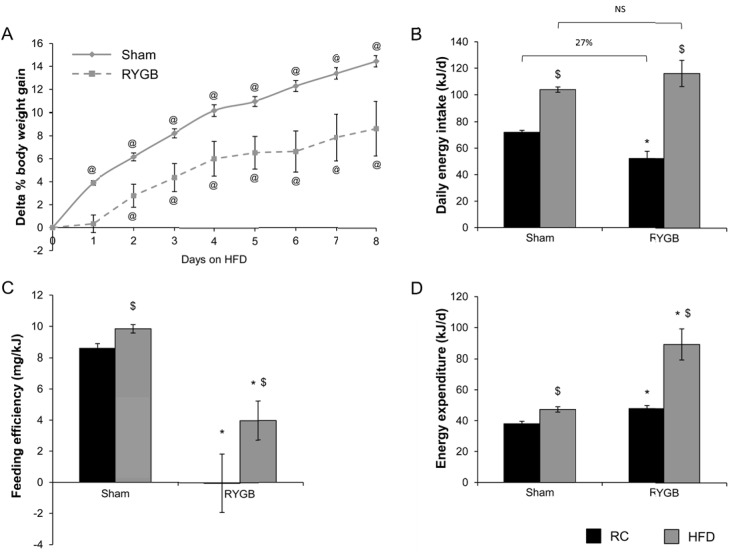
To investigate this hypothesis, we performed RYGB or sham operations on leptin-deficient ob/ob mice maintained on regular chow. To investigate whether leptin is involved in post-RYGB weight maintenance, we challenged post-surgical mice with high fat diet.
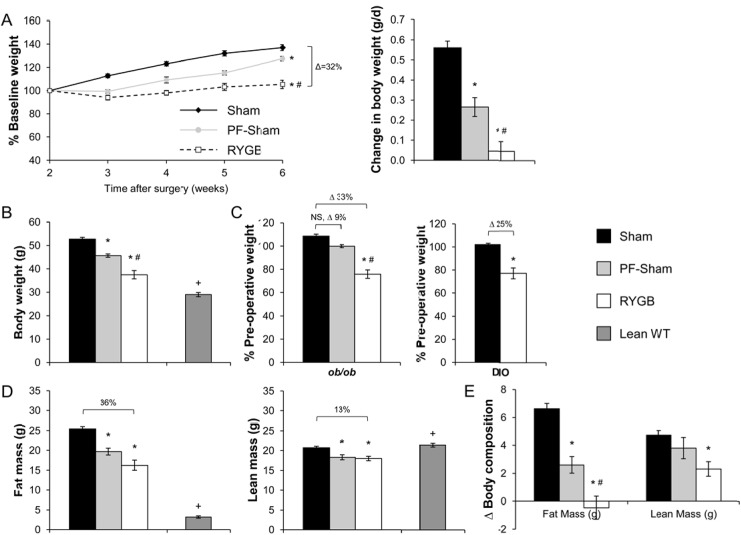
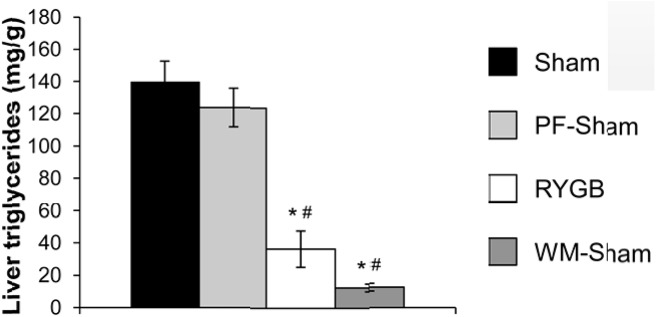
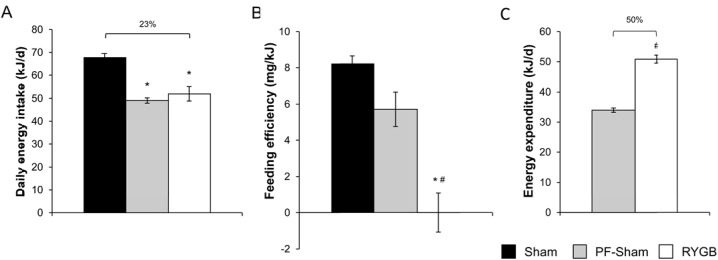
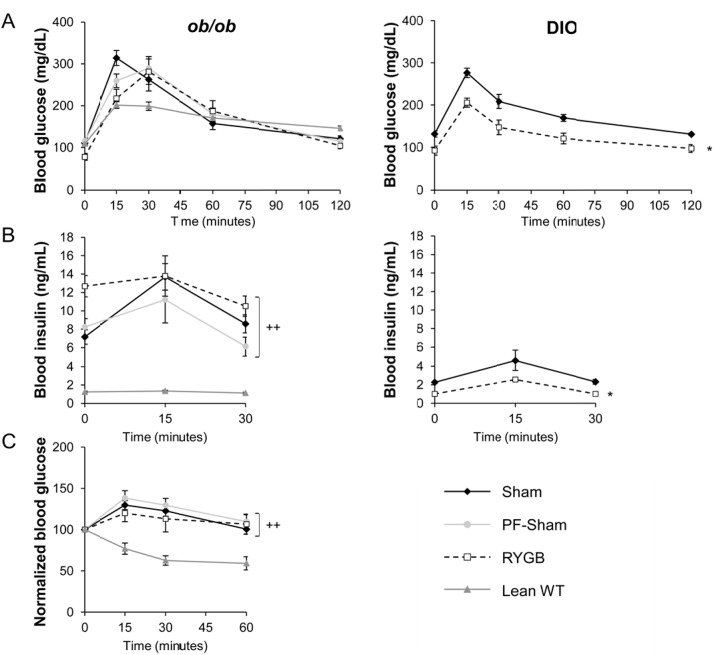
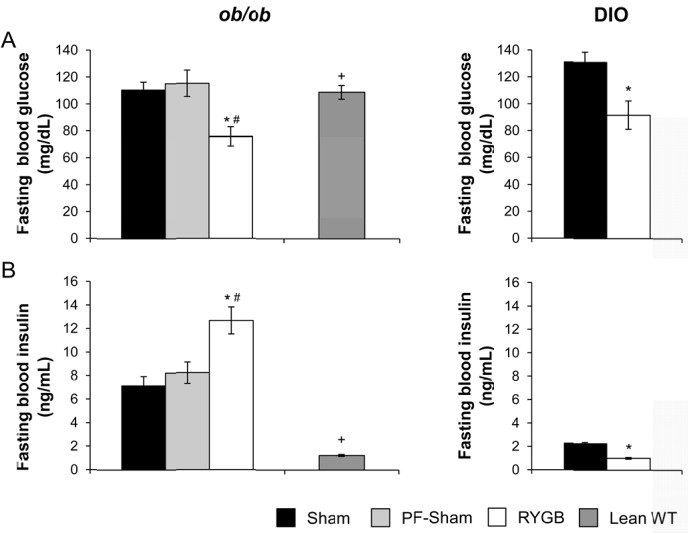
RYGB reduced total body weight, fat and lean mass and caused reduction in calorie intake in ob/ob mice. However, it failed to improve glucose tolerance, glucose-stimulated plasma insulin, insulin tolerance, and fasting plasma insulin. High fat diet eliminated the reduction in calorie intake observed after RYGB in ob/ob mice and promoted weight regain, although not to the same extent as in sham-operated mice. We conclude that leptin is required for the effects of RYGB on glucose homeostasis but not body weight or composition in mice. Our data also suggest that leptin may play a role in post-RYGB weight maintenance.
瘦素是肥胖基因的蛋白质产物,可增加能量消耗并减少食物摄入,从而促进体重减轻。在小鼠中,瘦素还通过下丘脑阿片-促黑素细胞皮质素原神经元调节葡萄糖稳态和肝脏胰岛素敏感性。尽管血浆瘦素水平降低,但Roux-en-Y胃旁路术(RYGB)仍能显著且持续地减轻体重。此外,与成功实现糖尿病缓解的患者以及瘦素对照组相比,RYGB术后未能实现糖尿病缓解的患者瘦素水平较低。我们之前已经证明,RYGB对小鼠有益的作用需要黑素皮质素-4受体,这是瘦素作用的下游效应器。基于这些观察结果,我们推测瘦素是RYGB术后持续减轻体重和改善葡萄糖稳态所必需的。
为了研究这一假设,我们对喂食常规饲料的瘦素缺乏型ob/ob小鼠进行了RYGB手术或假手术。为了研究瘦素是否参与RYGB术后的体重维持,我们用高脂饮食对术后小鼠进行了挑战。
RYGB降低了ob/ob小鼠的总体重、脂肪和瘦体重,并导致卡路里摄入量减少。然而,它未能改善葡萄糖耐量、葡萄糖刺激的血浆胰岛素水平、胰岛素耐量和空腹血浆胰岛素水平。高脂饮食消除了RYGB术后ob/ob小鼠卡路里摄入量的减少,并促进了体重反弹,尽管程度不如假手术小鼠。我们得出结论,瘦素是RYGB对小鼠葡萄糖稳态产生影响所必需的,但对体重或身体组成并无影响。我们的数据还表明,瘦素可能在RYGB术后的体重维持中发挥作用。