Beirer Marc, Crönlein Moritz, Venjakob Arne J, Saier Tim, Schmitt-Sody Marcus, Huber-Wagner Stefan, Biberthaler Peter, Kirchhoff Chlodwig
Department of Trauma Surgery, Klinikum rechts der Isar, Technical University of Munich, Ismaningerstrasse 22, 81675, Munich, Germany.
Berufsgenossenschaftliche Unfallklinik Murnau, Murnau am Staffelsee, Germany.
Eur J Med Res. 2015 Oct 7;20:82. doi: 10.1186/s40001-015-0178-5.
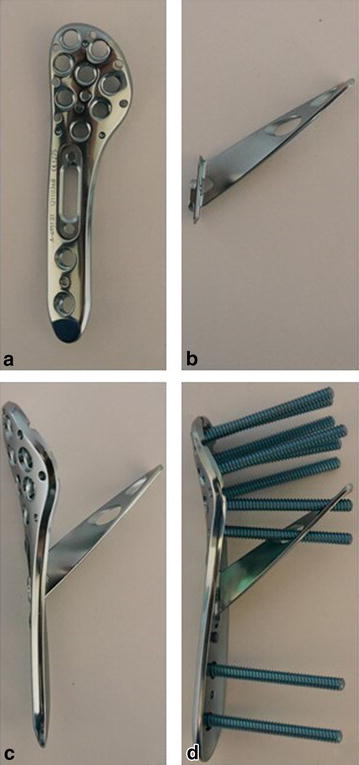
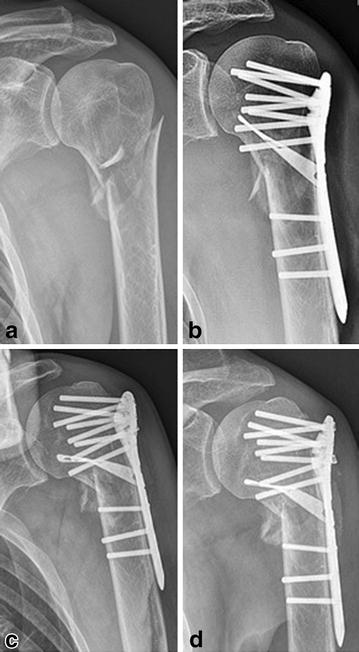
Locking plate fixation of displaced fractures of the proximal humerus is still accompanied by a distinct complication rate, especially in case of osteoporotic bone, short-segment fracture length and comminution of the medial calcar. Secondary loss of reduction leading to varus deformity and screw cutout most frequently lead to surgical revision. The aim of the present study was to evaluate the clinical and radiological outcome of a recently developed polyaxial locking plate that allows for the additional placement of a helical blade device, aiming for support of the medial calcar.
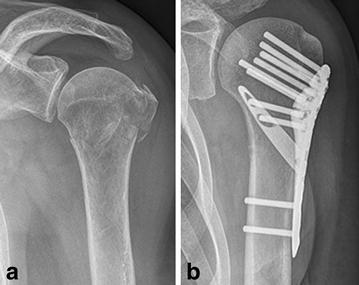
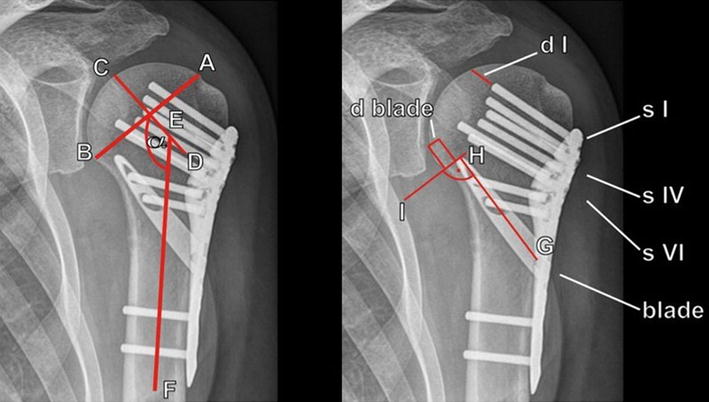
In this prospective study, 17 patients with a mean age of 63.0 ± 16.0 years suffering from displaced fractures of the proximal humerus (Neer type two-, three- and four-part) were enrolled. All patients were surgically treated using a polyaxial locking plate with additional blade device (group PAB, n = 12) or without blade device (group PA, n = 5). Functional outcome was recorded using the Munich Shoulder Questionnaire allowing for qualitative self-assessment of the Shoulder Pain and Disability Index (SPADI), the Disability of the Arm, Shoulder and Hand (DASH score) and the Constant Score. Radiological outcome was assessed by analyzing standardized true anterior-posterior and outlet-view radiographs with respect to radiographic evidence of secondary varus displacement, cutout of screws and hardware failure. Results were compared to an age-, gender- and fracture type-matched collective treated by monoaxial locking plate fixation (group MA, n = 15).
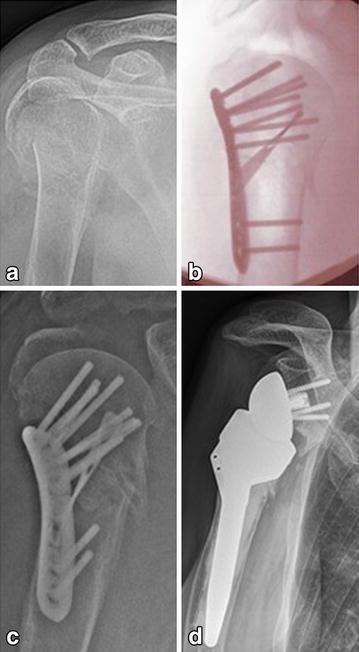
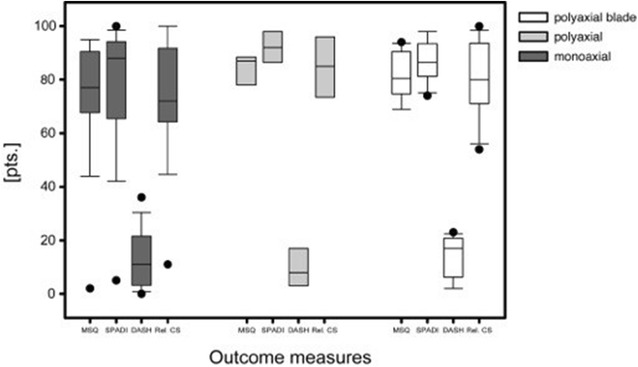
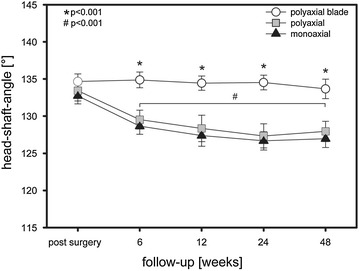
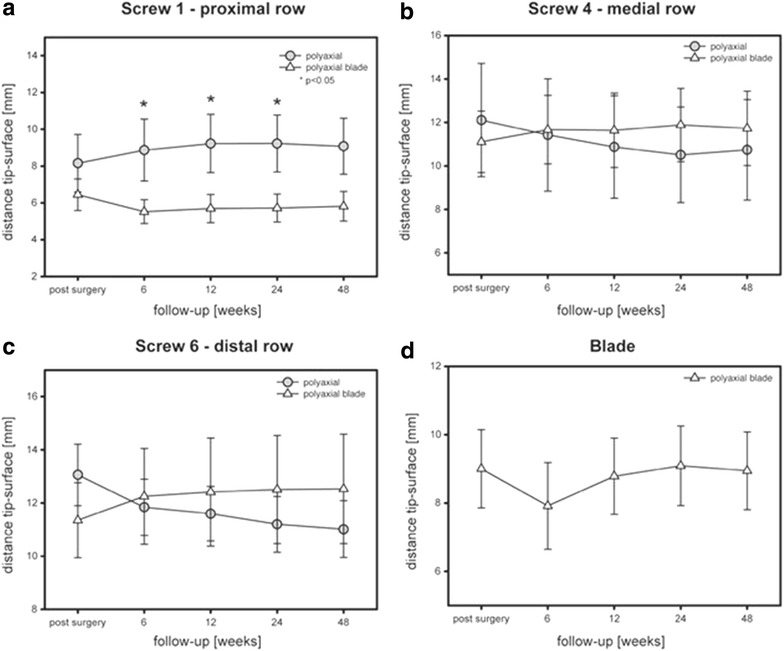
The mean follow-up was 12.4 ± 2.9 months after surgery. There were no statistical significant differences in clinical outcome in all three groups. Group MA and group PA revealed significant secondary varus displacement in comparison to group PAB at the final follow-up compared to postoperative analysis (p < 0.001). The distance between the blade and the articular surface showed no significant increase in group PAB at the final follow-up compared to postoperative analysis. Not-implant-related complications were seen in one and implant-related complications were seen in two patients in group PAB.
Polyaxial locking plate fixation with a blade device to restore medial cortical support reduces the risk of secondary varus displacement even in proximal humeral fractures of the elderly in comparison to monoaxial and polyaxial locking plate fixation without blade insertion.
肱骨近端移位骨折的锁定钢板固定术仍伴有一定的并发症发生率,尤其是在骨质疏松性骨、骨折段短以及内侧肱骨距粉碎的情况下。继发复位丢失导致内翻畸形和螺钉穿出最常导致手术翻修。本研究的目的是评估一种最近开发的多轴锁定钢板的临床和影像学结果,该钢板允许额外放置螺旋刀片装置,旨在支撑内侧肱骨距。
在这项前瞻性研究中,纳入了17例平均年龄为63.0±16.0岁的肱骨近端移位骨折(Neer二、三、四部分骨折)患者。所有患者均采用带有额外刀片装置的多轴锁定钢板(PAB组,n = 12)或不带有刀片装置的多轴锁定钢板(PA组,n = 5)进行手术治疗。使用慕尼黑肩关节问卷记录功能结果,以对肩痛和功能障碍指数(SPADI)、上肢、肩部和手部功能障碍(DASH评分)以及Constant评分进行定性自我评估。通过分析标准化的正位前后位和出口位X线片评估影像学结果,观察继发内翻移位、螺钉穿出和内固定失败的影像学证据。将结果与采用单轴锁定钢板固定的年龄、性别和骨折类型匹配的对照组(MA组,n = 15)进行比较。
术后平均随访12.4±2.9个月。三组的临床结果在统计学上无显著差异。与术后分析相比,在末次随访时,MA组和PA组与PAB组相比出现了显著的继发内翻移位(p < 0.001)。与术后分析相比,PAB组在末次随访时刀片与关节面之间的距离无显著增加。PAB组有1例出现非植入相关并发症,2例出现植入相关并发症。
与未插入刀片的单轴和多轴锁定钢板固定相比,采用带有刀片装置的多轴锁定钢板固定以恢复内侧皮质支撑,即使在老年肱骨近端骨折中也能降低继发内翻移位的风险。