Beckers Laura W M E, Bastiaenen Caroline H G
Department of Epidemiology, CAPHRI School for Public Health and Primary Care, Maastricht University, PO Box 616, 6200 MD, Maastricht, The Netherlands.
Department of Rehabilitation Medicine, CAPHRI School for Public Health and Primary Care, Maastricht University, PO Box 616, 6200 MD, Maastricht, The Netherlands.
BMC Pediatr. 2015 Oct 7;15:146. doi: 10.1186/s12887-015-0459-8.
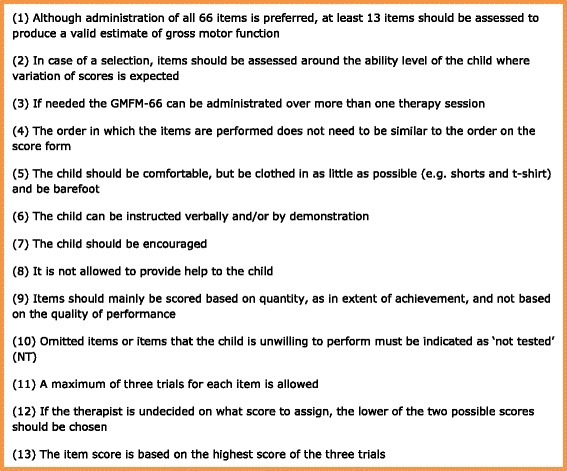
The Gross Motor Function Measure-66 (GMFM-66) is an observational clinical measure designed to evaluate gross motor function in children with Cerebral Palsy (CP). It is a shortened version of the GMFM-88. A free computer program, the Gross Motor Ability Estimator (GMAE), is required to calculate the interval level total score of the GMFM-66. The aim of this study was to explore pediatric physiotherapists' experiences with the GMFM-66 and application of the measure in Dutch clinical practice.
An explorative cross-sectional survey study was performed. Dutch pediatric physiotherapists were invited to complete an online survey. Data-analysis merely consisted of frequency tables, cross-tabulations and data-driven qualitative analysis.
Fifty-six respondents were included in the analysis. In general, the therapists expressed a positive opinion on the GMFM-66, in particular regarding its user-friendly administration and benefits of the GMAE. The majority of questions revealed that therapists deviate from the guidelines provided by the manual to a greater or lesser extent though. The most worrisome finding was that 28.8% (15/52) of the therapists calculate the total score of the GMFM-66 using the score form of the GMFM-88 instead of the GMAE.
The consequences of the high number of therapists who stated that they calculate the total score of the GMFM-66 with the GMFM-88 score form are far-reaching; it has a misleading impact on the opinion of rehabilitation teams and parents on the development of the child, on decision-making in rehabilitation, and ultimately on the development of the child.
Information currently available on psychometric properties, motor growth curves and percentiles cannot be generalized to clinical practice in the Netherlands, as they were generated in highly controlled testing conditions, which do not hold in clinical practice.
粗大运动功能测量量表-66(GMFM-66)是一种观察性临床测量工具,旨在评估脑瘫(CP)儿童的粗大运动功能。它是GMFM-88的简化版本。计算GMFM-66的区间水平总分需要一个免费的计算机程序,即粗大运动能力评估器(GMAE)。本研究的目的是探讨荷兰儿科物理治疗师使用GMFM-66的经验以及该测量工具在荷兰临床实践中的应用情况。
进行了一项探索性横断面调查研究。邀请荷兰儿科物理治疗师完成一项在线调查。数据分析仅包括频率表、交叉表和数据驱动的定性分析。
56名受访者纳入分析。总体而言,治疗师对GMFM-66表达了积极看法,特别是其使用方便以及GMAE的优点。不过,大多数问题显示治疗师在一定程度上偏离了手册提供的指南。最令人担忧的发现是,28.8%(15/52)的治疗师使用GMFM-88的评分表而非GMAE来计算GMFM-66的总分。
大量治疗师表示使用GMFM-88评分表计算GMFM-66总分的后果影响深远;这会对康复团队和家长对儿童发育的看法、康复决策以及最终对儿童发育产生误导性影响。
目前关于心理测量特性、运动生长曲线和百分位数的信息不能推广到荷兰的临床实践,因为这些信息是在高度受控的测试条件下生成的,而临床实践中并非如此。