Breuer Erica, De Silva Mary J, Shidaye Rahul, Petersen Inge, Nakku Juliet, Jordans Mark J D, Fekadu Abebaw, Lund Crick
Erica Breuer, MPH, Alan J Flisher Centre for Public Mental Health, Department of Psychiatry and Mental Health, University of Cape Town, Cape Town, South Africa; Mary J. De Silva, BA, MSc, PhD, Centre for Global Mental Health, London School of Hygiene and Tropical Medicine, London, UK; Rahul Shidaye, MBBS, MD, Public Health Foundation of India, Bhopal, Madhya Pradesh, India and Maastricht University/CAPHRI School for Public Health and Primary Care, Maastricht, The Netherlands; Inge Petersen, BSc, BSc(Hons), MSc, PhD, School of Applied Human Sciences, University of KwaZulu-Natal, Howard College Campus, Durban, South Africa; Juliet Nakku, MBChB, MMed, Butabika National Mental Hospital, Kampala, Uganda; Mark J. D. Jordans, MSc, PhD, HealthNet TPO, Amsterdam, The Netherlands and King's College London, Institute of Psychiatry, Psychology and Neuroscience, London, UK; Abebaw Fekadu, MD, PhD, MRCPsych, King's College London, Institute of Psychiatry, Psychology and Neuroscience, London, UK and Addis Department of Psychiatry, College of Health Sciences, Addis Ababa University, Addis Ababa, Ethiopia; Crick Lund, BA, BSocSci, MA, MSocSci, PhD, Alan J Flisher Centre for Public Mental Health, Department of Psychiatry and Mental Health, University of Cape Town, Cape Town, South Africa, and Centre for Global Mental Health, Institute of Psychiatry, Psychology and Neuroscience, King's College London, UK
Erica Breuer, MPH, Alan J Flisher Centre for Public Mental Health, Department of Psychiatry and Mental Health, University of Cape Town, Cape Town, South Africa; Mary J. De Silva, BA, MSc, PhD, Centre for Global Mental Health, London School of Hygiene and Tropical Medicine, London, UK; Rahul Shidaye, MBBS, MD, Public Health Foundation of India, Bhopal, Madhya Pradesh, India and Maastricht University/CAPHRI School for Public Health and Primary Care, Maastricht, The Netherlands; Inge Petersen, BSc, BSc(Hons), MSc, PhD, School of Applied Human Sciences, University of KwaZulu-Natal, Howard College Campus, Durban, South Africa; Juliet Nakku, MBChB, MMed, Butabika National Mental Hospital, Kampala, Uganda; Mark J. D. Jordans, MSc, PhD, HealthNet TPO, Amsterdam, The Netherlands and King's College London, Institute of Psychiatry, Psychology and Neuroscience, London, UK; Abebaw Fekadu, MD, PhD, MRCPsych, King's College London, Institute of Psychiatry, Psychology and Neuroscience, London, UK and Addis Department of Psychiatry, College of Health Sciences, Addis Ababa University, Addis Ababa, Ethiopia; Crick Lund, BA, BSocSci, MA, MSocSci, PhD, Alan J Flisher Centre for Public Mental Health, Department of Psychiatry and Mental Health, University of Cape Town, Cape Town, South Africa, and Centre for Global Mental Health, Institute of Psychiatry, Psychology and Neuroscience, King's College London, UK.
Br J Psychiatry. 2016 Jan;208 Suppl 56(Suppl 56):s55-62. doi: 10.1192/bjp.bp.114.153841. Epub 2015 Oct 7.
There is little practical guidance on how contextually relevant mental healthcare plans (MHCPs) can be developed in low-resource settings.
To describe how theory of change (ToC) was used to plan the development and evaluation of MHCPs as part of the PRogramme for Improving Mental health carE (PRIME).
ToC development occurred in three stages: (a) development of a cross-country ToC by 15 PRIME consortium members; (b) development of country-specific ToCs in 13 workshops with a median of 15 (interquartile range 13-22) stakeholders per workshop; and (c) review and refinement of the cross-country ToC by 18 PRIME consortium members.
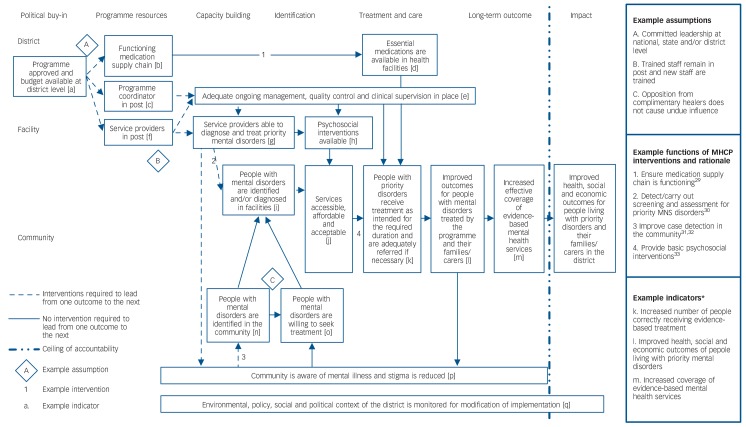
One cross-country and five district ToCs were developed that outlined the steps required to improve outcomes for people with mental disorders in PRIME districts.
ToC is a valuable participatory method that can be used to develop MHCPs and plan their evaluation.
关于如何在资源匮乏地区制定与实际情况相关的精神卫生保健计划(MHCPs),几乎没有实际指导。
描述如何将变革理论(ToC)用于规划MHCPs的制定和评估,作为改善精神卫生保健计划(PRIME)的一部分。
变革理论的制定分三个阶段进行:(a)由15名PRIME联盟成员制定跨国变革理论;(b)在13个研讨会上制定针对特定国家的变革理论,每个研讨会的利益相关者中位数为15名(四分位间距为13 - 22名);(c)由18名PRIME联盟成员对跨国变革理论进行审查和完善。
制定了一个跨国变革理论和五个地区变革理论,概述了在PRIME地区改善精神障碍患者结局所需的步骤。
变革理论是一种有价值的参与式方法,可用于制定MHCPs并规划其评估。