
变革理论:一种以理论为驱动的方法,用于完善医学研究理事会针对复杂干预措施的框架。
Theory of Change: a theory-driven approach to enhance the Medical Research Council's framework for complex interventions.
作者信息
De Silva Mary J, Breuer Erica, Lee Lucy, Asher Laura, Chowdhary Neerja, Lund Crick, Patel Vikram
机构信息
Centre for Global Mental Health, London School of Hygiene and Tropical Medicine, Keppel Street, London WC1E 7HT, UK.
出版信息
Trials. 2014 Jul 5;15:267. doi: 10.1186/1745-6215-15-267.
BACKGROUND
The Medical Research Councils' framework for complex interventions has been criticized for not including theory-driven approaches to evaluation. Although the framework does include broad guidance on the use of theory, it contains little practical guidance for implementers and there have been calls to develop a more comprehensive approach. A prospective, theory-driven process of intervention design and evaluation is required to develop complex healthcare interventions which are more likely to be effective, sustainable and scalable.
METHODS
We propose a theory-driven approach to the design and evaluation of complex interventions by adapting and integrating a programmatic design and evaluation tool, Theory of Change (ToC), into the MRC framework for complex interventions. We provide a guide to what ToC is, how to construct one, and how to integrate its use into research projects seeking to design, implement and evaluate complex interventions using the MRC framework. We test this approach by using ToC within two randomized controlled trials and one non-randomized evaluation of complex interventions.
RESULTS
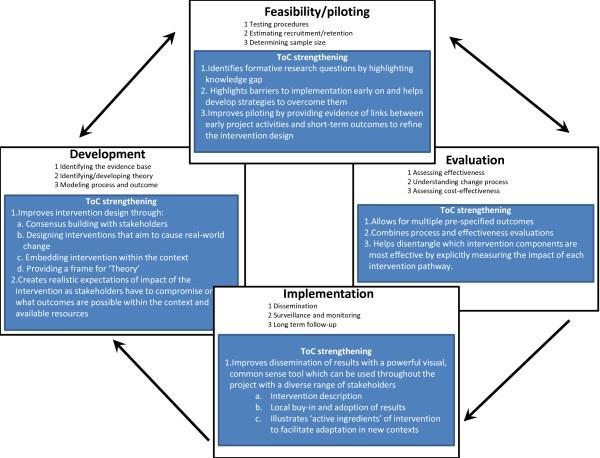
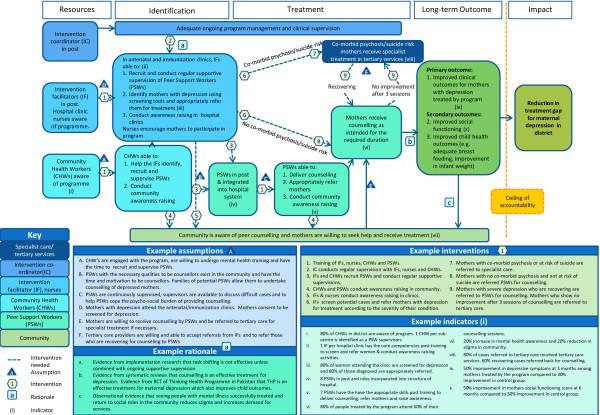
Our application of ToC in three research projects has shown that ToC can strengthen key stages of the MRC framework. It can aid the development of interventions by providing a framework for enhanced stakeholder engagement and by explicitly designing an intervention that is embedded in the local context. For the feasibility and piloting stage, ToC enables the systematic identification of knowledge gaps to generate research questions that strengthen intervention design. ToC may improve the evaluation of interventions by providing a comprehensive set of indicators to evaluate all stages of the causal pathway through which an intervention achieves impact, combining evaluations of intervention effectiveness with detailed process evaluations into one theoretical framework.
CONCLUSIONS
Incorporating a ToC approach into the MRC framework holds promise for improving the design and evaluation of complex interventions, thereby increasing the likelihood that the intervention will be ultimately effective, sustainable and scalable. We urge researchers developing and evaluating complex interventions to consider using this approach, to evaluate its usefulness and to build an evidence base to further refine the methodology.
TRIAL REGISTRATION
Clinical trials.gov: NCT02160249.
背景
医学研究理事会关于复杂干预措施的框架因未纳入理论驱动的评估方法而受到批评。尽管该框架确实包含了关于理论运用的宽泛指导,但对于实施者而言,实际指导却很少,因此有人呼吁制定一种更全面的方法。需要一种前瞻性的、理论驱动的干预设计与评估流程,以开发更有可能有效、可持续且可扩展的复杂医疗保健干预措施。
方法
我们提出一种理论驱动的方法,通过将一种规划性设计与评估工具——变革理论(ToC)进行调整和整合,纳入医学研究理事会复杂干预措施框架,用于复杂干预措施的设计与评估。我们提供了一份指南,介绍什么是ToC、如何构建ToC,以及如何将其运用整合到旨在使用医学研究理事会框架设计、实施和评估复杂干预措施的研究项目中。我们通过在两项随机对照试验和一项复杂干预措施的非随机评估中运用ToC来检验这种方法。
结果
我们在三个研究项目中运用ToC的实践表明,ToC可以强化医学研究理事会框架的关键阶段。它能够通过提供一个加强利益相关者参与的框架,并通过明确设计一种融入当地背景的干预措施,来助力干预措施的开发。对于可行性和试点阶段,ToC能够系统地识别知识空白,从而生成加强干预措施设计的研究问题。ToC可能通过提供一套全面的指标来改进干预措施的评估,这些指标用于评估干预措施产生影响的因果路径的所有阶段,将干预措施效果评估与详细的过程评估结合到一个理论框架中。
结论
将ToC方法纳入医学研究理事会框架有望改进复杂干预措施的设计与评估,从而增加干预措施最终有效、可持续且可扩展的可能性。我们敦促开展复杂干预措施开发和评估的研究人员考虑使用这种方法,评估其效用,并建立一个证据基础以进一步完善该方法。
试验注册
Clinical trials.gov:NCT02160249。
 Zotero 插件