Huang Xiaolin, Xu Min, Chen Ying, Peng Kui, Huang Ya, Wang Po, Ding Lin, Lin Lin, Xu Yu, Chen Yuhong, Lu Jieli, Wang Weiqing, Bi Yufang, Ning Guang
From the State Key Laboratory of Medical Genomics, Key Laboratory for Endocrine and Metabolic Diseases of Ministry of Health, National Clinical Research Center for Metabolic Diseases, Collaborative Innovation Center of Systems Biomedicine and Shanghai Clinical Center for Endocrine and Metabolic Diseases (XH, MX, YC, KP, YH, PW, LD, LL, YX, YC, JL, WW, YB, GN); and Shanghai Institute of Endocrine and Metabolic Diseases, Department of Endocrine and Metabolic Diseases, Rui-Jin Hospital, Shanghai Jiao-Tong University School of Medicine, Shanghai, China (XH, MX, YC, KP, YH, PW, LD, LL, YX, YC, JL, WW, YB, GN).
Medicine (Baltimore). 2015 Oct;94(40):e1682. doi: 10.1097/MD.0000000000001682.
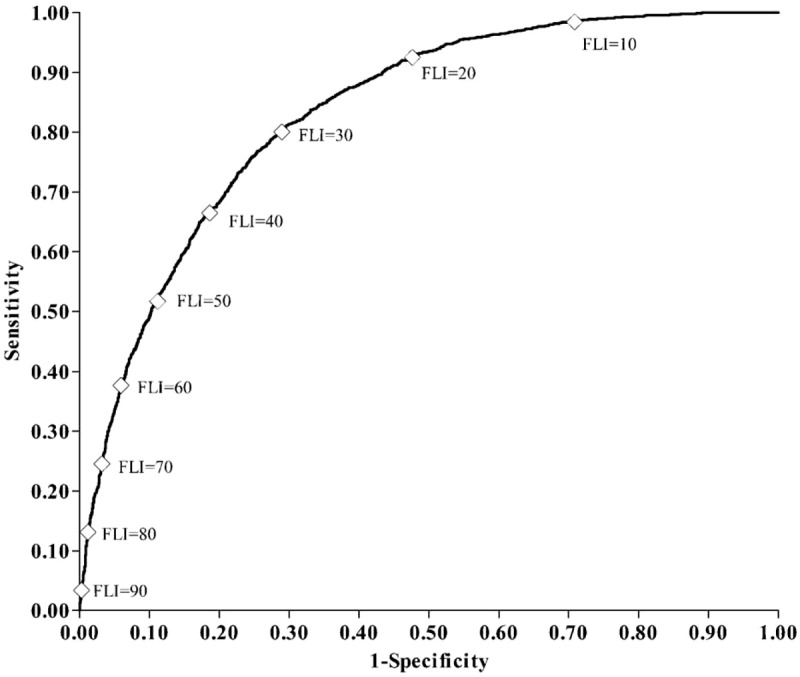
The fatty liver index (FLI), which is an algorithm based on waist circumference, body mass index (BMI), triglyceride, and gamma-glutamyl-transferase (GGT), was initially developed to detect fatty liver in Western countries. Our study aimed to evaluate the accuracy and optimal cut-off point of the FLI for predicting nonalcoholic fatty liver disease (NAFLD) in middle-aged and elderly Chinese. This cross-sectional study included 8626 Chinese adults aged 40 years or above recruited from Jiading District, Shanghai, China. Anthropometric and biochemical features were collected by a standard protocol. NAFLD was diagnosed by hepatic ultrasonography. The accuracy and cut-off point of the FLI to detect NAFLD were evaluated by area under the receiver operator characteristic curve (AUROC) and the maximum Youden index analysis, respectively. The AUROC of the FLI for NAFLD was 0.834 (95% confidence interval: 0.825-0.842), and larger than that of its each individual component [0.786 (0.776-0.796), 0.783 (0.773-0.793), 0.727 (0.716-0.739), and 0.707 (0.695-0.719) for waist circumference, BMI, triglyceride, and GGT, respectively] (all P < 0.001). The optimal cut-off point of the FLI for diagnosing NAFLD was 30 with the maximum Youden Index of 0.51, achieving a high sensitivity of 79.89% and a specificity of 71.51%. The FLI-diagnosed NAFLD individuals were in worse metabolic characteristics (waist circumference, BMI, blood pressure, serum lipids, and aminotransferases) than ultrasonography-diagnosed NAFLD patients (all P < 0.05).The FLI could accurately identify NAFLD and the optimal cut-off point was 30 in middle-aged and elderly Chinese. As FLI-diagnosed NAFLD patients were in worse metabolism, much attention should be paid to the metabolic controls and managements of NAFLD.
脂肪肝指数(FLI)是一种基于腰围、体重指数(BMI)、甘油三酯和γ-谷氨酰转移酶(GGT)的算法,最初是为在西方国家检测脂肪肝而开发的。我们的研究旨在评估FLI预测中国中老年非酒精性脂肪性肝病(NAFLD)的准确性和最佳切点。这项横断面研究纳入了从中国上海嘉定区招募的8626名40岁及以上的中国成年人。通过标准方案收集人体测量和生化特征。通过肝脏超声诊断NAFLD。分别通过受试者操作特征曲线下面积(AUROC)和最大约登指数分析评估FLI检测NAFLD的准确性和切点。FLI诊断NAFLD的AUROC为0.834(95%置信区间:0.825 - 0.842),大于其各个单独成分的AUROC[腰围、BMI、甘油三酯和GGT的AUROC分别为0.786(0.776 - 0.796)、0.783(0.773 - 0.793)、0.727(0.716 - 0.739)和0.707(0.695 - 0.719)](所有P < 0.001)。FLI诊断NAFLD的最佳切点为30,最大约登指数为(0.51),灵敏度为(79.89%),特异性为(71.51%)。FLI诊断为NAFLD的个体在代谢特征(腰围、BMI、血压、血脂和转氨酶)方面比超声诊断的NAFLD患者更差(所有P < 0.05)。FLI可以准确识别中国中老年人群中的NAFLD,最佳切点为30。由于FLI诊断的NAFLD患者代谢更差,应高度重视NAFLD的代谢控制和管理。