Wang Yan, Xie Jingdan, Yang Fei, Wu Shiwen, Wang Hebo, Zhang Xiaolan, Liu Hua, Deng Xin, Xie Wei, Yu Shengyuan
International Headache Center, Department of Neurology, Chinese PLA General Hospital, Fuxing Road 28, Haidian District, Beijing, 100853, China.
Department of Neurology, The General Hospital of Chinese Armed Police Forces, Beijing, 100039, China.
J Headache Pain. 2015;16:88. doi: 10.1186/s10194-015-0571-z. Epub 2015 Oct 8.
Sleep disorders and primary headaches are both more prevalent among nursing staff than in the general population. However, there have been no reports about the comorbidity of poor sleep and primary headaches among nursing staff.
Stratified random cluster sampling was used to select 1102 nurses from various departments in three hospitals in north China. Sleep quality was assessed with the Pittsburgh Sleep Quality Index (PSQI). The diagnosis of primary headaches including migraine, tension-type headache (TTH), and chronic daily headache (CDH) was based on the International Classification of Headache Disorders, 3rd edition (beta version) (ICHD-3-beta).
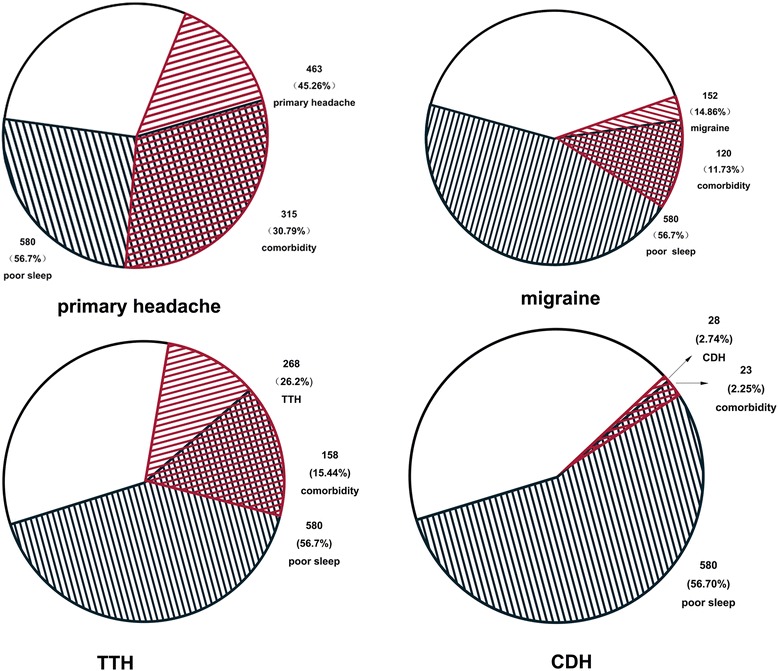
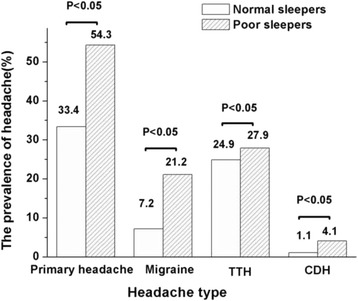
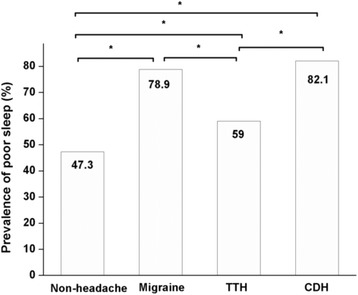
The response rate was 93 %. Among 1023 nurses, the prevalence of poor sleep was 56.7 %. Of these, 315 nurses (34.13 %) had poor sleep comorbid with primary headaches. The prevalence of poor sleep in the groups with CDH (82.1 %), migraine (78.9 %), and TTH (59.0 %) was significantly higher than that in the group without headaches (47.3 %) (all P < 0.05). Multivariate logistic regression revealed that rotating shifts and suffering headache were independent risk factors for poor sleep. Also, the 1-year prevalence of the three types of primary headache was significantly increased in the poor sleep group (migraine: 21.2 % vs. 7.2 %; TTH: 27.9 % vs. 24.9 %; CDH: 4.1 % vs. 1.1 %; P < 0.05). Compared with normal sleepers, nurses with poor sleep were 1.72 times more likely to have severe headache (OR: 1.72, 95 % CI: 1.14-2.57).
Comorbidity of poor sleep and primary headaches among nursing staff is common. Therefore, sleep quality should be carefully evaluated in nurses with primary headaches.
睡眠障碍和原发性头痛在护理人员中的患病率均高于普通人群。然而,尚无关于护理人员睡眠不佳与原发性头痛合并存在情况的报道。
采用分层随机整群抽样法,从中国北方3家医院的各个科室选取1102名护士。使用匹兹堡睡眠质量指数(PSQI)评估睡眠质量。原发性头痛包括偏头痛、紧张型头痛(TTH)和慢性每日头痛(CDH)的诊断依据是《国际头痛疾病分类》第3版(beta版)(ICHD - 3 - beta)。
应答率为93%。在1023名护士中,睡眠不佳的患病率为56.7%。其中,315名护士(34.13%)睡眠不佳合并原发性头痛。CDH组(82.1%)、偏头痛组(78.9%)和TTH组(59.0%)的睡眠不佳患病率显著高于无头痛组(47.3%)(所有P < 0.05)。多因素逻辑回归显示,轮班和患头痛是睡眠不佳的独立危险因素。此外,睡眠不佳组中三种原发性头痛的1年患病率显著升高(偏头痛:21.2%对7.2%;TTH:27.9%对24.9%;CDH:4.1%对1.1%;P < 0.05)。与睡眠正常者相比,睡眠不佳的护士出现严重头痛的可能性高1.72倍(比值比:1.72,95%置信区间:1.14 - 2.57)。
护理人员中睡眠不佳与原发性头痛合并存在的情况很常见。因此,对于患有原发性头痛的护士,应仔细评估其睡眠质量。