Köhnke Thomas, Krupka Christina, Tischer Johanna, Knösel Thomas, Subklewe Marion
Department of Internal Medicine III, Ludwig-Maximilians-Universität (LMU), Munich, Germany.
Clinical Cooperation Group Immunotherapy at the Helmholtz Zentrum München, Munich, Germany.
J Hematol Oncol. 2015 Oct 8;8:111. doi: 10.1186/s13045-015-0213-6.
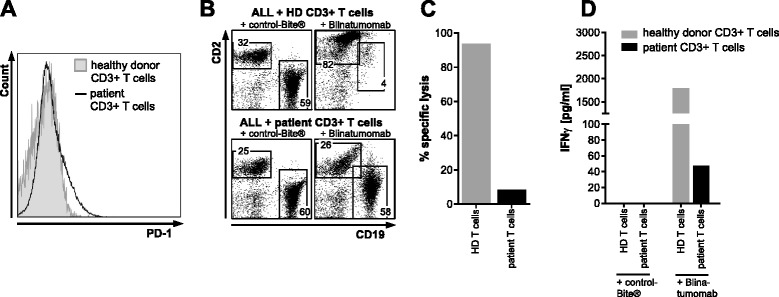
The bispecific T cell engager blinatumomab has shown encouraging clinical activity in B-precursor acute lymphoblastic leukemia (ALL). However, about half of relapsed/refractory patients do not respond to therapy. Here, we present the case of a 32-year-old male patient with refractory B-precursor ALL who was resistant to treatment with blinatumomab. Bone marrow immunohistochemistry revealed T cell infiltrates and an increase in programmed death-ligand 1 (PD-L1)-positive ALL cells as a potential immune escape mechanism. We were able to recapitulate the clinical observation in vitro by showing that blinatumomab was not able to mediate cytotoxicity of CD19-positive ALL cells using autologous T cells. In contrast, the addition of healthy donor T cells led to lysis of ALL cells.These results strongly encourage further systematic evaluation of checkpoint molecules in cases of blinatumomab treatment failure and might highlight a possible mechanism to overcome resistance to this otherwise highly effective treatment.
双特异性T细胞衔接器博纳吐单抗在B前体急性淋巴细胞白血病(ALL)中已显示出令人鼓舞的临床活性。然而,约一半的复发/难治性患者对治疗无反应。在此,我们报告一例32岁男性难治性B前体ALL患者,其对博纳吐单抗治疗耐药。骨髓免疫组化显示T细胞浸润以及程序性死亡配体1(PD-L1)阳性ALL细胞增加,这是一种潜在的免疫逃逸机制。我们通过体外实验再现了临床观察结果,即博纳吐单抗无法利用自体T细胞介导CD19阳性ALL细胞的细胞毒性。相反,添加健康供体T细胞则导致ALL细胞裂解。这些结果有力地促使在博纳吐单抗治疗失败的病例中进一步系统评估检查点分子,并可能突出一种克服对这种原本高效治疗耐药性的可能机制。