Cohen Cheryl, Naidoo Nireshni, Meiring Susan, de Gouveia Linda, von Mollendorf Claire, Walaza Sibongile, Naicker Preneshni, Madhi Shabir A, Feldman Charles, Klugman Keith P, Dawood Halima, von Gottberg Anne
Centre for Respiratory Diseases and Meningitis, National Institute for Communicable Diseases (NICD) of the National Health Laboratory Service (NHLS), Johannesburg, South Africa; School of Public Health, Faculty of Health Sciences, University of the Witwatersrand, Johannesburg South Africa.
Centre for Respiratory Diseases and Meningitis, National Institute for Communicable Diseases (NICD) of the National Health Laboratory Service (NHLS), Johannesburg, South Africa.
PLoS One. 2015 Oct 13;10(10):e0140185. doi: 10.1371/journal.pone.0140185. eCollection 2015.
An association between pneumococcal serotypes and mortality has been suggested. We aimed to investigate this among individuals aged ≥15 years with invasive pneumococcal disease (IPD) in South Africa.
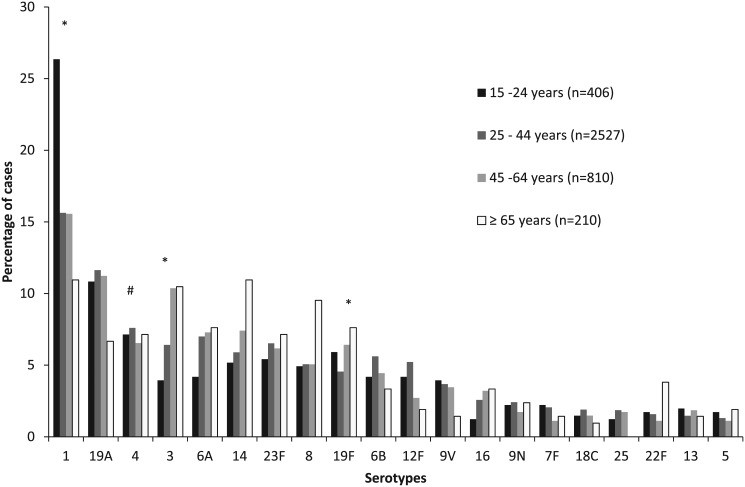
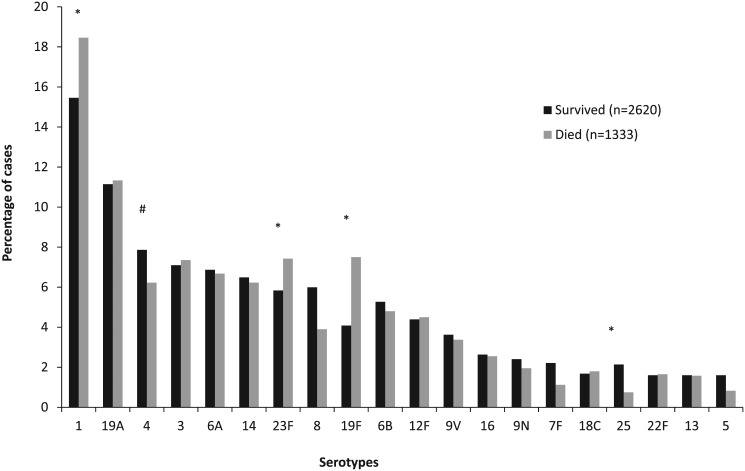
IPD cases were identified through national laboratory-based surveillance at 25 sites, pre-pneumococcal conjugate vaccine (PCV) introduction, from 2003-2008. We assessed the association between the 20 commonest serotypes and in-hospital mortality using logistic regression with serotype 4 (the third commonest serotype with intermediate case-fatality ratio (CFR)) as referent.
Among 3953 IPD cases, CFR was 55% (641/1166) for meningitis and 23% (576/2484) for bacteremia (p<0.001). Serotype 19F had the highest CFR (48%, 100/207), followed by serotype 23F (39%, 99/252) and serotype 1 (38%, 246/651). On multivariable analysis, factors independently associated with mortality included serotype 1 (OR 1.9, 95%CI 1.1-3.5) and 19F (OR 2.9, 95%CI 1.4-6.1) vs. serotype 4; increasing age (25-44 years, OR 1.8, 95%CI 1.0-3.0; 45-64 years, OR 3.6, 95%CI 2.0-6.4; ≥65 years, OR 5.2, 95%CI 1.9-14.1; vs. 15-24 years); meningitis (OR 4.1, 95%CI 3.0-5.6) vs. bacteremic pneumonia; and HIV infection (OR1.7, 95%CI 1.0-2.8). On stratified multivariate analysis, serotype 19F was associated with increased mortality amongst bacteremic pneumococcal pneumonia cases, while no serotype was associated with increased mortality in meningitis cases.
Mortality was increased in HIV-infected individuals, which may be reduced by increased antiretroviral therapy availability. Serotypes associated with increased mortality are included in the 10-and-13-valent PCV and may become less common in adults due to indirect effects following routine infant immunization.
已有研究表明肺炎球菌血清型与死亡率之间存在关联。我们旨在对南非年龄≥15岁的侵袭性肺炎球菌病(IPD)患者进行此项调查。
通过2003年至2008年在25个地点开展的基于实验室的全国监测,在肺炎球菌结合疫苗(PCV)引入前确定IPD病例。我们以血清型4(第三常见血清型,病死率中等)作为对照,采用逻辑回归分析评估20种最常见血清型与院内死亡率之间的关联。
在3953例IPD病例中,脑膜炎的病死率为55%(641/1166),菌血症的病死率为23%(576/2484)(p<0.001)。血清型19F的病死率最高(48%,100/207),其次是血清型23F(39%,99/252)和血清型1(38%,246/651)。多变量分析显示,与死亡率独立相关的因素包括血清型1(比值比1.9,95%置信区间1.1 - 3.5)和19F(比值比2.9,95%置信区间1.4 - 6.1)相对于血清型4;年龄增加(25 - 44岁,比值比1.8,95%置信区间1.0 - 3.0;45 - 64岁,比值比3.6,95%置信区间2.0 - 6.4;≥65岁,比值比5.2,95%置信区间1.9 - 14.1;相对于15 - 24岁);脑膜炎(比值比4.1,95%置信区间3.0 - 5.6)相对于菌血症性肺炎;以及HIV感染(比值比1.7,95%置信区间1.0 - 2.8)。分层多变量分析显示,血清型19F与菌血症性肺炎病例死亡率增加相关,而在脑膜炎病例中没有血清型与死亡率增加相关。
HIV感染个体的死亡率增加,增加抗逆转录病毒治疗的可及性可能会降低死亡率。与死亡率增加相关的血清型包含在10价和13价PCV中,由于婴儿常规免疫的间接影响,这些血清型在成年人中可能会变得不那么常见。