Adkins Chris E, Nounou Mohamed I, Hye Tanvirul, Mohammad Afroz S, Terrell-Hall Tori, Mohan Neel K, Eldon Michael A, Hoch Ute, Lockman Paul R
Department of Basic Pharmaceutical Sciences, West Virginia University Health Sciences Center, 1 Medical Center Drive, Morgantown, WV, 26506-905, USA.
School of Pharmacy, Department of Pharmaceutical Sciences, Texas Tech University Health Sciences Center, Amarillo, TX, 79106, USA.
BMC Cancer. 2015 Oct 13;15:685. doi: 10.1186/s12885-015-1672-4.
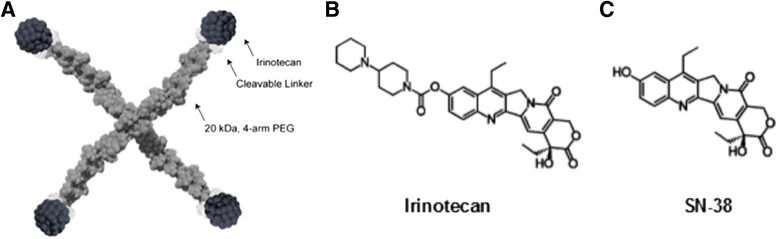
Brain metastases are an increasing problem in women with invasive breast cancer. Strategies designed to treat brain metastases of breast cancer, particularly chemotherapeutics such as irinotecan, demonstrate limited efficacy. Conventional irinotecan distributes poorly to brain metastases; therefore, NKTR-102, a PEGylated irinotecan conjugate should enhance irinotecan and its active metabolite SN38 exposure in brain metastases leading to brain tumor cytotoxicity.
Female nude mice were intracranially or intracardially implanted with human brain seeking breast cancer cells (MDA-MB-231Br) and dosed with irinotecan or NKTR-102 to determine plasma and tumor pharmacokinetics of irinotecan and SN38. Tumor burden and survival were evaluated in mice treated with vehicle, irinotecan (50 mg/kg), or NKTR-102 low and high doses (10 mg/kg, 50 mg/kg respectively).
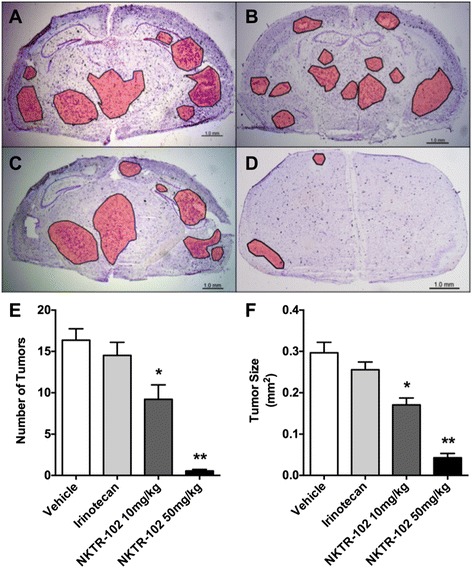
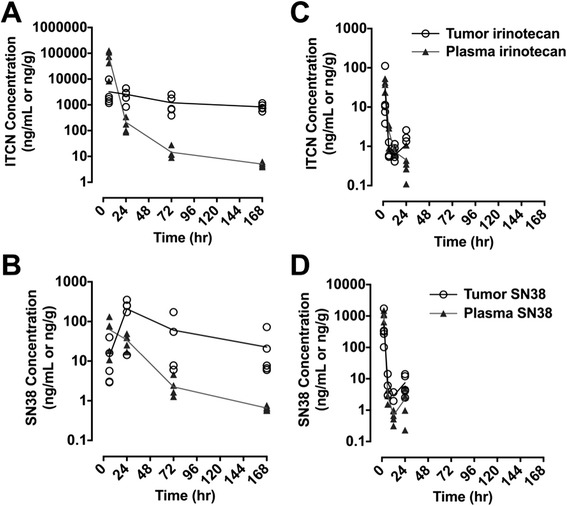
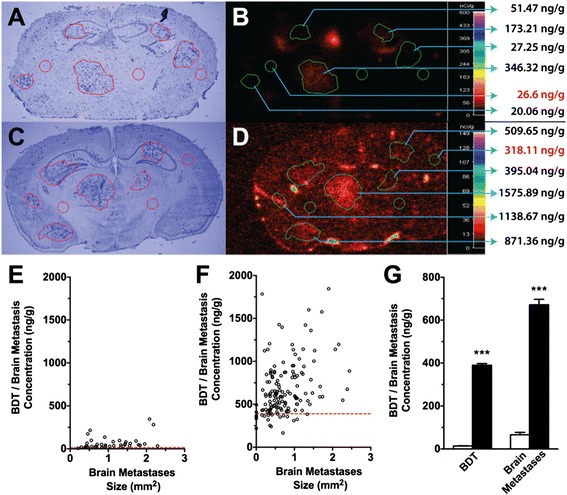
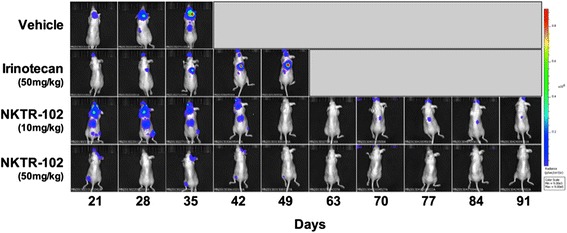
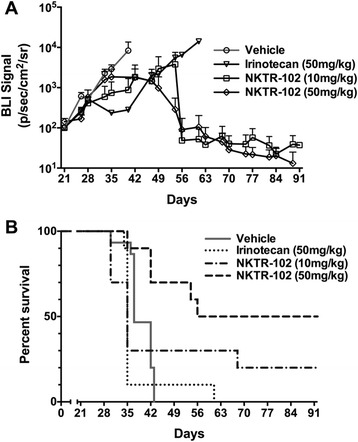
NKTR-102 penetrates the blood-tumor barrier and distributes to brain metastases. NKTR-102 increased and prolonged SN38 exposure (>20 ng/g for 168 h) versus conventional irinotecan (>1 ng/g for 4 h). Treatment with NKTR-102 extended survival time (from 35 days to 74 days) and increased overall survival for NKTR-102 low dose (30 % mice) and NKTR-102 high dose (50 % mice). Tumor burden decreased (37 % with 10 mg/kg NKTR-102 and 96 % with 50 mg/kg) and lesion sizes decreased (33 % with 10 mg/kg NKTR-102 and 83 % with 50 mg/kg NKTR-102) compared to conventional irinotecan treated animals.
Elevated and prolonged tumor SN38 exposure after NKTR-102 administration appears responsible for increased survival in this model of breast cancer brain metastasis. Further, SN38 concentrations observed in this study are clinically achieved with 145 mg/m(2) NKTR-102, such as those used in the BEACON trial, underlining translational relevance of these results.
脑转移是浸润性乳腺癌女性中日益严重的问题。旨在治疗乳腺癌脑转移的策略,尤其是如伊立替康等化疗药物,疗效有限。传统伊立替康在脑转移灶中的分布不佳;因此,聚乙二醇化伊立替康共轭物NKTR-102应能增强伊立替康及其活性代谢物SN38在脑转移灶中的暴露,从而导致脑肿瘤细胞毒性。
将人脑靶向性乳腺癌细胞(MDA-MB-231Br)颅内或心内植入雌性裸鼠,并用伊立替康或NKTR-102给药,以确定伊立替康和SN38的血浆及肿瘤药代动力学。在用赋形剂、伊立替康(50mg/kg)或NKTR-102低剂量和高剂量(分别为10mg/kg、50mg/kg)治疗的小鼠中评估肿瘤负荷和生存期。
NKTR-102可穿透血脑屏障并分布至脑转移灶。与传统伊立替康(4小时内>1ng/g)相比,NKTR-102增加并延长了SN38的暴露时间(168小时内>20ng/g)。用NKTR-102治疗可延长生存期(从35天延长至74天),并提高NKTR-102低剂量组(30%的小鼠)和NKTR-102高剂量组(50%的小鼠)的总生存率。与传统伊立替康治疗的动物相比,肿瘤负荷降低(10mg/kg NKTR-102组降低37%,50mg/kg组降低96%),病灶大小减小(10mg/kg NKTR-102组减小33%,50mg/kg NKTR-102组减小83%)。
在该乳腺癌脑转移模型中,给予NKTR-102后肿瘤SN38暴露增加且持续时间延长似乎是生存期延长的原因。此外,本研究中观察到的SN38浓度在临床应用145mg/m² NKTR-102时可达到,如BEACON试验中所使用的剂量,这突出了这些结果的转化相关性。