Feltmann Kristin, Fredriksson Ida, Wirf Malin, Schilström Björn, Steensland Pia
Department of Clinical Neuroscience, Karolinska Institutet, Solna, Stockholm, Sweden.
Sahlgrenska Academy, University of Gothenburg, Gothenburg, Sweden.
Addict Biol. 2016 Mar;21(2):438-49. doi: 10.1111/adb.12304. Epub 2015 Oct 14.
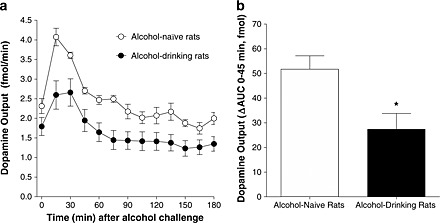
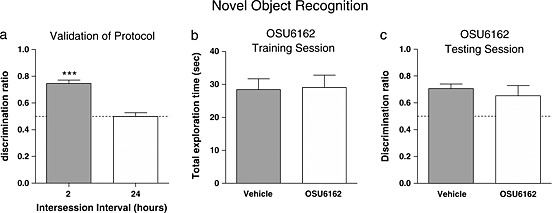
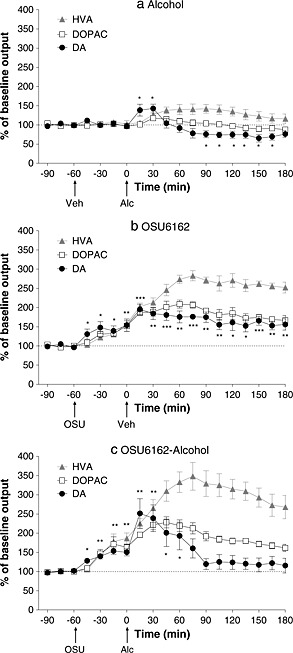
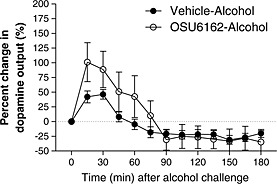
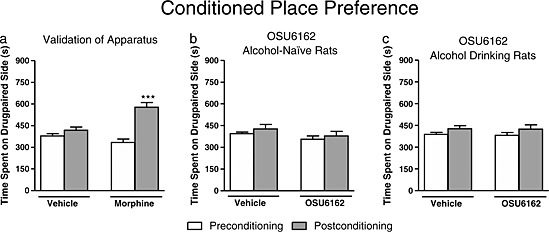
We recently established that the monoamine stabilizer (-)-OSU6162 (OSU6162) decreased voluntary alcohol-mediated behaviors, including alcohol intake and cue/priming-induced reinstatement, in long-term drinking rats, while blunting alcohol-induced dopamine output in the nucleus accumbens (NAc) of alcohol-naïve rats. Therefore, we hypothesized that OSU6162 attenuates alcohol-mediated behaviors by blunting alcohol's rewarding effects. Here, we evaluated the effects of long-term drinking and OSU6162 treatment (30 mg/kg, sc) on basal and alcohol-induced (2.5 g/kg, ip) NAc dopamine outputs in Wistar rats after 10 months of intermittent access to 20% alcohol. The results showed that basal and alcohol-induced NAc dopamine outputs were significantly lower in long-term drinking rats, compared with alcohol-naïve rats. In the long-term drinking rats, OSU6162 slowly increased and maintained the dopamine output significantly elevated compared with baseline for at least 4 hours. Furthermore, OSU6162 pre-treatment did not blunt the alcohol-induced output in the long-term drinking rats, a finding that contrasted with our previous results in alcohol-naïve rats. Finally, OSU6162 did not induce conditioned place preference (CPP) in either long-term drinking or alcohol-naïve rats, indicating that OSU6162 has no reinforcing properties. To verify that the CPP results were not due to memory acquisition impairment, we demonstrated that OSU6162 did not affect novel object recognition. In conclusion, these results indicate that OSU6162 attenuates alcohol-mediated behaviors by counteracting NAc dopamine deficits in long-term drinking rats and that OSU6162 is not rewarding on its own. Together with OSU6162's beneficial side-effect profile, the present study merits evaluation of OSU6162's clinical efficacy to attenuate alcohol use in alcohol-dependent patients.
我们最近证实,单胺稳定剂(-)-OSU6162(OSU6162)可减少长期饮酒大鼠的自愿性酒精介导行为,包括酒精摄入量以及线索/启动诱导的复吸,同时减弱酒精对未饮酒大鼠伏隔核(NAc)中多巴胺的释放。因此,我们推测OSU6162通过减弱酒精的奖赏效应来减轻酒精介导的行为。在此,我们评估了长期饮酒和OSU6162治疗(30mg/kg,皮下注射)对Wistar大鼠在间歇性接触20%酒精10个月后的基础及酒精诱导(2.5g/kg,腹腔注射)NAc多巴胺释放的影响。结果显示,与未饮酒大鼠相比,长期饮酒大鼠的基础及酒精诱导的NAc多巴胺释放显著降低。在长期饮酒大鼠中,OSU6162使多巴胺释放缓慢增加,并至少在4小时内维持与基线相比显著升高。此外,在长期饮酒大鼠中,OSU6162预处理并未减弱酒精诱导的多巴胺释放,这一结果与我们之前在未饮酒大鼠中的结果形成对比。最后,OSU6162在长期饮酒大鼠和未饮酒大鼠中均未诱导条件性位置偏爱(CPP),表明OSU6162没有强化特性。为验证CPP结果并非由于记忆获取受损,我们证明了OSU6162不影响新物体识别。总之,这些结果表明,OSU6162通过抵消长期饮酒大鼠NAc中的多巴胺缺乏来减轻酒精介导的行为,且OSU6162本身并无奖赏作用。结合OSU6162有益的副作用特征,本研究值得评估OSU6162在酒精依赖患者中减轻酒精使用的临床疗效。