Castellote-Caballero Yolanda, Valenza Maríe C, Puentedura Emilio J, Fernández-de-Las-Peñas César, Alburquerque-Sendín Francisco
Hospital Virgen de las Nieves, Servicio Andaluz de Salud, Avenida de las Fuerzas Armadas 2, 18014 Granada, Spain.
Department of Physical Therapy, Universidad de Granada, Avenida del Hospicio s/n, 18071 Granada, Spain.
J Sports Med (Hindawi Publ Corp). 2014;2014:127471. doi: 10.1155/2014/127471. Epub 2014 Apr 15.
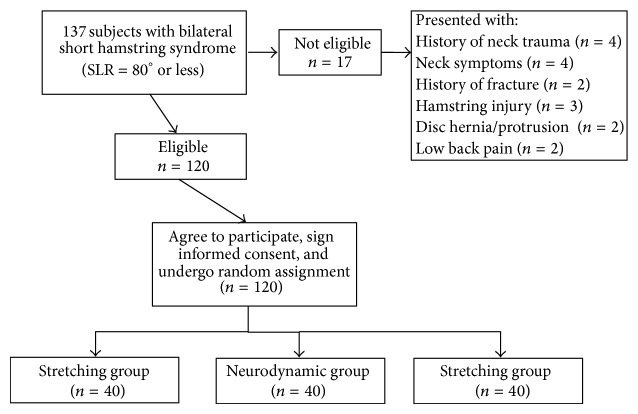
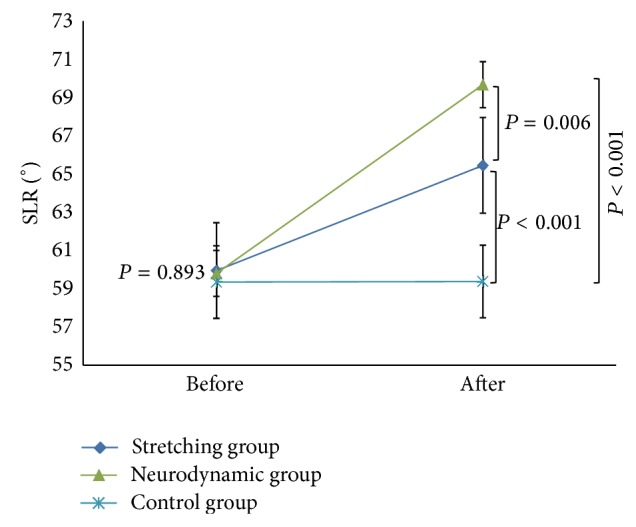
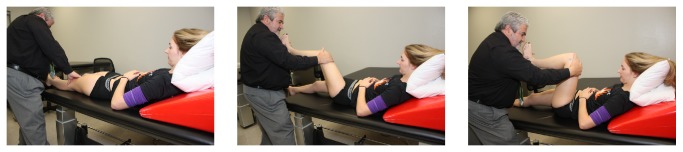
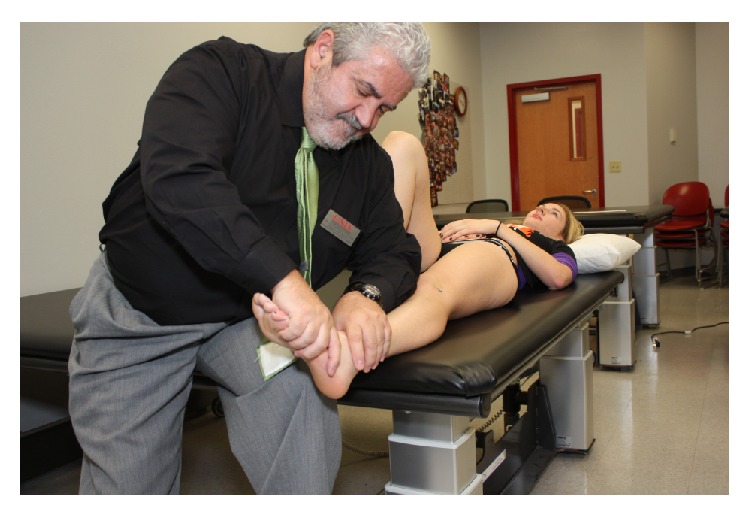
Background. Hamstring injuries continue to affect active individuals and although inadequate muscle extensibility remains a commonly accepted factor, little is known about the most effective method to improve flexibility. Purpose. To determine if an isolated neurodynamic sciatic sliding technique would improve hamstring flexibility to a greater degree than stretching or a placebo intervention in asymptomatic subjects with short hamstring syndrome (SHS). Study Design. Randomized double-blinded controlled trial. Methods. One hundred and twenty subjects with SHS were randomized to 1 of 3 groups: neurodynamic sliding, hamstring stretching, and placebo control. Each subject's dominant leg was measured for straight leg raise (SLR) range of motion (ROM) before and after interventions. Data were analyzed with a 3 × 2 mixed model ANOVA followed by simple main effects analyses. Results. At the end of the study, more ROM was observed in the Neurodynamic and Stretching groups compared to the Control group and more ROM in the Neurodynamic group compared to Stretching group. Conclusion. Findings suggest that a neurodynamic sliding technique will increase hamstring flexibility to a greater degree than static hamstring stretching in healthy subjects with SHS. Clinical Relevance. The use of neurodynamic sliding techniques to improve hamstring flexibility in sports may lead to a decreased incidence in injuries; however, this needs to be formally tested.
背景。腘绳肌损伤持续影响着活跃人群,尽管肌肉伸展性不足仍是一个普遍认可的因素,但对于提高柔韧性的最有效方法却知之甚少。目的。确定在患有短腘绳肌综合征(SHS)的无症状受试者中,孤立的神经动力学坐骨神经滑动技术是否比拉伸或安慰剂干预能更大程度地提高腘绳肌柔韧性。研究设计。随机双盲对照试验。方法。120名患有SHS的受试者被随机分为3组中的1组:神经动力学滑动组、腘绳肌拉伸组和安慰剂对照组。在干预前后测量每个受试者优势腿的直腿抬高(SLR)活动范围(ROM)。数据采用3×2混合模型方差分析,随后进行简单主效应分析。结果。在研究结束时,与对照组相比,神经动力学组和拉伸组观察到更多的ROM,与拉伸组相比,神经动力学组有更多的ROM。结论。研究结果表明,在患有SHS的健康受试者中,神经动力学滑动技术比静态腘绳肌拉伸能更大程度地提高腘绳肌柔韧性。临床意义。在运动中使用神经动力学滑动技术来提高腘绳肌柔韧性可能会降低受伤发生率;然而,这需要进行正式测试。