Sawada Genta, Niida Atsushi, Hirata Hidenari, Komatsu Hisateru, Uchi Ryutaro, Shimamura Teppei, Takahashi Yusuke, Kurashige Junji, Matsumura Tae, Ueo Hiroki, Takano Yuki, Ueda Masami, Sakimura Shotaro, Shinden Yoshiaki, Eguchi Hidetoshi, Sudo Tomoya, Sugimachi Keishi, Yamasaki Makoto, Tanaka Fumiaki, Tachimori Yuji, Kajiyama Yoshiaki, Natsugoe Shoji, Fujita Hiromasa, Tanaka Yoichi, Calin George, Miyano Satoru, Doki Yuichiro, Mori Masaki, Mimori Koshi
Department of Surgery, Beppu Hospital, Kyushu University, 4546, Tsurumihara, Beppu 874-0838, Japan; Department of Gastroenterological Surgery, Graduate School of Medicine, Osaka University, 2-2 Yamadaoka, Suita 565-0871, Japan.
Laboratory of DNA Information Analysis, Human Genome Center, Institute of Medical Science, University of Tokyo, 4-6-1 Shirokanedai, Minato-ku, Tokyo 108-8639, Japan.
PLoS One. 2015 Oct 14;10(10):e0139808. doi: 10.1371/journal.pone.0139808. eCollection 2015.
Few driver genes have been well established in esophageal squamous cell carcinoma (ESCC). Identification of the genomic aberrations that contribute to changes in gene expression profiles can be used to predict driver genes.
We searched for driver genes in ESCC by integrative analysis of gene expression microarray profiles and copy number data. To narrow down candidate genes, we performed survival analysis on expression data and tested the genetic vulnerability of each genes using public RNAi screening data. We confirmed the results by performing RNAi experiments and evaluating the clinical relevance of candidate genes in an independent ESCC cohort.
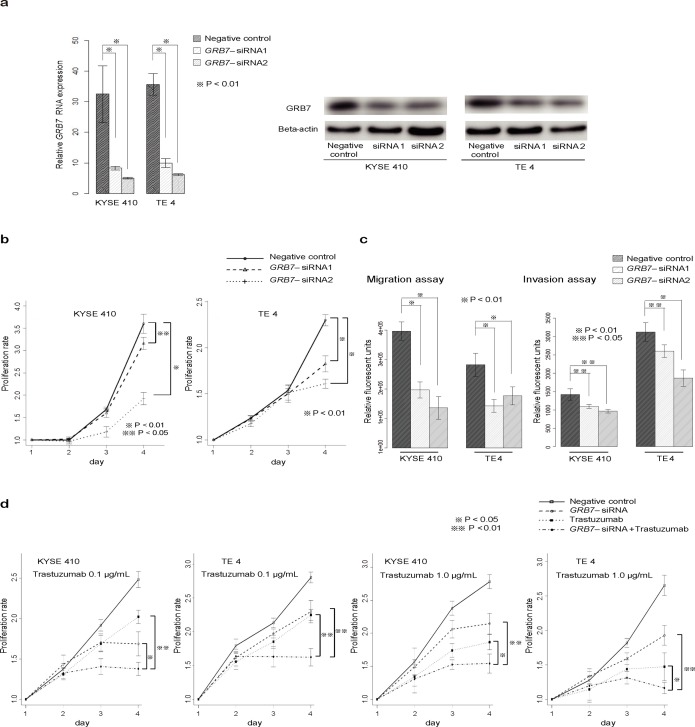
We found 10 significantly recurrent copy number alterations accompanying gene expression changes, including loci 11q13.2, 7p11.2, 3q26.33, and 17q12, which harbored CCND1, EGFR, SOX2, and ERBB2, respectively. Analysis of survival data and RNAi screening data suggested that GRB7, located on 17q12, was a driver gene in ESCC. In ESCC cell lines harboring 17q12 amplification, knockdown of GRB7 reduced the proliferation, migration, and invasion capacities of cells. Moreover, siRNA targeting GRB7 had a synergistic inhibitory effect when combined with trastuzumab, an anti-ERBB2 antibody. Survival analysis of the independent cohort also showed that high GRB7 expression was associated with poor prognosis in ESCC.
Our integrative analysis provided important insights into ESCC pathogenesis. We identified GRB7 as a novel ESCC driver gene and potential new therapeutic target.
在食管鳞状细胞癌(ESCC)中,很少有驱动基因得到充分证实。识别导致基因表达谱变化的基因组畸变可用于预测驱动基因。
我们通过对基因表达微阵列谱和拷贝数数据进行综合分析,在ESCC中寻找驱动基因。为了缩小候选基因范围,我们对表达数据进行生存分析,并使用公开的RNAi筛选数据测试每个基因的遗传易感性。我们通过进行RNAi实验并评估独立ESCC队列中候选基因的临床相关性来证实结果。
我们发现10个伴随基因表达变化的显著复发性拷贝数改变,包括11q13.2、7p11.2、3q26.33和17q12位点,它们分别含有CCND1、EGFR、SOX2和ERBB2。生存数据分析和RNAi筛选数据表明,位于17q12的GRB7是ESCC中的一个驱动基因。在携带17q12扩增的ESCC细胞系中,敲低GRB7可降低细胞的增殖、迁移和侵袭能力。此外,靶向GRB7的siRNA与抗ERBB2抗体曲妥珠单抗联合使用时具有协同抑制作用。独立队列的生存分析还表明,ESCC中GRB7高表达与预后不良相关。
我们的综合分析为ESCC发病机制提供了重要见解。我们将GRB7鉴定为一种新的ESCC驱动基因和潜在的新治疗靶点。