Santiago Erika Vieira Almeida e, Silveira Micheline Rosa, Araújo Vânia Eloisa de, Farah Katia de Paula, Acurcio Francisco de Assis, Ceccato Maria das Graças Braga
Faculdade de Farmácia, Universidade Federal de Minas Gerais, Belo Horizonte, MG, BR.
Departamento de Odontologia, Instituto de Ciências Biológicas e da Saúde. Pontifícia, Universidade Católica de Minas Gerais, Belo Horizonte, MG, BR.
Rev Saude Publica. 2015;49:68. doi: 10.1590/S0034-8910.2015049005822. Epub 2015 Oct 9.
OBJECTIVE To analyze whether gender influence survival results of kidney transplant grafts and patients.METHODS Systematic review with meta-analysis of cohort studies available on Medline (PubMed), LILACS, CENTRAL, and Embase databases, including manual searching and in the grey literature. The selection of studies and the collection of data were conducted twice by independent reviewers, and disagreements were settled by a third reviewer. Graft and patient survival rates were evaluated as effectiveness measurements. Meta-analysis was conducted with the Review Manager® 5.2 software, through the application of a random effects model. Recipient, donor, and donor-recipient gender comparisons were evaluated.
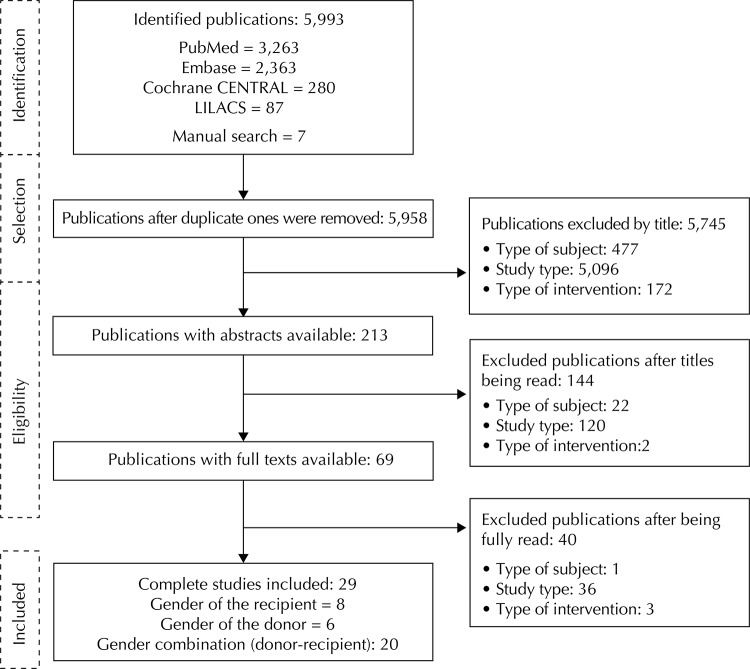
Twenty-nine studies involving 765,753 patients were included. Regarding graft survival, those from male donors were observed to have longer survival rates as compared to the ones from female donors, only regarding a 10-year follow-up period. Comparison between recipient genders was not found to have significant differences on any evaluated follow-up periods. In the evaluation between donor-recipient genders, male donor-male recipient transplants were favored in a statistically significant way. No statistically significant differences were observed in regards to patient survival for gender comparisons in all follow-up periods evaluated.CONCLUSIONS The quantitative analysis of the studies suggests that donor or recipient genders, when evaluated isolatedly, do not influence patient or graft survival rates. However, the combination between donor-recipient genders may be a determining factor for graft survival.
目的 分析性别是否会影响肾移植移植物和患者的存活结果。方法 对Medline(PubMed)、LILACS、CENTRAL和Embase数据库中可用的队列研究进行系统评价和荟萃分析,包括手动检索和灰色文献检索。研究的选择和数据收集由独立评审员进行两次,分歧由第三位评审员解决。将移植物和患者存活率作为有效性指标进行评估。使用Review Manager® 5.2软件,通过应用随机效应模型进行荟萃分析。评估受者、供者以及供受者性别之间的比较。
纳入了29项研究,涉及765,753名患者。关于移植物存活,仅在10年随访期内观察到男性供者的移植物存活率比女性供者的更长。在任何评估的随访期内,未发现受者性别之间的比较存在显著差异。在供受者性别之间的评估中,男性供者-男性受者移植在统计学上具有显著优势。在所有评估的随访期内,性别比较在患者存活方面未观察到统计学上的显著差异。结论 研究的定量分析表明,单独评估供者或受者性别时,不会影响患者或移植物存活率。然而,供受者性别的组合可能是移植物存活的决定因素。