Ferreira Carolina Sanitá Tafner, Marconi Camila, Parada Cristina Maria de Lima Garcia, Duarte Marli Teresinha Cassamassimo, Gonçalves Ana Paula Oliveira, Rudge Marilza Vieira Cunha, Silva Márcia Guimarães da
Department of Pathology, Faculdade de Medicina de Botucatu, Universidade Estadual Paulista, Botucatu, São Paulo, Brazil.
Department of Nursing, Faculdade de Medicina de Botucatu, Universidade Estadual Paulista, Botucatu, São Paulo, Brazil.
Sao Paulo Med J. 2015 Nov-Dec;133(6):465-70. doi: 10.1590/1516-3180.2014.9182710. Epub 2015 Oct 9.
Bacterial vaginosis occurs frequently in pregnancy and increases susceptibility to sexually transmitted infections (STI). Considering that adolescents are disproportionally affected by STI, the aim of this study was to evaluate the cervicovaginal levels of interleukin (IL)-1 beta, IL-6, IL-8 and bacterial sialidase in pregnant adolescents with bacterial vaginosis.
Cross-sectional study at mother and child referral units in Belém, Pará, Brazil.
Vaginal samples from 168 pregnant adolescents enrolled were tested for trichomoniasis and candidiasis. Their vaginal microbiota was classified according to the Nugent criteria (1991) as normal, intermediate or bacterial vaginosis. Cervical infection due to Chlamydia trachomatisand Neisseria gonorrhoeae was also assessed. Cytokine and sialidase levels were measured, respectively, using enzyme-linked immunosorbent assays and MUAN conversion in cervicovaginal lavages. Forty-eight adolescents (28.6%) were excluded because they tested positive for some of the infections investigated. The remaining 120 adolescents were grouped according to vaginal flora type: normal (n = 68) or bacterial vaginosis (n = 52). Their cytokine and sialidase levels were compared between the groups using the Mann-Whitney test (P < 0.05).
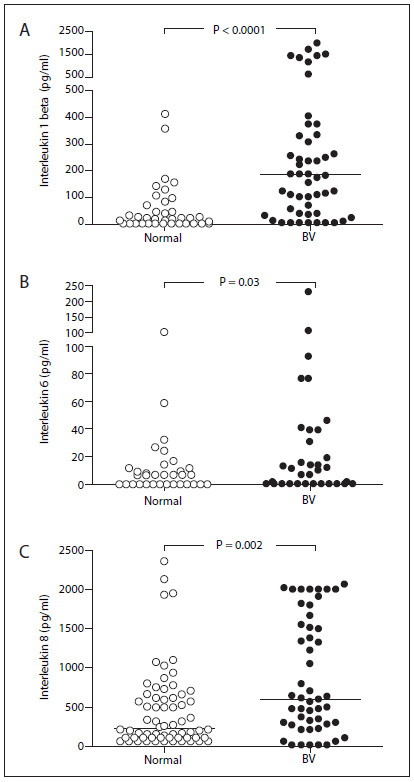
The pregnant adolescents with bacterial vaginosis had higher levels of IL-1 beta, IL-6 and IL-8 (P < 0.05). Sialidase was solely detected in 35 adolescents (67.2%) with bacterial vaginosis.
Not only IL-1 beta and sialidase levels, but also IL-6 and IL-8 levels are higher in pregnant adolescents with bacterial vaginosis, thus indicating that this condition elicits a more pronounced inflammatory response in this population, which potentially increases vulnerability to STI acquisition.
细菌性阴道病在孕期很常见,会增加性传播感染(STI)的易感性。考虑到青少年受性传播感染的影响尤为严重,本研究旨在评估患有细菌性阴道病的妊娠青少年宫颈阴道白细胞介素(IL)-1β、IL-6、IL-8和细菌唾液酸酶水平。
在巴西帕拉州贝伦的母婴转诊单位进行的横断面研究。
对168名纳入研究的妊娠青少年的阴道样本进行滴虫病和念珠菌病检测。根据纽金特标准(1991年)将其阴道微生物群分类为正常、中间型或细菌性阴道病。还评估了沙眼衣原体和淋病奈瑟菌引起的宫颈感染。分别使用酶联免疫吸附测定法和宫颈阴道灌洗中的MUAN转换法测量细胞因子和唾液酸酶水平。48名青少年(28.6%)因检测出所调查的某些感染呈阳性而被排除。其余120名青少年根据阴道菌群类型分组:正常(n = 68)或细菌性阴道病(n = 52)。使用曼-惠特尼检验比较两组之间的细胞因子和唾液酸酶水平(P < 0.05)。
患有细菌性阴道病的妊娠青少年IL-1β、IL-6和IL-8水平较高(P < 0.05)。仅在35名(67.2%)患有细菌性阴道病的青少年中检测到唾液酸酶。
患有细菌性阴道病的妊娠青少年不仅IL-1β和唾液酸酶水平较高,IL-6和IL-8水平也较高,这表明这种情况在该人群中引发了更明显的炎症反应,这可能会增加获得性传播感染的易感性。