Mendonça Vitor R R, Souza Ligia C L, Garcia Gabriela C, Magalhães Belisa M L, Gonçalves Marilda S, Lacerda Marcus V G, Barral-Netto Manoel
Laboratório Integrado de Microbiogia e Imunoregulação (LIMI), Centro de Pesquisas Gonçalo Moniz, Fundação Oswaldo Cruz (FIOCRUZ), Salvador, Brazil.
Faculdade de Medicina, Universidade Federal da Bahia, Salvador, Brazil.
Malar J. 2015 Oct 14;14:407. doi: 10.1186/s12936-015-0930-x.
Hyperbilirubinaemia (bilirubin >51.3 μmol/L) alone is not indicative of severe malaria, and the immune response underlying hyperbilirubinaemia remains largely unexplored. Liver damage associated with hyperbilirubinaemia may alter the expression of hepcidin, which regulates systemic iron by degrading ferroportin. For this study, the association between hepcidin and the levels of cytokines and chemokines in the serum of individuals with mild and severe vivax malaria and subjects with malaria with isolated hyperbilirubinaemia was evaluated.
Cytokines/chemokines and hepcidin were measured in individuals with mild (n = 72) and severe (n = 17) vivax malaria, as well as in the serum of subjects with vivax malaria with isolated hyperbilirubinaemia (n = 14) from the Brazilian Amazon between 2009 and 2013 by multiplex assay and ELISA, respectively. The polymorphism 744 G > T in the ferroportin gene was identified by restriction fragment-length polymorphism analysis and the restriction enzyme PvuII.
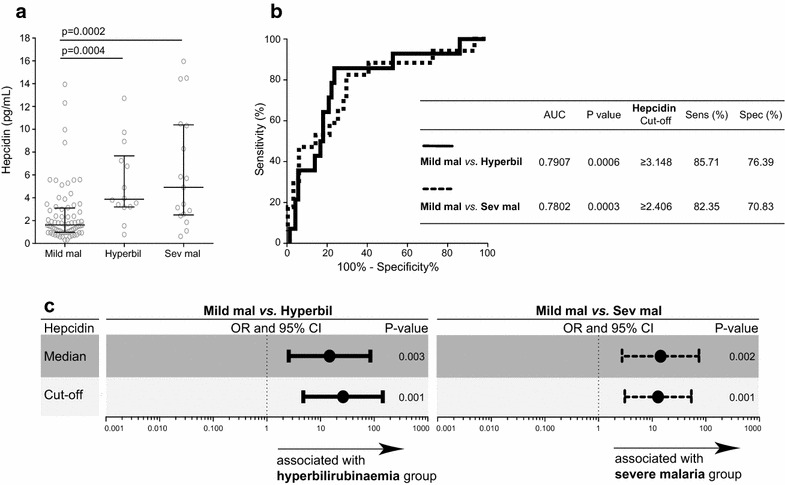
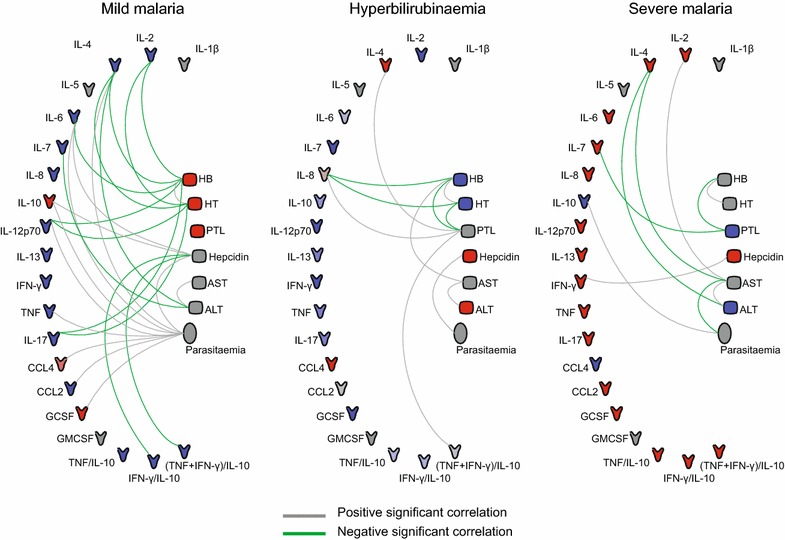
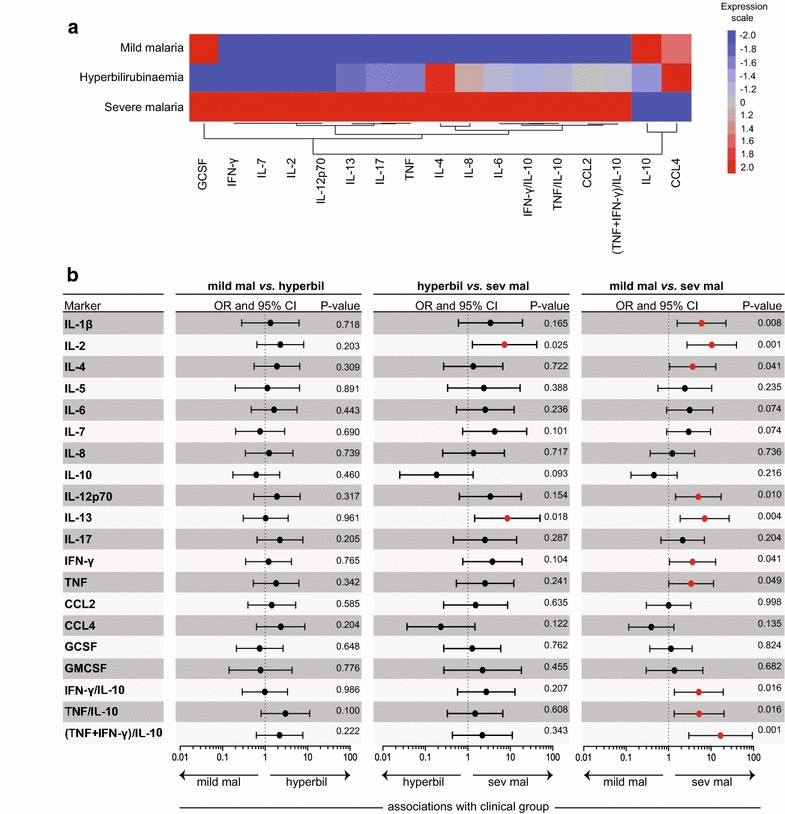
The polymorphism at position 744 G > T in the ferroportin gene was typed and no differences in the distributions of genotypes or alleles were observed between the study groups. Subjects with severe malaria had higher levels of interleukin (IL)-2 and IL-13 than subjects with hyperbilirubinaemia. No differences in the expression of immune markers were observed between subjects with mild malaria and those with hyperbilirubinaemia. However, hepcidin levels were higher in individuals with severe malaria and hyperbilirubinaemia than those with mild malaria (p = 0.0002 and p = 0.0004, respectively) and cut-off values of hepcidin differentiated these groups from subjects with mild malaria. Hepcidin was positively associated with IL-6 and IL-10 levels and with parasitaemia in subjects with mild malaria and with IFN-γ in subjects with severe malaria.
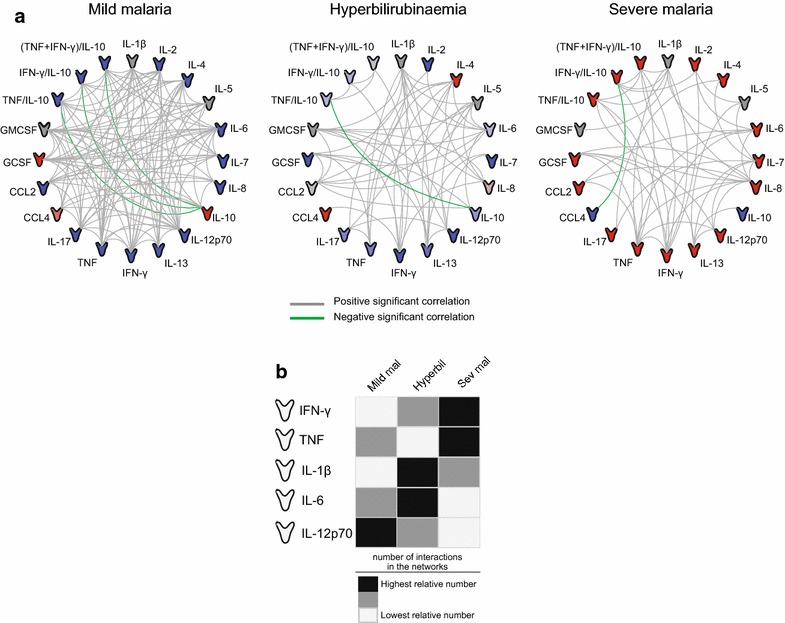
Malaria in the presence of hyperbilirubinaemia produces a less robust inflammatory response compared to severe cases of malaria. Hepcidin levels are positively associated with immune markers in vivax malaria outcomes.
单纯高胆红素血症(胆红素>51.3μmol/L)并不表明患有重症疟疾,高胆红素血症背后的免疫反应在很大程度上仍未得到探索。与高胆红素血症相关的肝损伤可能会改变铁调素的表达,铁调素通过降解铁转运蛋白来调节全身铁代谢。在本研究中,评估了铁调素与间日疟轻症和重症患者以及单纯高胆红素血症疟疾患者血清中细胞因子和趋化因子水平之间的关联。
2009年至2013年期间,分别通过多重检测和酶联免疫吸附测定法,对来自巴西亚马逊地区的72例间日疟轻症患者、17例间日疟重症患者以及14例单纯高胆红素血症间日疟患者血清中的细胞因子/趋化因子和铁调素进行了检测。通过限制性片段长度多态性分析和限制性内切酶PvuII鉴定铁转运蛋白基因中的744G>T多态性。
对铁转运蛋白基因中744G>T位点的多态性进行了分型,各研究组之间在基因型或等位基因分布上未观察到差异。重症疟疾患者的白细胞介素(IL)-2和IL-13水平高于高胆红素血症患者。轻症疟疾患者与高胆红素血症患者之间在免疫标志物表达上未观察到差异。然而,重症疟疾和高胆红素血症患者的铁调素水平高于轻症疟疾患者(分别为p = 0.0002和p = 0.0004),铁调素的临界值将这些组与轻症疟疾患者区分开来。在轻症疟疾患者中,铁调素与IL-6和IL-10水平以及寄生虫血症呈正相关,在重症疟疾患者中与干扰素-γ呈正相关。
与重症疟疾病例相比,存在高胆红素血症的疟疾产生的炎症反应较弱。在间日疟疾病转归中,铁调素水平与免疫标志物呈正相关。