Zhu Bo, Wang Yanjie, Zhang Guifeng, Ouyang Huailiang, Zhang Jiping, Zheng Yu, Zhang Shaoqun, Wu Chunxiao, Qu Shanshan, Chen Junqi, Huang Yong, Tang Chunzhi
First Clinical School, Southern Medical University, Guangzhou, 510515, Guangdong Province, China.
School of Traditional Chinese Medicine, Southern Medical University, Guangzhou, 510515, Guangdong Province, China.
BMC Complement Altern Med. 2015 Oct 14;15:361. doi: 10.1186/s12906-015-0881-3.
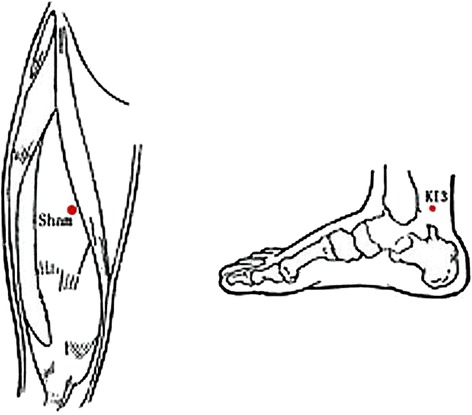
Using functional magnetic resonance imaging (fMRI), we determined brain regions that were activated/deactivated more by acupuncture at Taixi (KI3) than by non-acupoint or sham acupuncture.
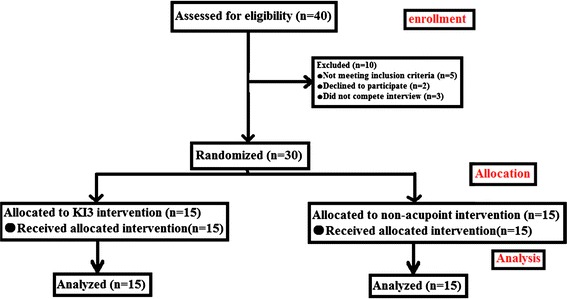
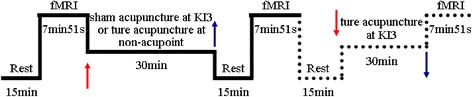
A total of 30 healthy volunteers were randomly divided into a KI3 group (15 subjects) and non-acupoint group (15 subjects). Subjects in KI3 group received a sham acupuncture and then a real acupuncture, fMRI was performed before and after sham acupuncture as well as after ture acupuncture. Subjects in non-acupoint group received a ture acupuncture and the fMRI was performed before and after ture acupuncture. The fMRI data obtained were successively analyzed using DPARSF2.3 and REST1.8 software, yielding regional homogeneity (ReHo) and amplitude of low frequency fluctuations (ALFF) values.
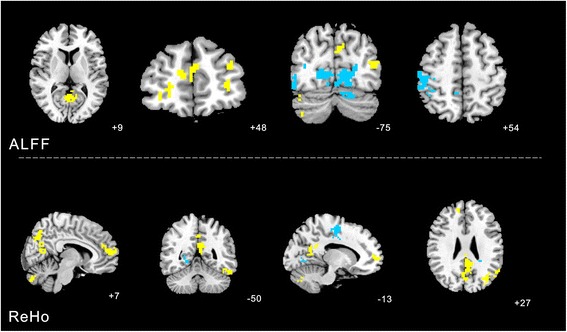
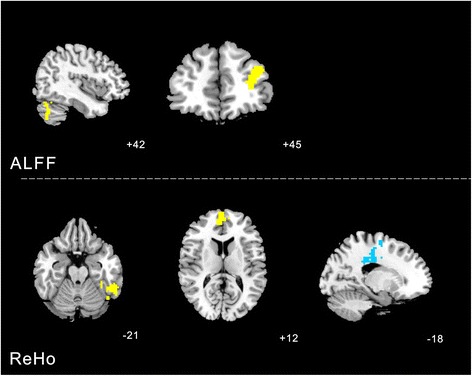
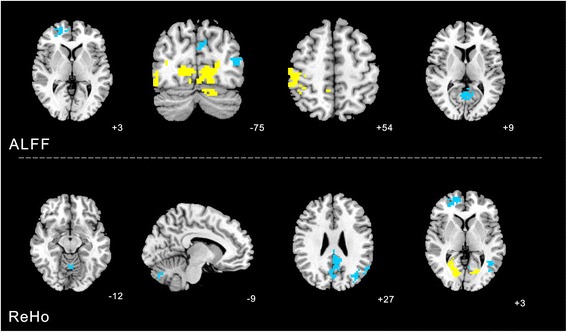
Compared with sham acupuncture, ALFF values were higher in Brodmann area (BA) 10 and lower in BA7 and BA18. ReHo values after real acupuncture at KI3 were higher in the right sub-lobar region and BA10 and were lower in BA31. Compared with the changes before and after real acupuncture at non-acupoint, the changes at KI3 showed higher ALFF valued in the left cerebellum posterior lobe, BA10, BA39, BA31 and decreased ALFF was observed in the BA18, BA19 and BA40; and higher ReHo values were shown in left cerebellum posterior lobe pyramis, left cerebellum anterior lobe. BA37, BA10, BA39, BA31 and lower ReHo values were shown in BA18 and BA31.
Acupuncture at KI3 has a specific effect on certain brain regions associated with perception, body movement, spirit, and association. Additionally, visual and auditory cortices were affected, which may be related to the clinical applications of KI3 acupuncture in auditory and cognitive disorders, hypomnesis, loss of concentration, and the loss of ability to work and learn.
The research ethics committee was achieved at 01/08/2012, the NO. was ChiECRCT-2012011. Website for Clinical Trial Registration: http://www.chictr.org.cn/showproj.aspx?proj=7123 . This study was registered at www.chictr.org, the Clinical Trial Registration Number was ChiCTR-TRC-12002427, and the registration number was achieved at 18/08/2012. The name of IRB that provided approval for the study and clearly state is Chinese Clinical Trail Registry.
利用功能磁共振成像(fMRI),我们确定了与非穴位针刺或假针刺相比,太溪穴(KI3)针刺更能激活/失活的脑区。
30名健康志愿者被随机分为KI3组(15名受试者)和非穴位组(15名受试者)。KI3组受试者先接受假针刺,然后接受真针刺,在假针刺前后以及真针刺后进行fMRI检查。非穴位组受试者接受真针刺,并在真针刺前后进行fMRI检查。使用DPARSF2.3和REST1.8软件对获得的fMRI数据进行连续分析,得出局部一致性(ReHo)和低频振幅(ALFF)值。
与假针刺相比,Brodmann区(BA)10的ALFF值较高,而BA7和BA18的ALFF值较低。KI3真针刺后的ReHo值在右侧脑叶下区域和BA10较高,而在BA31较低。与非穴位真针刺前后的变化相比,KI3处的变化显示左侧小脑后叶、BA10、BA39、BA31的ALFF值较高,而在BA18、BA19和BA40观察到ALFF值降低;左侧小脑后叶锥体、左侧小脑前叶、BA37、BA10、BA39、BA31的ReHo值较高,而BA18和BA31的ReHo值较低。
针刺太溪穴对与感知、身体运动、精神和联想相关的某些脑区有特定作用。此外,视觉和听觉皮层也受到影响,这可能与太溪穴针刺在听觉和认知障碍、记忆力减退、注意力不集中以及工作和学习能力丧失方面的临床应用有关。
研究伦理委员会于2012年8月1日批准,编号为ChiECRCT - 2012011。临床试验注册网站:http://www.chictr.org.cn/showproj.aspx?proj = 7123 。本研究在www.chictr.org注册,临床试验注册号为ChiCTR - TRC - 12002427,注册日期为2012年8月18日。提供研究批准的IRB名称并明确说明为中国临床试验注册中心。