Zhang Shu-Dong, Ling Li-Zhen, Yi Ting-Shuang
Germplasm Bank of Wild Species, Kunming Institute of Botany of the Chinese Academy of Sciences, Kunming, 650201, China.
BGI-Yunnan, BGI-Shenzhen, Kunming, 650106, China.
BMC Genomics. 2015 Oct 14;16:787. doi: 10.1186/s12864-015-1998-y.
Squamosa promoter binding protein (SBP)-box family genes encode plant-specific transcription factors that control many important biological functions, including phase transition, inflorescence branching, fruit ripening, and copper homeostasis. Nevertheless, the evolutionary patterns of SBP-box genes and evolutionary forces driving them are still not well understood.
104 SBP-box gene candidates of five representative land plants were obtained from Phytozome database (v10.3). Phylogenetic combined with gene structure analyses were used to identify SBP-box gene lineages in land plants. Gene copy number and the sequence and structure features were then compared among these different SBP-box lineages. Selection analysis, relative rate tests and expression divergence were finally used to interpret the evolutionary relationships and divergence of SBP-box genes in land plants.
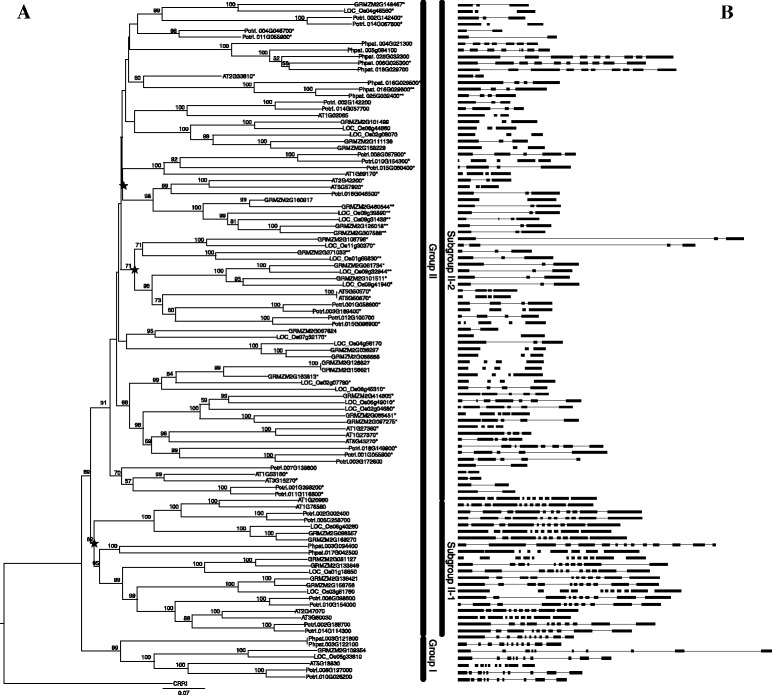
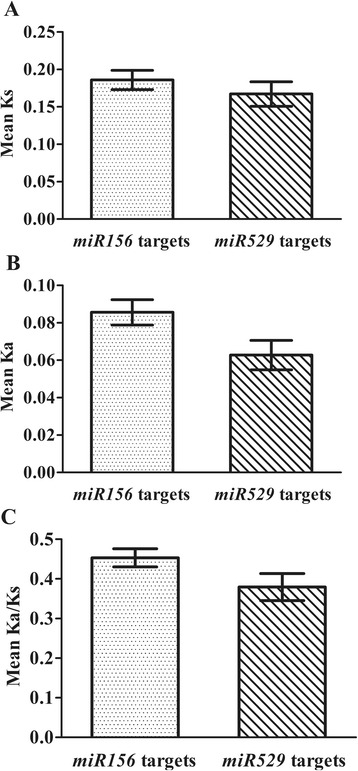
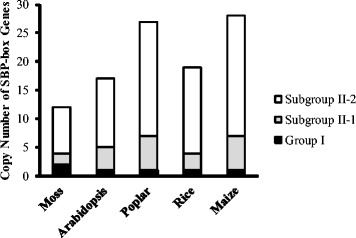
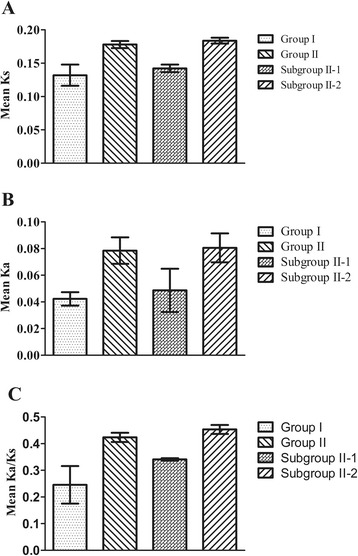
We investigated 104 SBP-box genes from moss, Arabidopsis, poplar, rice, and maize. These genes are divided into group I and II, and the latter is further divided into two subgroups (subgroup II-1 and II-2) based on phylogenetic analysis. Interestingly, subgroup II-1 genes have similar sequence and structural features to group I genes, whereas subgroup II-2 genes exhibit intrinsic differences on these features, including high copy numbers and the presence of miR156/miR529 regulation. Further analyses indicate that subgroup II-1 genes are constrained by stronger purifying selection and evolve at a lower substitution rate than II-2 genes, just as group I genes do when compared to II genes. Among subgroup II-2 genes, miR156 targets evolve more rapidly than miR529 targets and experience comparatively relaxed purifying selection. These results suggest that group I and subgroup II-1 genes under strong selective constraint are conserved. By contrast, subgroup II-2 genes evolve under relaxed purifying selection and have diversified through gene copy duplications and changes in miR156/529 regulation, which might contribute to morphological diversifications of land plants.
Our results indicate that different evolutionary rates and selection strengths lead to differing evolutionary patterns in SBP-box genes in land plants, providing a guide for future functional diversity analyses of these genes.
Squamosa启动子结合蛋白(SBP)-盒家族基因编码植物特有的转录因子,这些转录因子控制许多重要的生物学功能,包括阶段转变、花序分支、果实成熟和铜稳态。然而,SBP-盒基因的进化模式以及驱动它们的进化力量仍未得到很好的理解。
从植物基因组数据库(v10.3)中获得了五种代表性陆地植物的104个SBP-盒基因候选序列。利用系统发育分析结合基因结构分析来鉴定陆地植物中的SBP-盒基因谱系。然后比较这些不同SBP-盒谱系之间的基因拷贝数以及序列和结构特征。最后通过选择分析、相对速率测试和表达差异分析来解释陆地植物中SBP-盒基因的进化关系和分化情况。
我们研究了来自苔藓、拟南芥、杨树、水稻和玉米的104个SBP-盒基因。这些基因分为I组和II组,基于系统发育分析,II组进一步分为两个亚组(亚组II-1和II-2)。有趣的是,亚组II-1基因在序列和结构特征上与I组基因相似,而亚组II-2基因在这些特征上表现出内在差异,包括高拷贝数以及存在miR156/miR529调控。进一步分析表明,亚组II-1基因受到更强的纯化选择限制,并且与II-2基因相比进化替代率更低,就像I组基因与II组基因相比一样。在亚组II-2基因中,miR156的靶标比miR529的靶标进化得更快,并且经历相对宽松的纯化选择。这些结果表明,受到强选择限制的I组和亚组II-1基因是保守的。相比之下,亚组II-2基因在宽松的纯化选择下进化,并通过基因复制和miR156/529调控的变化而多样化,这可能有助于陆地植物的形态多样化。
我们的结果表明,不同的进化速率和选择强度导致陆地植物中SBP-盒基因的进化模式不同,为这些基因未来的功能多样性分析提供了指导。