Maeda Yoshimasa, Moribata Kosaku, Deguchi Hisanobu, Inoue Izumi, Maekita Takao, Iguchi Mikitaka, Tamai Hideyuki, Kato Jun, Ichinose Masao
Second Department of Internal Medicine, Wakayama Medical University, 811-1 Kimiidera, Wakayama City, Wakayama, 641-0012, Japan.
BMC Gastroenterol. 2015 Oct 14;15:132. doi: 10.1186/s12876-015-0362-7.
Both double-balloon enteroscopy (DBE) and video capsule endoscopy (VCE) have similar diagnostic yields for patients with overt obscure gastrointestinal bleeding (OGIB). However, the choice of initial modality is still controversial. The aim of this study was to show the clinical outcome of the strategy of initial VCE, followed by DBE.
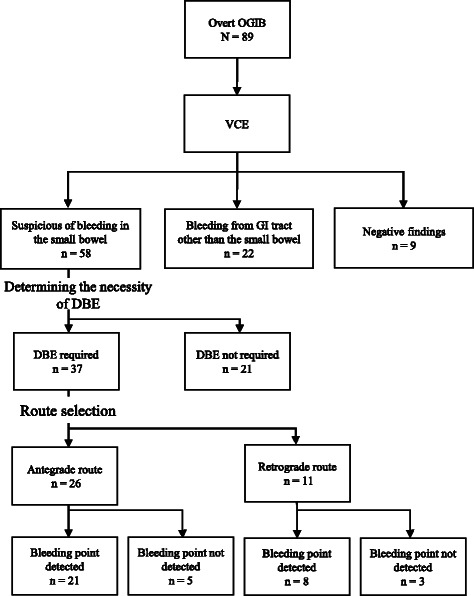
Eighty-nine consecutive overt OGIB patients who had undergone VCE as the initial examination were analyzed. The interpreters of VCE evaluated the necessity of performing DBE, and the antegrade or retrograde route was chosen, depending on the transit time of the capsule.
Thirty-seven patients (42 %) underwent DBE depending on the findings of VCE. Of these, bleeding sites in the small bowel were identified in 29 patients with the initially selected route (21 antegrade and 8 retrograde). The remaining 8 later underwent DBE by the other route, but 7 had no bleeding lesion, which was confirmed by second-look VCE. One remaining patient had a jejunal varix found by VCE, but DBE from either side could not reach the lesion. The sensitivity and negative predictive value of VCE were 100 %, both for the presence of small bowel lesions and the requirement of hemostasis in the small bowel; this indicated that VCE never misses relevant findings in the small bowel, and that negative VCE findings correspond to the lack of necessity for further examination.
VCE as the initial examination can efficiently identify overt OGIB patients who require DBE. The strategy of initial VCE for overt OGIB appears to be reasonable.
对于显性不明原因胃肠道出血(OGIB)患者,双气囊小肠镜检查(DBE)和视频胶囊内镜检查(VCE)的诊断率相似。然而,初始检查方式的选择仍存在争议。本研究的目的是展示先进行VCE,然后进行DBE这一策略的临床结果。
分析了89例连续接受VCE作为初始检查的显性OGIB患者。VCE的解读人员根据胶囊的通过时间评估进行DBE的必要性,并选择顺行或逆行路径。
37例患者(42%)根据VCE的结果接受了DBE。其中,29例患者通过最初选择的路径在小肠中发现了出血部位(21例顺行,8例逆行)。其余8例后来通过另一条路径接受了DBE,但7例没有出血病变,第二次VCE证实了这一点。剩下的1例患者通过VCE发现了空肠静脉曲张,但从任何一侧进行DBE都无法到达病变部位。VCE对小肠病变的存在和小肠止血需求的敏感性和阴性预测值均为100%;这表明VCE从未遗漏小肠中的相关发现,并且VCE阴性结果对应于无需进一步检查的情况。
以VCE作为初始检查可以有效地识别需要DBE的显性OGIB患者。对于显性OGIB,先进行VCE的策略似乎是合理的。