Ávila-Jiménez María Luisa, Coulson Stephen James
Department Arctic Biology, University Centre in Svalbard, P.O. box 156. 9171, Longyearbyen, Norway.
Ecological and Environmental Change Research Group (EECRG), Department of Biology, University of Bergen, p.b. 7800, N-5200 Bergen, Norway.
Insects. 2011 Jun 29;2(3):273-96. doi: 10.3390/insects2030273.
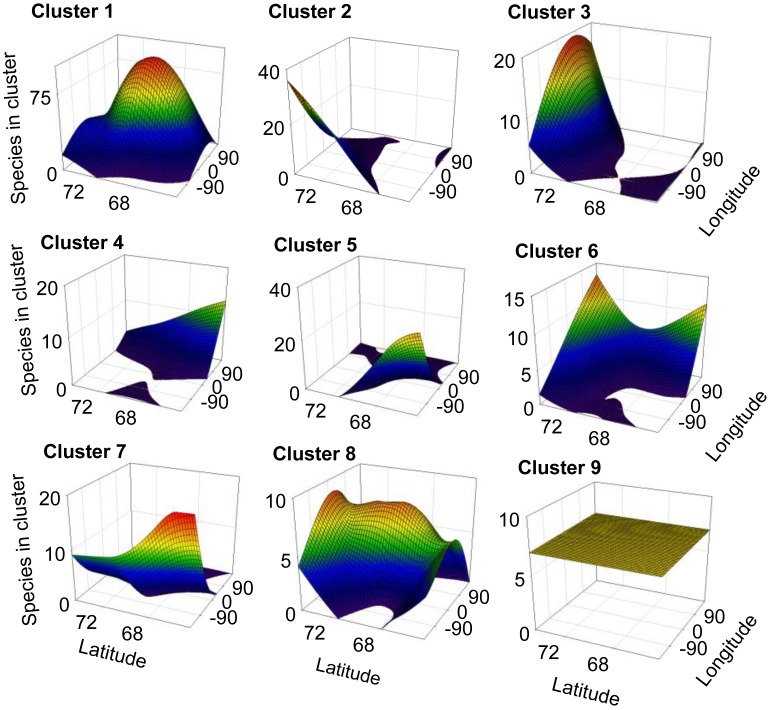
We aimed to describe the main Arctic biogeographical patterns of the Collembola, and analyze historical factors and current climatic regimes determining Arctic collembolan species distribution. Furthermore, we aimed to identify possible dispersal routes, colonization sources and glacial refugia for Arctic collembola. We implemented a Gaussian Mixture Clustering method on species distribution ranges and applied a distance-based parametric bootstrap test on presence-absence collembolan species distribution data. Additionally, multivariate analysis was performed considering species distributions, biodiversity, cluster distribution and environmental factors (temperature and precipitation). No clear relation was found between current climatic regimes and species distribution in the Arctic. Gaussian Mixture Clustering found common elements within Siberian areas, Atlantic areas, the Canadian Arctic, a mid-Siberian cluster and specific Beringian elements, following the same pattern previously described, using a variety of molecular methods, for Arctic plants. Species distribution hence indicate the influence of recent glacial history, as LGM glacial refugia (mid-Siberia, and Beringia) and major dispersal routes to high Arctic island groups can be identified. Endemic species are found in the high Arctic, but no specific biogeographical pattern can be clearly identified as a sign of high Arctic glacial refugia. Ocean currents patterns are suggested as being an important factor shaping the distribution of Arctic Collembola, which is consistent with Antarctic studies in collembolan biogeography. The clear relations between cluster distribution and geographical areas considering their recent glacial history, lack of relationship of species distribution with current climatic regimes, and consistency with previously described Arctic patterns in a series of organisms inferred using a variety of methods, suggest that historical phenomena shaping contemporary collembolan distribution can be inferred through biogeographical analysis.
我们旨在描述弹尾目昆虫在北极地区的主要生物地理模式,并分析决定北极弹尾目物种分布的历史因素和当前气候状况。此外,我们旨在确定北极弹尾目昆虫可能的扩散路线、殖民来源和冰期避难所。我们对物种分布范围实施了高斯混合聚类方法,并对弹尾目昆虫物种存在与否的分布数据进行了基于距离的参数自举检验。此外,还进行了多变量分析,考虑了物种分布、生物多样性、聚类分布和环境因素(温度和降水)。未发现当前气候状况与北极地区物种分布之间存在明确关系。高斯混合聚类在西伯利亚地区、大西洋地区、加拿大北极地区、西伯利亚中部聚类以及特定的白令地区元素中发现了共同元素,这与之前使用各种分子方法对北极植物所描述的模式相同。因此,物种分布表明了近期冰期历史的影响,因为可以确定末次盛冰期的冰期避难所(西伯利亚中部和白令地区)以及通往北极高纬度岛屿群的主要扩散路线。在北极高纬度地区发现了特有物种,但没有明确的生物地理模式可被确定为北极高纬度冰期避难所的标志。洋流模式被认为是塑造北极弹尾目昆虫分布的一个重要因素,这与南极弹尾目生物地理学的研究结果一致。考虑到其近期冰期历史,聚类分布与地理区域之间的明确关系、物种分布与当前气候状况缺乏相关性以及与一系列使用各种方法推断的北极生物模式的一致性,表明可以通过生物地理分析推断塑造当代弹尾目昆虫分布的历史现象。