Carter Tim, Guo Boliang, Turner David, Morres Ioannis, Khalil Elizabeth, Brighton Emily, Armstrong Marie, Callaghan Patrick
School of Health Sciences, University of Nottingham, Nottingham, UK.
Division of Psychiatry & Applied Psychology, University of Nottingham, Nottingham, UK.
BMC Psychiatry. 2015 Oct 14;15:247. doi: 10.1186/s12888-015-0638-z.
Exercise has been shown to be effective in treating depression, but trials testing the effect of exercise for depressed adolescents utilising mental health services are rare. The aim of this study was to determine the effectiveness of a preferred intensity exercise intervention on the depressive symptoms of adolescents with depression.
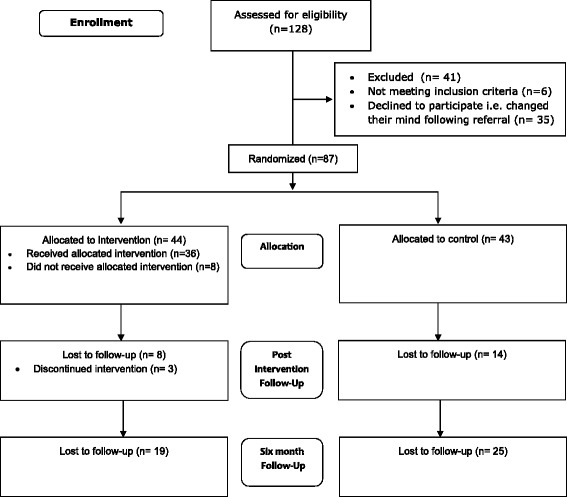
We randomly assigned 87 adolescents who were receiving treatment for depression to either 12 sessions of aerobic exercise at preferred intensity alongside treatment as usual or treatment as usual only. The primary outcome was depressive symptom change using the Children's Depression Inventory 2(nd) Version (CDI-2) at post intervention. Secondary outcomes were health-related quality of life and physical activity rates. Outcomes were taken at baseline, post intervention and at six month follow up.
CDI-2 score reduction did not differ significantly between groups at post-intervention (est. 95% CI -6.82, 1.68, p = 0.23). However, there was a difference in CDI-2 score reduction at six month follow-up in favour of the intervention of -4.81 (est. 95% CI -9.49, -0.12, p = 0.03). Health-related quality of life and physical activity rates did not differ significantly between groups at post-intervention and follow-up.
There was no additional effect of preferred intensity exercise alongside treatment as usual on depressive reduction immediately post intervention. However, effects were observed at six months post-intervention, suggesting a delayed response. However, further trials, with larger samples are required to determine the validity of this finding.
ClinicalTrials.gov NCT01474837, March 16 2011.
运动已被证明对治疗抑郁症有效,但利用心理健康服务来测试运动对抑郁青少年影响的试验却很少见。本研究的目的是确定一种首选强度运动干预对患有抑郁症青少年抑郁症状的有效性。
我们将87名正在接受抑郁症治疗的青少年随机分为两组,一组在接受常规治疗的同时进行12节首选强度的有氧运动,另一组仅接受常规治疗。主要结局是干预后使用儿童抑郁量表第二版(CDI - 2)测量的抑郁症状变化。次要结局是与健康相关的生活质量和身体活动率。在基线、干预后和六个月随访时获取结局数据。
干预后两组之间CDI - 2评分降低没有显著差异(估计95%置信区间为 - 6.82, 1.68,p = 0.23)。然而,在六个月随访时,CDI - 2评分降低存在差异,有利于干预组,降低了 - 4.81(估计95%置信区间为 - 9.49, - 0.12,p = 0.03)。干预后和随访时两组之间与健康相关的生活质量和身体活动率没有显著差异。
在常规治疗的基础上,首选强度运动对干预后立即减轻抑郁没有额外效果。然而,在干预后六个月观察到了效果,表明存在延迟反应。然而,需要进一步进行更大样本量的试验来确定这一发现的有效性。
ClinicalTrials.gov NCT01474837,2011年3月16日。