Kim Sung-Ho, Son Sang-Yong, Park Young-Suk, Ahn Sang-Hoon, Park Do Joong, Kim Hyung-Ho
Department of Surgery, Seoul National University Bundang Hospital, Seongnam, Korea.
Department of Surgery, Ajou University Hospital, Suwon, Korea.
J Gastric Cancer. 2015 Sep;15(3):167-75. doi: 10.5230/jgc.2015.15.3.167. Epub 2015 Sep 30.
Although several studies report risk factors for anastomotic leakage after gastrectomy for gastric cancer, they have yielded conflicting results. The present retrospective cohort study was performed to identify risk factors that are consistently associated with anastomotic leakage after gastrectomy for stomach cancer.
All consecutive patients who underwent gastrectomy at a single gastric surgical unit between May 2003 and December 2012 were identified retrospectively. The associations between anastomotic leakage and 23 variables related to patient history, diagnosis, and surgery were assessed and analyzed with logistic regression.
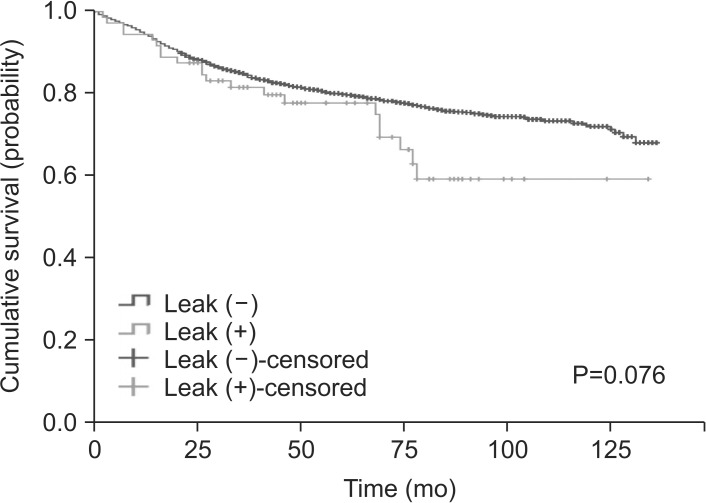
In total, 3,827 patients were included. The rate of anastomotic leakage was 1.88% (72/3,827). Multiple regression analysis showed that male sex (P=0.001), preoperative/intraoperative transfusion (P<0.001), presence of cardiovascular disease (P=0.023), and tumor location (P<0.001) were predictive of anastomotic leakage. Patients with and without leakage did not differ significantly in terms of their 5-year survival: 97.6 vs. 109.5 months (P=0.076).
Male sex, cardiovascular disease, perioperative transfusion, and tumor location in the upper third of the stomach were associated with an increased risk of anastomotic leakage. Although several studies have reported that an anastomotic complication has a negative impact on long-term survival, this association was not observed in the present study.
尽管多项研究报告了胃癌胃切除术后吻合口漏的危险因素,但结果相互矛盾。本回顾性队列研究旨在确定与胃癌胃切除术后吻合口漏始终相关的危险因素。
回顾性确定2003年5月至2012年12月在单个胃外科单位接受胃切除术的所有连续患者。采用逻辑回归评估和分析吻合口漏与23个与患者病史、诊断和手术相关变量之间的关联。
共纳入3827例患者。吻合口漏发生率为1.88%(72/3827)。多元回归分析显示,男性(P = 0.001)、术前/术中输血(P < 0.001)、心血管疾病(P = 0.023)和肿瘤位置(P < 0.001)是吻合口漏的预测因素。有和没有吻合口漏的患者5年生存率无显著差异:分别为97.6个月和109.5个月(P = 0.076)。
男性、心血管疾病、围手术期输血以及胃上三分之一的肿瘤位置与吻合口漏风险增加相关。尽管多项研究报告吻合口并发症对长期生存有负面影响,但本研究未观察到这种关联。