Woiceshyn Jaana, Blades Kenneth, Pendharkar Sachin R
Jaana Woiceshyn, PhD, is Associate Professor, Haskayne School of Business, University of Calgary, Alberta, Canada. E-mail:
Health Care Manage Rev. 2017 Jan/Mar;42(1):76-86. doi: 10.1097/HMR.0000000000000092.
Increased demand and escalating costs necessitate innovation in health care. The challenge is to implement complex innovations-those that require coordinated use across the adopting organization to have the intended benefits.
We wanted to understand why and how two of five similar hospitals associated with the same health care authority made more progress with implementing a complex inpatient discharge innovation whereas the other three experienced more difficulties in doing so.
We conducted a qualitative comparative case study of the implementation process at five comparable urban hospitals adopting the same inpatient discharge innovation mandated by their health care authority. We analyzed documents and conducted 39 interviews of the health care authority and hospital executives and frontline managers across the five sites over a 1-year period while the implementation was ongoing.
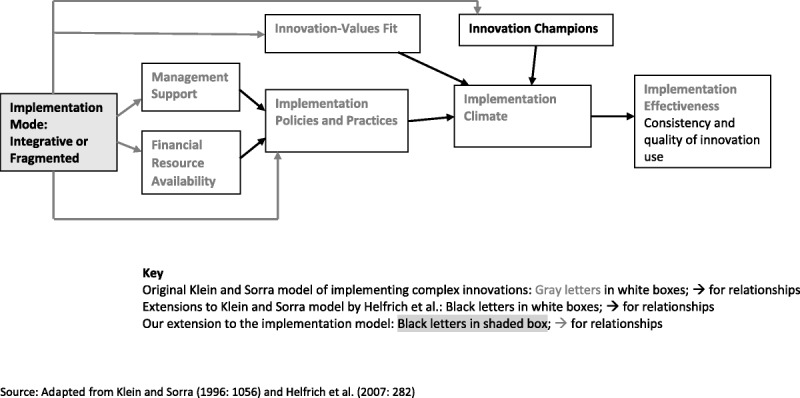
In two and a half years, two of the participating hospitals had made significant progress with implementing the innovation and had begun to realize benefits; they exemplified an integrated implementation mode. Three sites had made minimal progress, following a fragmented implementation mode. In the former mode, a semiautonomous health care organization developed a clear overall purpose and chose one umbrella initiative to implement it. The integrative initiative subsumed the rest and guided resource allocation and the practices of hospital executives, frontline managers, and staff who had bought into it. In contrast, in the fragmented implementation mode, the health care authority had several overlapping, competing innovations that overwhelmed the sites and impeded their implementation.
Implementing a complex innovation across hospital sites required (a) early prioritization of one initiative as integrative, (b) the commitment of additional (traded off or new) human resources,
需求增加和成本上升使得医疗保健领域的创新成为必要。挑战在于实施复杂的创新——即那些需要在采用该创新的组织内进行协调使用才能产生预期效益的创新。
我们想了解为何以及如何在与同一医疗保健机构相关联的五家类似医院中,有两家在实施一项复杂的住院患者出院创新方面取得了更大进展,而另外三家则遇到了更多困难。
我们对五家可比的城市医院实施同一住院患者出院创新的过程进行了定性比较案例研究,该创新是由其医疗保健机构强制要求实施的。在实施过程持续的一年时间里,我们分析了文件,并对五家医院的医疗保健机构、医院管理人员和一线经理进行了39次访谈。
在两年半的时间里,两家参与的医院在实施该创新方面取得了显著进展,并开始实现效益;它们体现了一种综合实施模式。三个医院进展甚微,遵循的是分散实施模式。在前一种模式中,一个半自主的医疗保健组织制定了明确的总体目标,并选择了一项总括性举措来实施。这一综合性举措涵盖了其他方面,并指导资源分配以及医院管理人员、一线经理和认同该举措的员工的实践。相比之下,在分散实施模式中,医疗保健机构有几项相互重叠、相互竞争的创新举措,使各医院应接不暇,阻碍了它们的实施。
在多个医院实施一项复杂的创新需要:(a)尽早将一项举措确定为综合性举措并进行优先排序,(b)投入额外(权衡或新增)的人力资源,