Carter Anouska, Humphreys Liam, Snowdon Nicky, Sharrack Basil, Daley Amanda, Petty Jane, Woodroofe Nicola, Saxton John
The Centre for Sport and Exercise Science, Health and Wellbeing Research Institute, Sheffield Hallam University, Collegiate Hall, Collegiate Crescent, Sheffield, S10 2BP, UK.
Academic Department of Neuroscience, Sheffield Teaching Hospitals NHS Foundation Trust, Sheffield, UK.
Trials. 2015 Oct 15;16:468. doi: 10.1186/s13063-015-0996-3.
The success of a clinical trial is often dependant on whether recruitment targets can be met in the required time frame. Despite an increase in research into the benefits of exercise in people with multiple sclerosis (PwMS), no trial has reported detailed data on effective recruitment strategies for large-scale randomised controlled trials. The main purpose of this report is to provide a detailed outline of recruitment strategies, rates and estimated costs in the Exercise Intervention for Multiple Sclerosis (ExIMS) trial to identify best practices for future trials involving multiple sclerosis (MS) patient recruitment.
The ExIMS researchers recruited 120 PwMS to participate in a 12-week exercise intervention. Participants were randomly allocated to either exercise or usual-care control groups. Participants were sedentary, aged 18-65 years and had Expanded Disability Status Scale scores of 1.0-6.5. Recruitment strategies included attendance at MS outpatient clinics, consultant mail-out and trial awareness-raising activities.
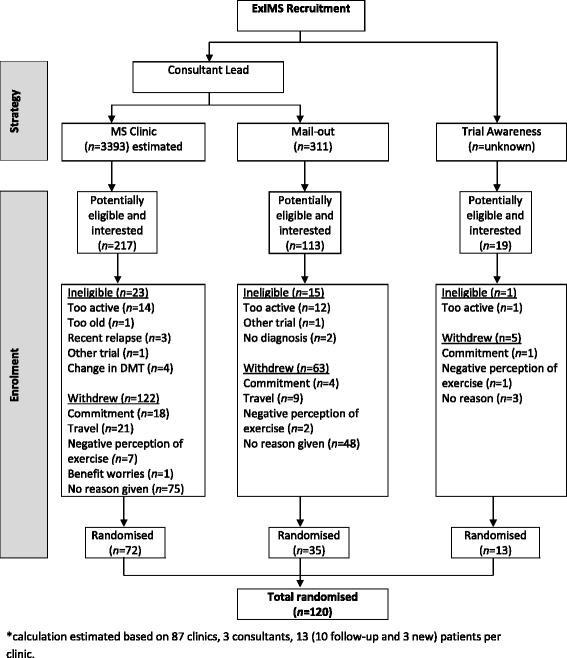
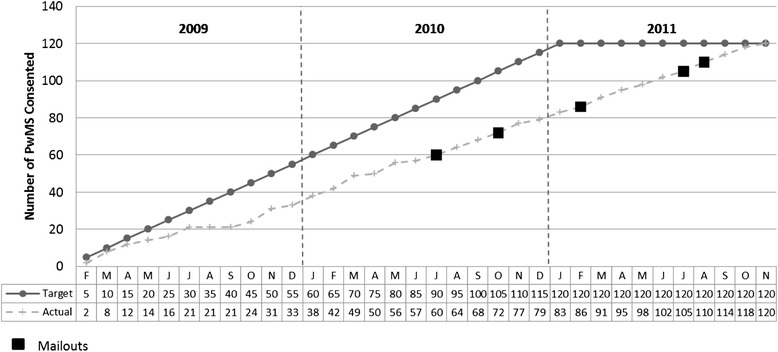
A total of 120 participants were recruited over the course of 34 months. To achieve this target, 369 potentially eligible and interested participants were identified. A total of 60 % of participants were recruited via MS clinics, 29.2 % from consultant mail-outs and 10.8 % through trial awareness. The randomisation yields were 33.2 %, 31.0 % and 68.4 % for MS clinic, consultant mail-outs and trial awareness strategies, respectively. The main reason for ineligibility was being too active (69.2 %), whilst for eligible participants the most common reason for non-participation was the need to travel to the study site (15.8 %). Recruitment via consultant mail-out was the most cost-effective strategy, with MS clinics being the most time-consuming and most costly.
To reach recruitment targets in a timely fashion, a variety of methods were employed. Although consultant mail-outs were the most cost-effective recruitment strategy, use of this method alone would not have allowed us to obtain the predetermined number of participants in the required time period, thus leading to costly extensions of the project or failure to reach the number of participants required for sufficient statistical power. Thus, a multifaceted approach to recruitment is recommended for future trials.
International Standard Randomised Controlled Trial Registry number: ISRCTN41541516 ; date registered: 5 February 2009.
临床试验的成功往往取决于能否在规定时间内实现招募目标。尽管对运动对多发性硬化症患者(PwMS)益处的研究有所增加,但尚无试验报告大规模随机对照试验有效招募策略的详细数据。本报告的主要目的是详细概述多发性硬化症运动干预(ExIMS)试验中的招募策略、招募率和估计成本,以确定未来涉及多发性硬化症(MS)患者招募试验的最佳实践。
ExIMS研究人员招募了120名PwMS参与为期12周的运动干预。参与者被随机分配到运动组或常规护理对照组。参与者久坐不动,年龄在18 - 65岁之间,扩展残疾状态量表评分在1.0 - 6.5之间。招募策略包括参加MS门诊、向顾问发送邮件以及开展提高试验知晓度的活动。
在34个月的时间里共招募了120名参与者。为实现这一目标,确定了369名潜在符合条件且感兴趣的参与者。共有60%的参与者通过MS诊所招募,29.2%来自向顾问发送邮件,10.8%通过提高试验知晓度招募。MS诊所、向顾问发送邮件和提高试验知晓度策略的随机化成功率分别为33.2%、31.0%和68.4%。不符合条件的主要原因是活动量过大(69.2%),而对于符合条件的参与者,最常见的不参与原因是需要前往研究地点(15.8%)。通过向顾问发送邮件招募是最具成本效益的策略,MS诊所是最耗时且成本最高的。
为及时实现招募目标,采用了多种方法。尽管向顾问发送邮件是最具成本效益的招募策略,但仅使用这种方法无法在规定时间内获得预定数量的参与者,从而导致项目成本高昂的延期或无法达到足够统计效力所需的参与者数量。因此,建议未来的试验采用多方面的招募方法。
国际标准随机对照试验注册编号:ISRCTN41541516;注册日期:2009年2月5日。